A bed frame is judged on one thing that no product photograph shows: whether it is silent at three in the morning. Everything else — species, headboard height, finish — is style. Silence is engineering, and it comes down to how many places two pieces of wood are allowed to rub.
A wooden bed squeaks at a joint, not along a board. The four candidates, in the order worth checking: the bolts where the side rails meet the headboard and footboard, the slats moving in their pockets, the centre support leg not quite touching the floor, and the mattress sliding on bare slats. Tighten in that order and most beds go quiet without a single new part.
Anatomy of a wooden bed frame
- Headboard and footboard — the two ends. Usually the only parts anyone looks at.
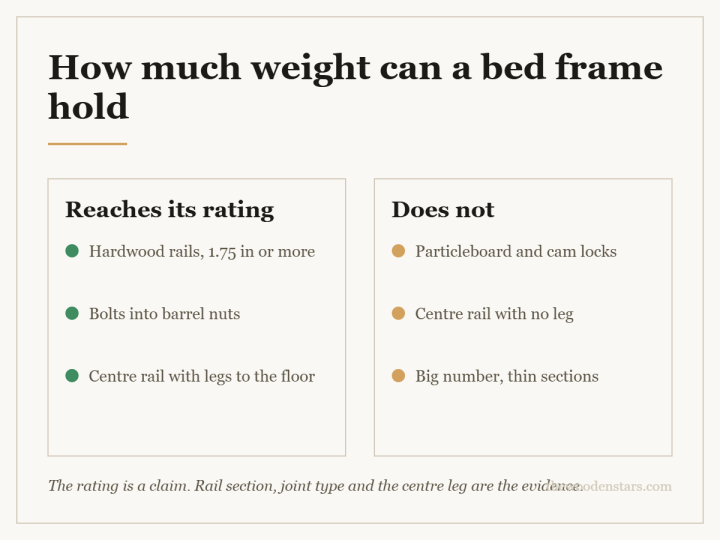
- Side rails — the two long members. On better frames they carry a steel bracket; on cheaper ones, bolts straight into end grain, which is where beds loosen.
- Slats — the cross members carrying the mattress. Either loose and dropped into pockets, or fixed to a webbing strap.
- Slat pockets or ledgers — the strips inside the rails that the slats sit on.
- Centre rail and support leg — the spine down the middle. Mandatory at queen size and above; the single most common missing part.
- Bolts, barrel nuts and cam locks — the hardware. Nearly always a standard metric size, nearly always replaceable.
The numbers that decide fit
Mattress sizes are standardised in the US market, and a frame is built to them rather than to the room. Check both.
| Size | Width | Length |
|---|---|---|
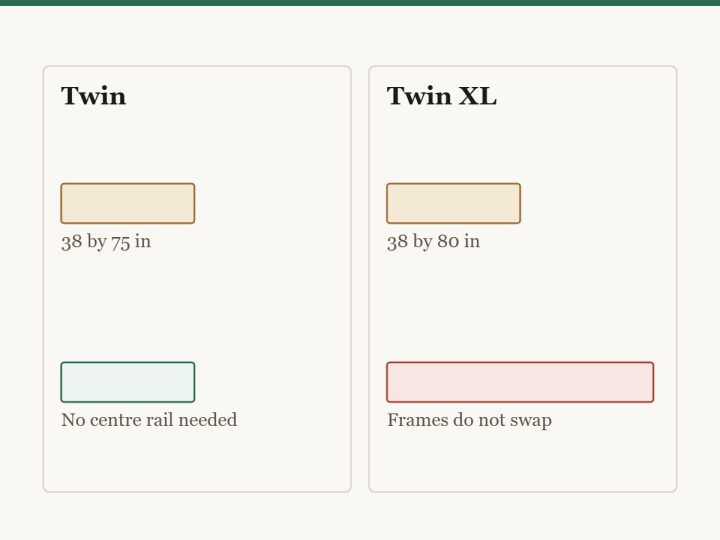
| Twin | 38 in | 75 in |
| Twin XL | 38 in | 80 in |
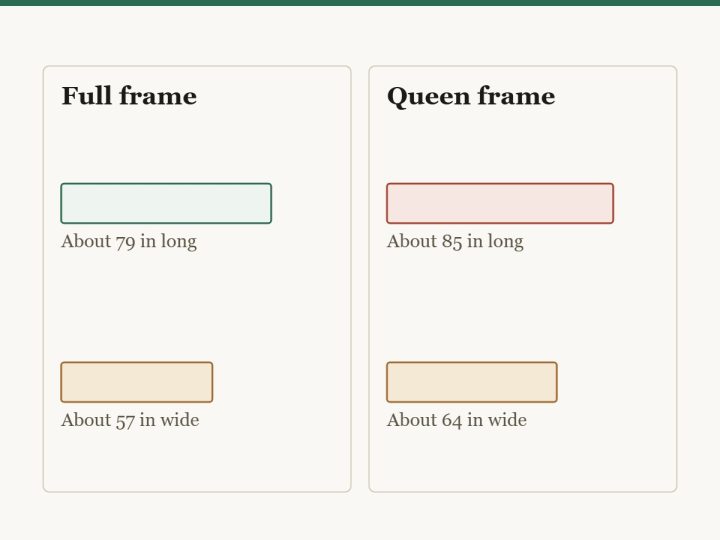
| Full / Double | 54 in | 75 in |
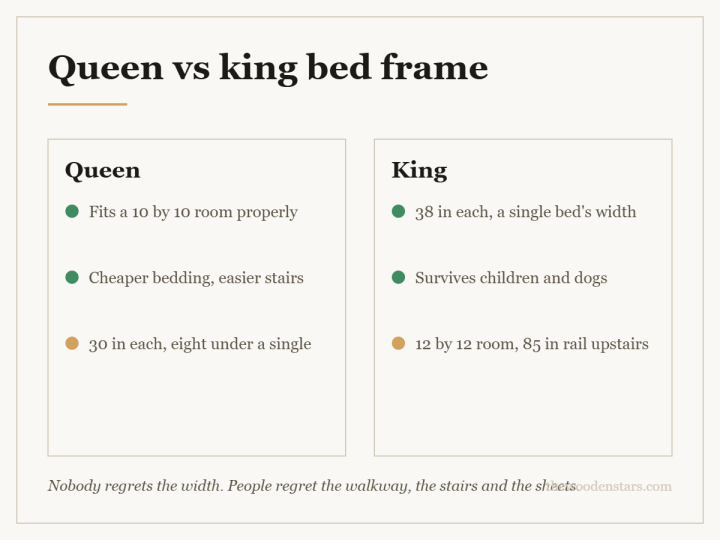
| Queen | 60 in | 80 in |
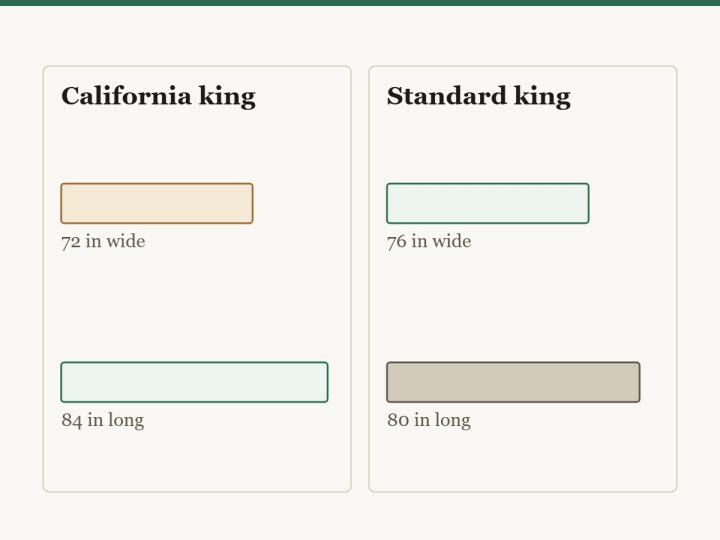
| King | 76 in | 80 in |
| California King | 72 in | 84 in |
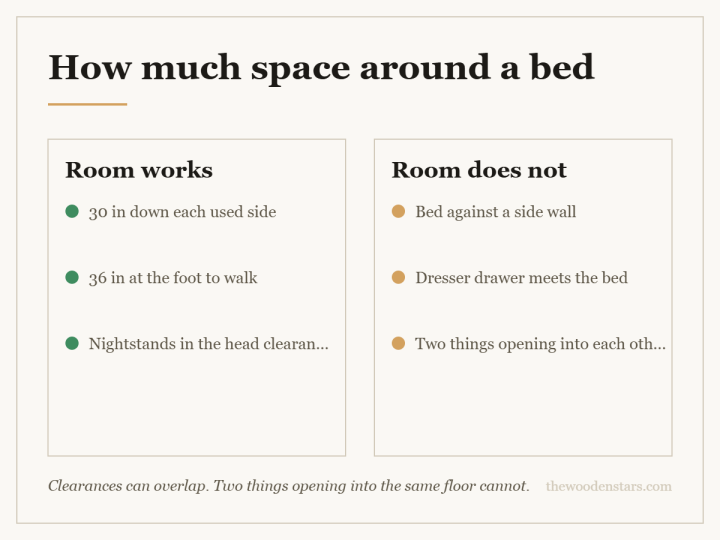
To that add the frame itself. A wooden frame typically adds 2 to 4 inches on each side and rather more at the head if there is a headboard, so a queen frame usually occupies about 65 by 88 inches of floor. Leave 24 inches of walking space on any side you need to get down, and 36 inches where a wardrobe door has to open.
Slats: the part that decides whether the mattress survives
Slat spacing is not a style choice. Most foam and hybrid mattress warranties specify a maximum gap, and exceeding it can void them — and, warranty aside, an unsupported foam mattress sags between slats permanently.
- Foam, memory foam and most hybrids want a gap of no more than about 3 inches. Check the mattress maker’s own figure; some specify less.
- Traditional innerspring tolerates wider gaps because the spring unit spreads the load itself.
- Slat thickness matters as much as spacing. Thin, flexible slats meeting the spacing rule still let a heavy mattress dish.
If a frame arrived with gaps wider than the mattress allows, the fix is almost always to add slats rather than replace the frame — they are cut to length from softwood and cost very little.
Which species belong in a bed frame
A bed carries a static load and takes a shear load at four bolted joints. That means hardness matters less here than on a table, and joint strength matters more.
- Oak, maple, ash and beech — dense, hold a bolt thread well, heavy enough to be a nuisance to move and quiet because of it.
- Rubberwood — the standard for affordable “solid wood” beds. Perfectly adequate for the load; the failure point is nearly always the hardware, not the timber.
- Pine and paulownia — light, cheap, and prone to bolts pulling out of end grain over years of movement. Fine with steel brackets, marginal without.
- Acacia and sheesham — often used for the visible parts. As always, check what the label means; see wood types.
Solid, engineered or veneer
Beds are the category where “engineered wood” hides in plain sight. A headboard is a large flat panel, and large flat panels are exactly what MDF is good at and solid wood is bad at.
- Solid rails and slats, veneered headboard panel is a legitimate and common construction. The structural parts are wood; the panel is stable.
- Solid everything is heavier, more expensive, and needs the panel to be framed so it can move.
- MDF rails are the one to refuse. A bolt in MDF end grain will not stay tight under a shear load.
The listing rarely spells this out. Weight is the tell — a queen frame in genuine solid hardwood is a two-person lift.
What goes wrong, and why
- The squeak. Almost always wood on wood or bolt in an oversized hole. Beds do not develop squeaks in the timber; they develop them at interfaces.
- Slats that keep falling out of their pockets. The frame has racked very slightly out of square, so the pocket is no longer parallel to the slat end.
- A wobbling headboard. Nearly always the same four bolts, and nearly always because they were tightened once at assembly and never again. Wood compresses; bolts need re-torquing after a few weeks.
- A sagging middle. The centre support leg is short, missing, or standing on carpet that has compressed.
- Bolt holes that will no longer hold. Repairable — the hole is drilled out, plugged with hardwood dowel, and re-drilled. This is a standard repair, not a write-off.
Parts you can actually replace
- Slats — cut to the inside width of the rails. The cheapest fix in the bedroom.
- Centre support legs — usually adjustable steel. Adding one to a frame that shipped without is a genuine upgrade, not a repair.
- Bolts and barrel nuts — metric, standard, and sold in kits. Take the old one to compare rather than guessing.
- Rail brackets — steel hook-and-plate sets that convert a bolted joint into a hooked one, which is both stronger and quieter.
- Felt or rubber shims for slat ends. Twenty cents of material solves most remaining noise.
Before you buy
- Check the slat gap against your mattress warranty, not against the frame’s own marketing.
- Confirm a centre support is included at queen and above. Many frames list it as an accessory.
- Find out how the rails attach. Steel brackets or hooks beat bolts into end grain, every time.
- Weigh it — figuratively. A shipping weight far below comparable frames means panels rather than timber.
- Measure the route in, not just the room. Headboards are the one furniture part that regularly will not turn a stair landing. The sidebar calculator is for exactly this.
Questions we get asked
Do I need a box spring with a slatted wooden frame?
No, provided the slat spacing suits the mattress. A slatted platform is doing the box spring’s job. Adding one on top simply raises the bed.
Why did the bed start squeaking after six months and not on day one?
Because wood under a bolt compresses slowly. Every joint in a new frame loses a little tension in the first few weeks. Re-tightening every bolt at the one-month mark prevents most squeaks that would otherwise appear.
Are wooden beds quieter than metal ones?
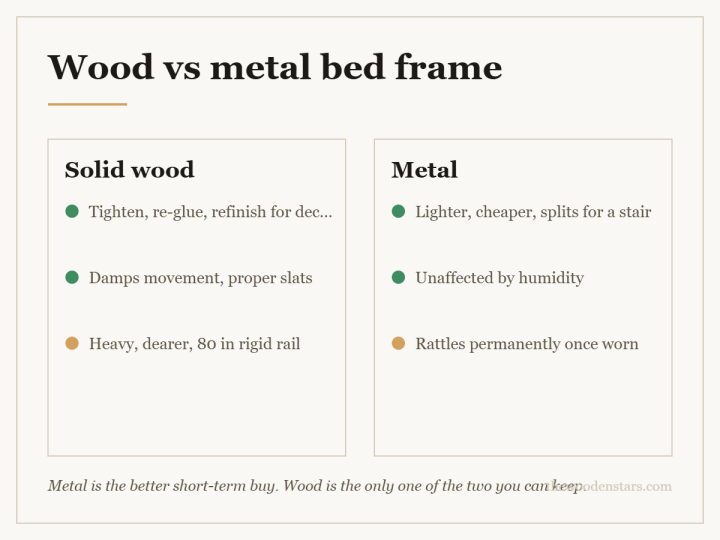
Generally yes, because wood damps vibration instead of ringing. But a wooden frame with loose joints is louder than a tight metal one — the material sets the ceiling, the assembly decides where you land.
Can I put a heavier mattress on an existing frame?
Check the centre support first and the slat count second. Frames rarely fail at the rails; they fail in the middle where nothing is holding the load.
The frame is solid wood but the headboard sounds hollow. Is that a fake?
Not necessarily. A framed panel headboard is often intentionally a thin panel inside a solid frame — that is how large panels are built without splitting. Tap the frame, not the panel.