How much space above a bunk bed? Thirty inches, measured
The Wooden Stars is a participant in the Amazon Services LLC Associates Program. We may earn a commission when you buy through links on our site, at no extra cost to you.
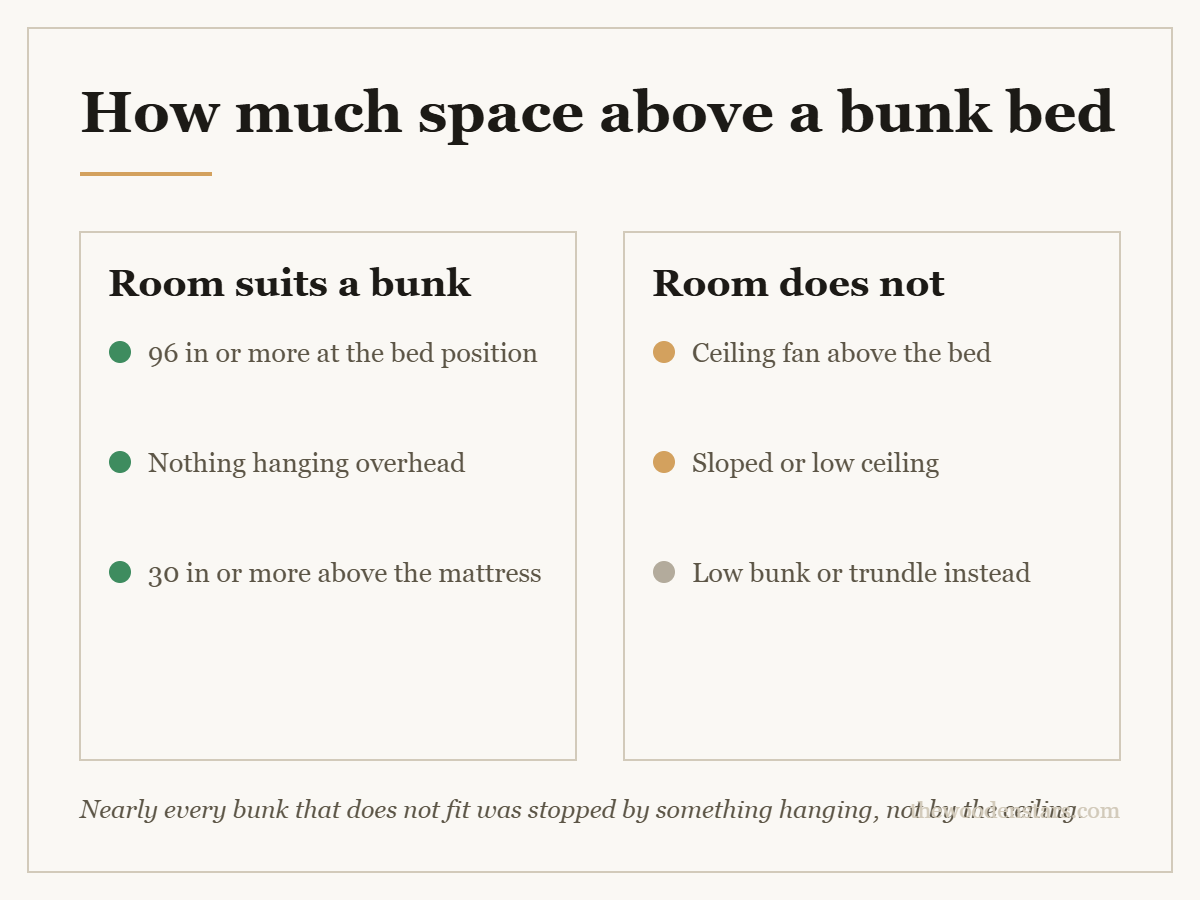
How much space above a bunk bed do you need? At least 30 inches from the top mattress to the ceiling, and 33 to 36 if an adult ever sleeps up there.
That is the number that decides whether a bunk fits your room, and it is measured from the mattress surface rather than from the frame.
Allow 30 inches minimum from the top mattress surface to the lowest thing above it — 33 to 36 for an adult, who needs to sit up without ducking. Work it from the ceiling down: a typical twin-over-twin bunk stands 60 to 68 inches, add a 6-inch mattress, and you need about 96 inches of ceiling. The thing that catches people is not the ceiling but what hangs from it — a ceiling fan usually rules a bunk out, and a pendant light or a sloped ceiling changes the answer completely. Measure at the bed’s exact position, not in the middle of the room.
How much space above a bunk bed the sleeper actually needs
The requirement is sitting-up room, and it varies by who is up there.
- A child: 24 inches is survivable, 30 is comfortable.
- A teenager: 30 to 33.
- An adult: 33 to 36. An average adult’s sitting height from seat to head is about 34 inches, so below that they duck permanently.
Below 24 inches the top bunk stops being a place anyone chooses to be. People sit up in bed to read, to get dressed and to get out — it is not a marginal activity.
| Element | Typical | Note |
|---|---|---|
| Ceiling height | 96 in | Measure at the bed’s position |
| Bunk frame height | 60 to 68 in | Low bunks 48 to 56 |
| Top mattress | 6 in | The stated maximum, usually |
| Headroom left | 22 to 30 in | 30 comfortable, 33 to 36 for an adult |
| Ceiling fan | Takes 12 to 18 in | Usually rules a bunk out |
| Pendant light | Takes 10 to 30 in | Often movable |
Work it from the ceiling down, not the floor up
The arithmetic is simple and people do it in the wrong order, then discover the problem after delivery.
- Measure the ceiling at the bed’s exact position. Not the middle of the room — ceilings slope, and beds go against walls.
- Subtract anything hanging at that spot: fan, pendant, sprinkler head, beam, duct boxing.
- Subtract the frame height from the listing.
- Subtract the mattress thickness, which the listing does not include.
- What is left is the headroom. Under 24 inches, buy a lower frame.
Example: 96-inch ceiling, no fixture, 66-inch frame, 6-inch mattress ⇒ 24 inches. Workable for a child, tight for anyone else. Drop to a 56-inch low bunk and it becomes 34.
What hangs from the ceiling is the usual problem
A ceiling fan is the common one. Blades sweep 12 to 18 inches below a 96-inch ceiling, leaving perhaps 78 inches of clear height where the bed goes. A 66-inch bunk with a 6-inch mattress puts the sleeping surface at 72 — six inches under the blades. That is not a headroom problem, it is a hazard, and it usually means no bunk in that room.
A pendant light is often movable, and cheaply.
A sloped ceiling can work in your favour if the bed goes on the tall side, and rules the room out if it does not. Measure at the low corner of the bed’s footprint.
If the ceiling is not enough
Three routes, in the order most people should consider them.
A low bunk. Frames at 48 to 56 inches instead of 60 to 68. The lower bunk loses sitting room and the top gains it, which is the right trade when the ceiling is the constraint — low loft beds.
A trundle. Spends floor instead of ceiling, and needs no headroom at all — trundle bed against bunk bed.
Two twins. If the floor is there, this removes the problem entirely — bunk bed against two twin beds.
The other clearance nobody measures: under the top deck
Headroom above the top bunk gets all the attention, and the lower bunk has the same problem.
Clear height under the top deck is typically 33 to 40 inches. Subtract the lower mattress and you get the sitting room down there:
- 36-inch clearance, 6-inch mattress ⇒ 30 inches. Fine.
- 36-inch clearance, 12-inch mattress ⇒ 24. A child sits up; an adult does not.
On a twin-over-full where an adult uses the bottom, check this figure as carefully as the ceiling one — twin over full bunk beds. The mattress cap rules are in how thick a bunk bed mattress can be.
One more clearance: the ladder
An angled ladder needs about 14 inches of floor in front of the bed, plus room to stand. A vertical ladder takes almost none but is harder to descend half asleep.
And the bunk needs its own side clearance for making the bed — 24 inches along one side if you want to change a fitted sheet without crawling. Frame specifics in wooden bunk beds.
Measuring and fitting
- Laser distance measure Reads floor to ceiling at the bed’s exact position in a second
- Clip-on bed light The fix for a pendant you had to move away from the bunk
- Six-inch bunk mattress Every inch of mattress is an inch of headroom gone
- Stud finder The anti-tip strap has to reach a stud
What to buy


For frames, see wooden bunk beds, twin over twin and low loft beds. For the loft version of the same question, how high a loft bed should be. For the alternatives, trundle bed against bunk bed.
Questions we get asked
How much space do you need above a bunk bed?
At least 30 inches from the top mattress surface to the lowest thing overhead, and 33 to 36 if an adult sleeps there.
What ceiling height does a bunk bed need?
About 96 inches for a standard 60 to 68-inch frame with a 6-inch mattress. Low bunks at 48 to 56 inches work under less.
Can you put a bunk bed under a ceiling fan?
Generally no. Blades hang 12 to 18 inches below the ceiling, which usually puts them close to the top sleeping surface.
Is the frame height the same as the mattress height?
No — listings give the frame. Add the mattress thickness, because headroom is measured from the surface someone lies on.
How much clearance does the lower bunk need?
Thirty inches of sitting room after the mattress. Clear height under the top deck is usually 33 to 40 inches, so a thick lower mattress eats it.
Where should I measure the ceiling?
At the bed’s exact position, not the middle of the room. Ceilings slope and beds go against walls.