How much weight can a bed frame hold? 500 to 2,000 lb
The Wooden Stars is a participant in the Amazon Services LLC Associates Program. We may earn a commission when you buy through links on our site, at no extra cost to you.
How much weight can a bed frame hold? Between 500 and 2,000 lb for a queen or king — and the number includes the mattress, which is a bigger share of it than most people expect.
The rating also tells you almost nothing on its own. What it is made of and how the middle is supported tell you far more.
Typical ratings: 500 to 800 lb on light metal and particleboard frames, 800 to 1,200 lb on decent pine or rubberwood platforms, and 1,200 to 2,000 lb on solid hardwood with bolted joints and a proper centre support. Subtract the mattress first — a queen is 70 to 130 lb, a king 90 to 150. Ratings are static, and people are not: sitting down hard on an edge applies two to three times body weight at one corner. The single thing that decides whether a frame reaches its rating is the centre support, and it is the part most often missing.
How much weight can a bed frame hold once the mattress is counted
The rating covers everything on the frame. Work out what is left:
- Queen innerspring mattress: 70 to 100 lb. Memory foam, 100 to 130.
- King: 90 to 150 lb.
- Box spring, if used: another 50 to 80 lb.
- Bedding: 15 to 30 lb.
So a 600 lb-rated queen with a 110 lb foam mattress and bedding leaves about 465 lb for people — comfortable for two adults. The same frame with a box spring leaves 400. A 500 lb frame with a heavy mattress and a box spring leaves under 300, which is closer than it looks once two adults and a dog are on it.
| Rating | Frame | Suits |
|---|---|---|
| 500 to 800 lb | Light metal tube or particleboard | Two adults, no margin |
| 800 to 1,200 lb | Pine or rubberwood platform | Two adults with margin |
| 1,200 to 2,000 lb | Solid hardwood, bolted, centre support | Any household, decades |
| Unstated | Treat as the lowest band | Be sceptical |
Static rating against real use
Published figures are static loads — what the frame holds without deflecting past a limit. Nobody applies a static load to a bed.
Sitting down hard on the edge momentarily applies two to three times body weight through one rail, at the point furthest from any support. That is the load that loosens joints, and it is why a frame rated at exactly the occupants’ weight is the wrong frame.
The rule of thumb is to rate for roughly double the combined sleeping weight, mattress included. It is not that the frame will collapse otherwise — it is that it will start creaking and racking within a couple of years.
The centre support, which decides everything
This is the part that actually matters and the part most often missing or under-specified.
A queen is 60 inches wide and a king 76. Slats spanning that unsupported will bow under load no matter what the frame is rated at — the rails can be perfect and the middle still sags.
- Queen: one centre rail running head to foot, with at least one leg to the floor.
- King: a centre rail with two or three legs. One leg on a king is not enough.
- The leg must reach the floor, not just brace the rail. A centre rail bolted at both ends with no leg is decoration.
If a frame is sold without one, budget for it — this is the cheapest upgrade in the category and the one that changes the outcome. Detail in bed frame centre support legs.
Where the rating actually comes from
Three things, and they travel together.
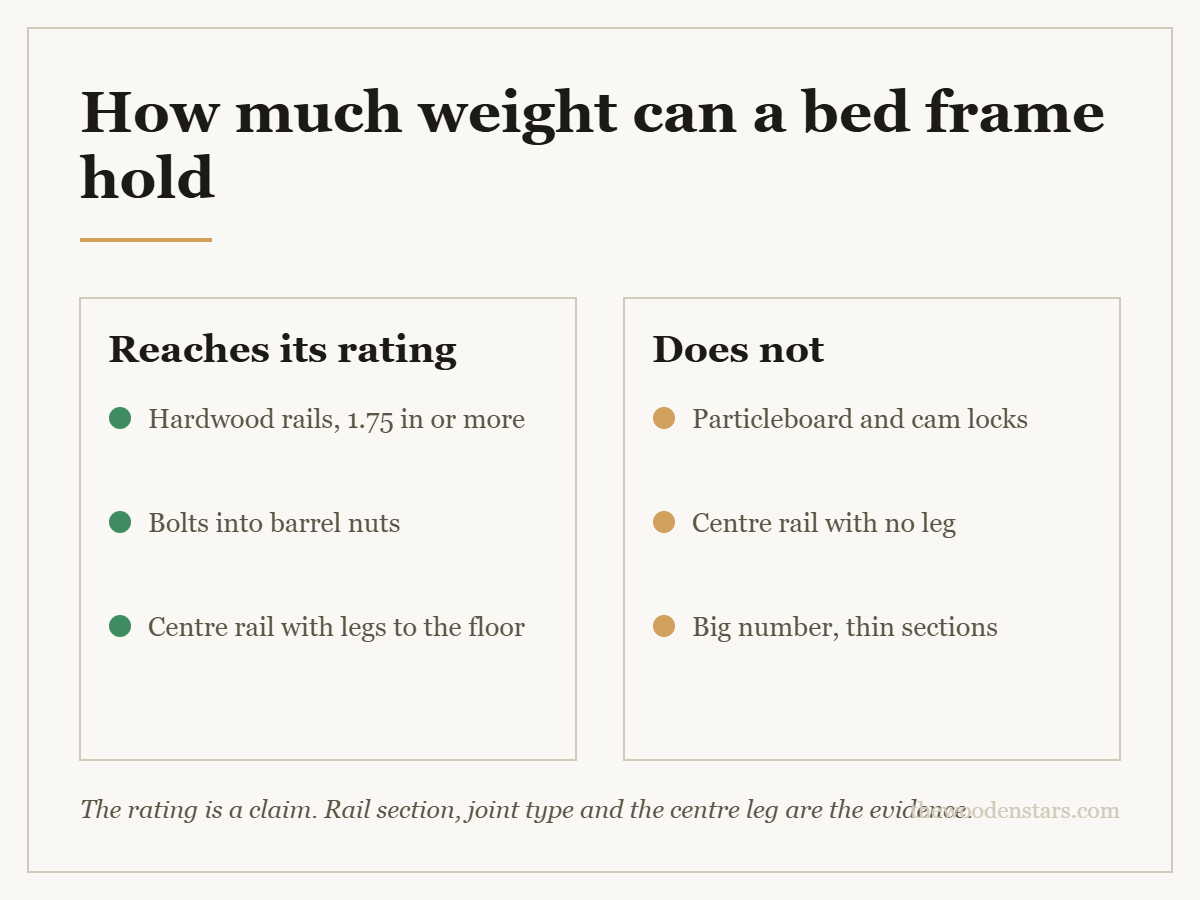
Rail section. A side rail carries the whole deck between two posts. Under about 1.25 inches thick, an 80-inch hardwood rail flexes; at 1.75 to 2 it does not.
Joint type. Bolts into barrel nuts can be pulled up annually and last decades. Hook-plate brackets are the common middle ground and work well. Cam locks cannot be meaningfully re-tightened, which is the real argument against them — see bed frame brackets.
Species and construction. Solid hardwood holds a bolt in end grain under cyclic load. Particleboard does not, at any stated rating — the screw crushes its way out of the board over a year or two. See what engineered wood actually is and the hardwood hardness scale.
A listing quoting 2,000 lb on thin rails with cam locks is quoting a laboratory number that has nothing to do with year three.
The slats, which the rating assumes are correct
A deck rating assumes slats in place and properly spaced. They are also the cheapest thing for a maker to skimp on.
- Spacing under 3 inches for a foam or hybrid mattress, up to about 4 for sprung. Most mattress warranties specify it and void over it.
- Solid timber of a real section, not thin sprung ply, on anything that takes two adults.
- Fixed at both ends rather than resting in a groove. A loose slat rubs, and that rub is most of the noise a bed makes.
Replacements and sizes are in bed slat replacement and spacing. If the frame has started talking rather than sagging, it is usually slats or a loose bracket: why a wooden bed frame squeaks.
Keeping the rating over time
Tighten every joint after the first month, then annually. Ten minutes with a T-handle key; the supplied L-key is too short to apply real torque. This is only possible on a bolted frame.
Check the centre leg is still touching the floor. Carpet compresses, floors move, and a leg an eighth of an inch short is doing nothing.
Level the frame. A bed rocking between diagonal corners puts its whole load through two legs instead of four.
Reaching and keeping the rating
- Centre support leg The part that decides the outcome, and often not included
- T-handle hex key The supplied L-key cannot torque a bed joint properly
- Felt slat tape Stops the slat rub that is most bed-frame noise
- Bed frame levelling glides A rocking frame loads two legs instead of four
What to buy


For frames, see wood bed frames, queen bed frames and king size bed frames. For sizing, queen against king. For the bunk version of this question, how much weight a bunk bed can hold. For the support parts, centre support legs and bed frame brackets.
Questions we get asked
How much weight can a bed frame hold?
Typically 500 to 2,000 lb for a queen or king, depending on material and joints. Solid hardwood with bolted joints sits at the top of that range.
Does the rating include the mattress?
Yes. Subtract 70 to 150 lb for the mattress and another 15 to 30 for bedding before working out what is left.
How much margin should I leave?
Rate for roughly double the combined sleeping weight. Published figures are static, and sitting on an edge applies two to three times body weight.
What matters most for strength?
The centre support. A 60 or 76-inch span without a rail and legs to the floor will sag whatever the rails are rated at.
How many centre legs does a king need?
Two or three. One leg is enough for a queen and not for a king.
Can I trust a high rating on a cheap frame?
Check the rail thickness and the joints. Two thousand pounds quoted on thin sections with cam locks does not survive year three.