Wood bed frames — The category, and what the price buys
The Wooden Stars is a participant in the Amazon Services LLC Associates Program. We may earn a commission when you buy through links on our site, at no extra cost to you.

A wood bed frame does one job: it holds a mattress off the floor and keeps holding it, quietly, for years. Everything else — the headboard, the finish, the style label — is decoration on top of that job.
Which is why the frames that last and the frames that squeak within a year often look identical in a photograph. The difference is in four places, and none of them are the part the listing photographs.
Judge a wood bed frame on four things: the slats (how many, how thick, how far apart — most mattress warranties want gaps under 3 inches), the centre support (a full, queen or king needs a centre rail with its own leg to the floor), the joints (bolted through metal inserts rather than screws straight into end grain), and the material (solid timber and plywood hold a screw; particleboard does not). Style, species and finish matter after those. A frame that fails does it at a joint or a slat, never at the headboard.
The four things that decide whether it lasts
1. Slats
The slats carry the mattress and everything on it. Three numbers matter: how many there are, how thick each one is, and the gap between them.
Most foam and hybrid mattress warranties specify a maximum slat gap — commonly 3 inches — and will decline a claim if the base did not meet it. Wider gaps let the mattress sag between slats and that sag becomes permanent. Thin slats bow in the middle of their span, which is why a wide frame needs either thicker slats or a centre support under them.
Check whether slats sit in a routed groove or simply rest on a ledge. A slat that can walk sideways will, and then it drops.
2. Centre support
Anything wider than a twin needs a centre rail running head to foot, and that rail needs at least one leg going down to the floor. A queen or king usually needs two or three legs.
This is the single most common omission on cheap frames. Without it the slats span the full width unsupported, the frame flexes every time someone moves, and the flex works the joints loose. A frame advertised as supporting 800 pounds with no centre leg is quoting a number it cannot hold.
3. Joints
Bed frames come apart and go back together, so the joints are designed to be dismantled. The good version is a bolt passing into a threaded metal insert set into the timber. The bad version is a wood screw driven into end grain — it holds the first time, holds less the second, and strips the third.
Traditional joinery — mortise and tenon, dovetails on drawer boxes in storage beds — is a good sign where you find it, but on a knock-down frame the metal insert is the part that decides whether the bed survives a house move.
4. Material
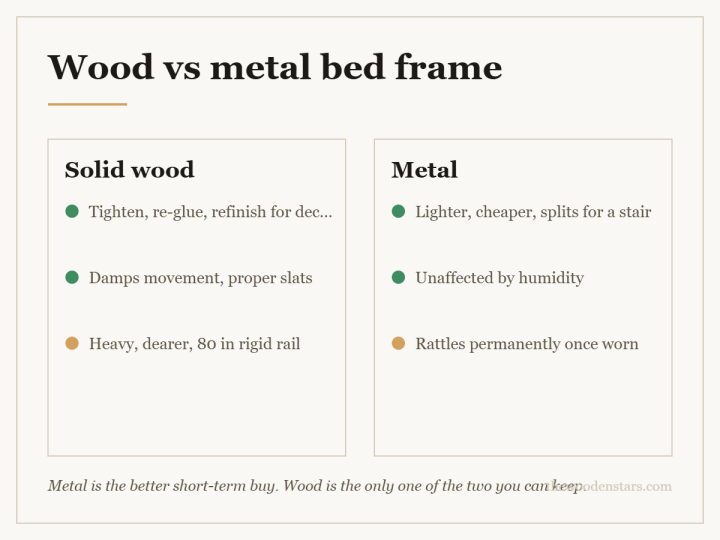
Solid hardwood and good plywood hold a screw indefinitely. Softwood holds well enough if the sections are generous. Particleboard enlarges its hole under cyclic load and there is no clean repair — which matters most exactly where the rails meet the posts.
Most frames at ordinary prices mix materials: solid rails, plywood or panel elsewhere. That is fine. What matters is where the load goes. The words on the listing are decoded in what engineered wood actually is.
| Size | Mattress | Centre support | Typical slat count |
|---|---|---|---|
| Twin | 38 × 75 in | Not required | 10 to 13 |
| Full | 54 × 75 in | One centre rail, 1 leg | 12 to 14 |
| Queen | 60 × 80 in | One centre rail, 2 legs | 13 to 16 |
| King | 76 × 80 in | Centre rail, 2 to 3 legs | 15 to 18 |
| California king | 72 × 84 in | Centre rail, 2 to 3 legs | 15 to 18 |
Species, and what it actually buys
Hardwood and softwood are botanical categories, not hardness ratings, and the difference matters less on a bed frame than people assume — because a bed frame is not a worktop. Nothing abrades it.
What species changes is stiffness per inch of section, weight, and how well it holds a fixing. Oak, maple, birch and beech are stiff and hold screws well. Pine and rubberwood are lighter and cheaper, and need more generous sections to match — which good pine frames simply do. Walnut is chosen for colour and is priced accordingly.
A well-designed pine frame beats a thin oak one. Read the section sizes before the species name. The full comparison for the biggest size is in hardwood against softwood at queen size.
Platform, slatted or with a box spring
Platform beds support the mattress directly on slats. Lower, simpler, and correct for foam and hybrid mattresses — which is most mattresses sold today.
Frames designed for a box spring have a perimeter rail and rely on the box spring for support. Putting a foam mattress on one without the box spring is the classic mistake: the mattress has nothing under its middle.
Check which one you are buying, because the same photograph fits both. If the listing mentions a required box spring, it is not a platform bed.
Height, and why it is a real decision
Deck height — the distance from the floor to the top of the slats — plus your mattress thickness gives the height you sit on to put your shoes on. Somewhere around 22 to 26 inches suits most adults.
Low platform frames look excellent and can be genuinely awkward for anyone with a knee or hip problem. High frames give storage underneath and can make a small room feel crowded. Neither is wrong, but the number is worth calculating before ordering rather than discovering on delivery.
Getting it into the room
Bed frames arrive flat-packed for a reason, but the long rails are the length of the mattress and they do not bend. Measure the tightest point of the route — a stairwell turn, a narrow landing, a door at an angle — against the longest single component listed.
Also check whether the headboard ships as one piece. A one-piece queen headboard is about five feet wide and rigid, and it is the part that most often will not turn a corner.
For assembly and after
- Hex key set Better than the folded key in the box, and it saves rounded bolt heads
- Threadlocker A drop on the rail bolts is what stops the squeak coming back
- Felt pads Under the legs, so the frame does not walk on a hard floor
- Rubber mallet For seating joints without bruising the timber
What to buy


For the size you need, go to twin, full, queen, king or California king. If you want the checklist rather than the explanation, use what to check before you order, and for a specific look, how to spot a real midcentury frame.
Questions we get asked
What is the best wood for a bed frame?
Oak, maple, birch and beech are stiff and hold fixings well. Pine and rubberwood work when the sections are generous. Section size matters more than species name.
How far apart should bed slats be?
Under 3 inches for most foam and hybrid mattresses — check your mattress warranty, because it is usually written into it.
Does a queen bed frame need a centre support?
Yes, a centre rail with at least two legs to the floor. Anything wider than a twin does. Without it the slats span unsupported and the joints work loose.
Why does my wood bed frame squeak?
Almost always a loose joint or a slat moving in its seat. Tighten every bolt, add threadlocker, and check the slats are captive rather than resting loose.
Do I need a box spring with a wood bed frame?
Only if the frame was designed for one. Platform frames support the mattress on slats and do not need it; a foam mattress on a box-spring frame without the box spring has nothing under its middle.
Is a solid wood bed frame worth it over particleboard?
Where the load goes, yes. Particleboard enlarges its fixing holes under repeated load and cannot be cleanly repaired. Panel elsewhere in the frame is not a problem.