Full size daybeds — Depth is the comfort problem
The Wooden Stars is a participant in the Amazon Services LLC Associates Program. We may earn a commission when you buy through links on our site, at no extra cost to you.
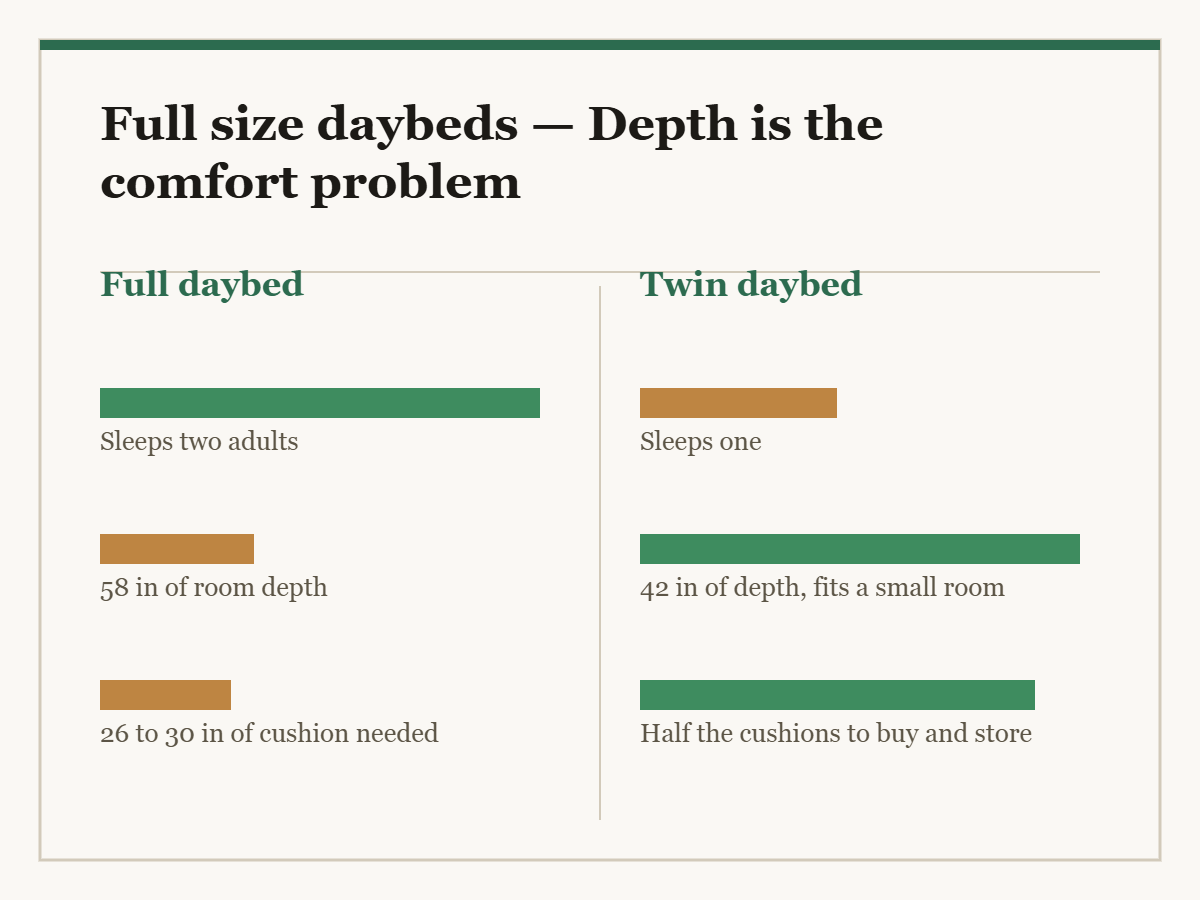
A full size daybed is 54 inches deep. That is sixteen inches more than a twin daybed and it changes what the piece is: as a bed it sleeps two, and as seating it is so deep that without cushions you cannot reach the back rail while your feet touch the floor.
Both of those follow from the same number, and whether the daybed works in your room depends on which one you care about.
A full daybed takes a 54 × 75 inch mattress and stands about 80 inches long by 58 deep. It genuinely sleeps two adults, which a twin daybed does not. As seating it needs 26 to 30 inches of cushion depth at the back — nearly double a twin’s — and that is a lot of cushions to buy and to store. Seat height depends on the mattress: 6 to 8 inches keeps it near 22 to 26, a 12-inch mattress puts it at 28 to 30. Check for a centre support leg, because 54 inches of slat span sags, and prefer timber slats over a wire grid.
The depth problem, doubled
A sofa seat is 21 to 24 inches deep. A twin daybed is 38, so you need 14 to 17 inches of cushion to bring the back forward. A full daybed is 54, so you need 26 to 30.
That is not a decorative row of scatter cushions. It is two rows of firm bolsters, or a pair of large back cushions the size of sofa cushions, and they have to be firm or they compress and put you right back where you started.
Three consequences worth planning for:
- Cost. Good firm bolsters at that depth are a real line item, sometimes a quarter of the daybed price.
- Storage. When the daybed becomes a bed, 30 inches of cushion has to live somewhere. In a spare room this is the detail that ends up with cushions on the floor.
- Width lost. Nothing — the cushions go against the back rail, so the seating length is unchanged. This is the one thing that does work in your favour.
Seat height, set by the mattress
A full daybed deck sits at 14 to 18 inches. The mattress decides the rest:
- 6 inches: seat at 20 to 24. Sits like a dining chair.
- 8 inches: 22 to 26. Comfortable for most people.
- 12 inches: 26 to 30. A perch — good for sleeping, poor for sitting.
If the daybed is mainly a guest bed, take the thicker mattress and accept the seat height. If it is seating that occasionally sleeps someone, take 6 to 8 inches and add a topper for the nights it is used. A topper on top of a thin mattress gives a better night than a thin mattress alone and stores flat.
| Measure | Typical | Note |
|---|---|---|
| Mattress | 54 × 75 in | Standard full, not full XL |
| Overall length | 78 to 82 in | — |
| Overall depth | 56 to 60 in | Deeper than most sofas by 2 feet |
| Deck height | 14 to 18 in | Before the mattress |
| Seat height | 20 to 30 in | Set by mattress thickness |
| Cushion depth needed | 26 to 30 in | To seat like a sofa |
| Sleeps | Two adults | A twin daybed does not |
Centre support across 54 inches
Fifty-four inches of slat span sags without something in the middle, and on a daybed the sag shows up faster than on a bed because people also sit on the front edge.
Look for a centre rail with a leg to the floor. A daybed has no reason not to have one — unlike a loft, there is no bay to keep clear — so its absence is a cost decision rather than a design constraint.
On the deck itself:
Timber slats under 3 inches apart for a foam mattress, 4 for sprung. Rigid and replaceable — bed slat replacement and spacing.
A steel wire grid is the traditional daybed deck and sags into a hammock under nightly use. Fine for a guest bed used twice a year, poor for anything more.
A solid platform works and traps moisture under the mattress; stand it up occasionally.
The general case for centre support is in bed frame centre support legs.
Where it fits
A full daybed is a big piece and it is the depth that catches people out, not the length.
- Allow 58 to 60 inches from the wall. That is five feet of room depth gone, before any walkway.
- Add 30 inches of clear floor in front to get past it, or 36 if it is the main route.
- Check the corner. A full daybed in a corner blocks 80 inches along one wall and 58 along the other.
- Measure the route in. The back and end panels are large rigid pieces; the 80-inch back rail is the awkward one on a stair turn.
In a room under 11 feet deep, a full daybed against one wall leaves a corridor. A twin daybed at 42 inches deep is often the better answer in a small spare room — see twin daybeds.
What goes underneath
A deck at 14 to 18 inches leaves a usable void the full 54-inch width.
Drawers give 3 to 4 cubic feet each at this width. The usual question applies — runners fixed to the frame work on any floor, castors rolling on the floor stall in carpet. See daybeds with storage.
A trundle at full width is uncommon and heavy; most full daybeds that offer one use a twin trundle, which leaves a gap. Pop-up versus roll-out is covered in daybeds with a trundle.
It is one void, so you choose one or the other.
What it is made of
The joint that matters on a daybed is where the back rail meets the end frames. Every time someone leans back, that joint takes a lever — and on a full daybed the back rail is 80 inches long, so the leverage is real.
Solid hardwood holds a bolt in end grain under that load — the hardwood hardness scale and the best wood for furniture.
Pine works and wants annual tightening.
Particleboard ends fail exactly at that bolt — what engineered wood actually is.
Also check the ends are panelled or closely slatted rather than two posts and a rail. That is what stops an 80-inch frame racking along its length.
Making it work
- Firm bolster cushions You need 26 to 30 inches of depth, and soft ones compress to nothing
- Mattress topper Lets a thin mattress keep the seat height and still sleep well
- Slat roll Replaces a sagging wire grid with proper timber slats
- Centre support leg 54 inches of span sags, and a daybed has no reason to omit one
What to buy


For a smaller one, see twin daybeds. For the largest, queen daybeds. For a second bed underneath, daybeds with a trundle, or drawers in daybeds with storage. If the room needs the bed to vanish, murphy bed against sofa bed.
Questions we get asked
Does a full daybed sleep two?
Yes — it takes a standard 54 × 75-inch full mattress. A twin daybed does not.
How deep is it?
Fifty-six to 60 inches overall. Allow that plus 30 to 36 inches of walkway in front.
How many cushions does it need?
Twenty-six to 30 inches of firm cushion depth at the back — roughly double a twin daybed, and they have to go somewhere when it is a bed.
How high will the seat be?
Twenty to 30 inches depending on the mattress. Six to 8 inches keeps it near chair height; 12 makes it a perch.
Does it need a centre support leg?
Yes, across 54 inches of span — and unlike a loft there is no reason for a daybed to leave one out.
Can it have a full-width trundle?
Rarely. Most full daybeds that offer a trundle use a twin one, which leaves a gap down one side.