Queen loft beds — Weight rating is the whole decision
The Wooden Stars is a participant in the Amazon Services LLC Associates Program. We may earn a commission when you buy through links on our site, at no extra cost to you.
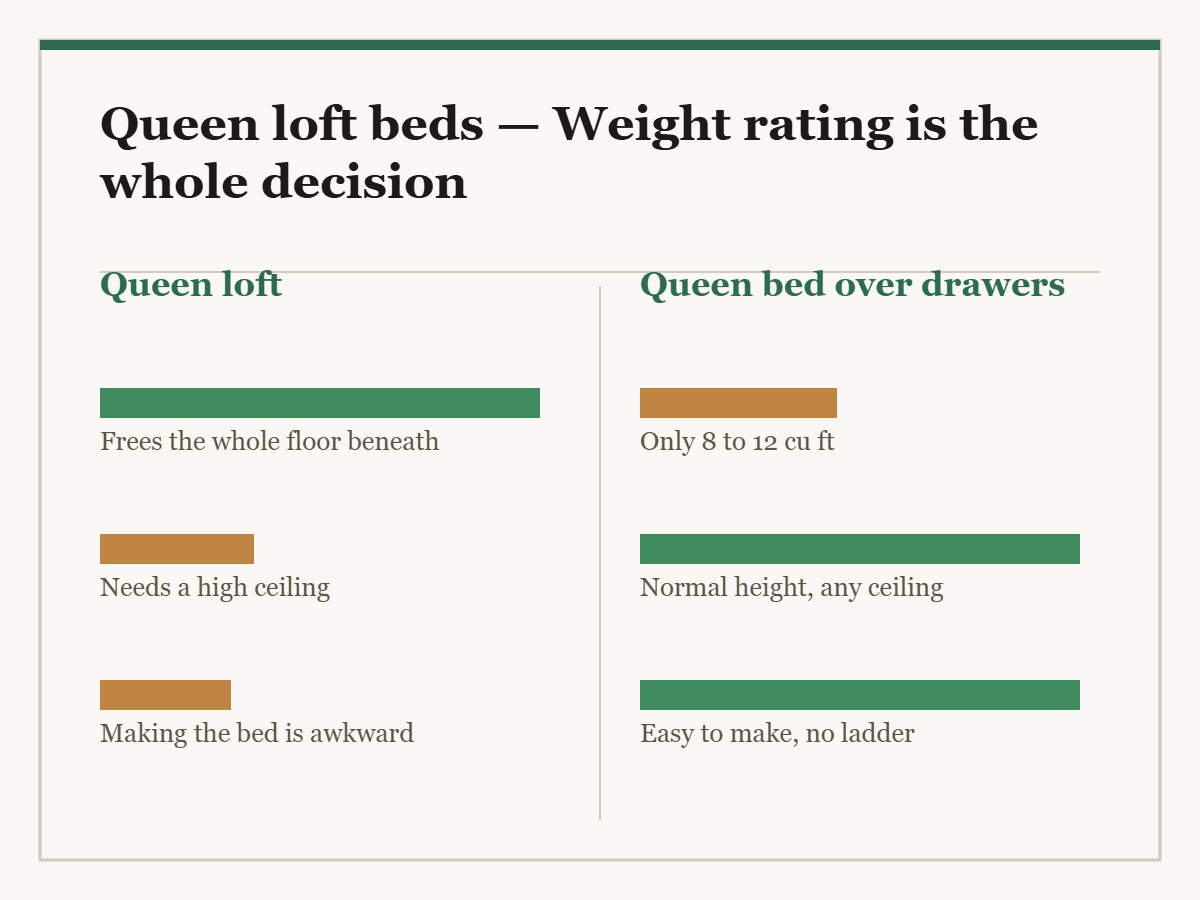
A queen loft bed is a different object from a children’s loft with a queen mattress on it. Sixty inches of deck width carrying two adults is roughly four times the load a twin loft is designed for, and almost nothing about a child’s frame scales up to it.
So the buying question is not about height or storage. It is whether the frame in front of you was engineered for adult weight, and there are three specifications that answer it.
The three numbers that matter: weight rating — you want 600 lb or more on the top deck for two adults plus a mattress, and a frame rated 300 is a single-sleeper frame whatever the listing says; post section — 2.5 to 4 inches square in solid hardwood, because a 60-inch span on thin posts flexes; and centre support under the deck, which a queen span of 60 inches needs and many loft frames leave out because a leg would land in the bay. Overall height is 68 to 84 inches; allow 30 inches above the mattress and 44 to 60 of clear bay below if an adult is to use the space.
Weight rating, and the arithmetic behind it
Work out what actually goes up there.
- A queen mattress: 70 to 130 lb depending on type. Memory foam is at the heavy end.
- Two adults: 300 to 400 lb.
- Bedding: 15 to 25 lb.
That is 385 to 555 lb of static load, before anyone sits down hard or two people move at once. A rating of 600 lb gives sensible margin; 800 is what the better solid hardwood frames quote.
A frame rated 300 lb is not a queen loft bed with a lower rating — it is a frame that should not have a queen mattress on it. If the listing does not state a figure at all, that is the answer.
Post section and span
A queen loft has four posts carrying a 60 × 80-inch deck six feet up. The posts are columns and the side rails are beams, and both want section.
Posts: 2.5 inches square is the sensible minimum in solid hardwood; 3 to 4 is what the heavy-duty frames use. Under 2 inches, a six-foot post under this load flexes visibly when someone climbs.
Side rails: the 80-inch rails carry the slats. Look for a rail depth of 4 inches or more, or a rail with a ledger strip that spreads the slat load.
Metal frames can be fine here — tube section and wall thickness do the same job — but check the rating rather than assuming steel means strong. Thin-wall tube at queen width is worse than good hardwood.
Centre support, the part that gets left out
Any queen bed needs support under the middle of its 60-inch slat span. On a normal frame that is a centre rail on one or two legs down to the floor.
On a loft, a leg down to the floor lands in the middle of the bay — which is the space you bought. So manufacturers either:
- Run a centre rail between the head and foot ends with its own deep section, which works if the rail is substantial;
- Use a steel platform rather than slats, which also works;
- Leave it out, which does not. The deck dips along the centre line within a year and the mattress follows.
Look at the assembly diagram for what runs down the middle of the deck. The general case is in bed frame centre support legs, and slat spacing — under 3 inches for foam — in bed slat replacement and spacing.
| Measure | Child-grade frame | Adult-grade frame |
|---|---|---|
| Top deck rating | 200 to 300 lb | 600 to 800 lb |
| Post section | 1.5 to 2 in | 2.5 to 4 in |
| Centre support | Often absent | Deep centre rail or steel deck |
| Joints | Screws, cam locks | Bolts into barrel nuts |
| Overall height | 60 to 70 in | 68 to 84 in |
| Typical price | Under $300 | $450 to $800 |
Height, and what the bay is for
A queen loft in an adult bedroom is usually solving one of two problems, and they want different heights.
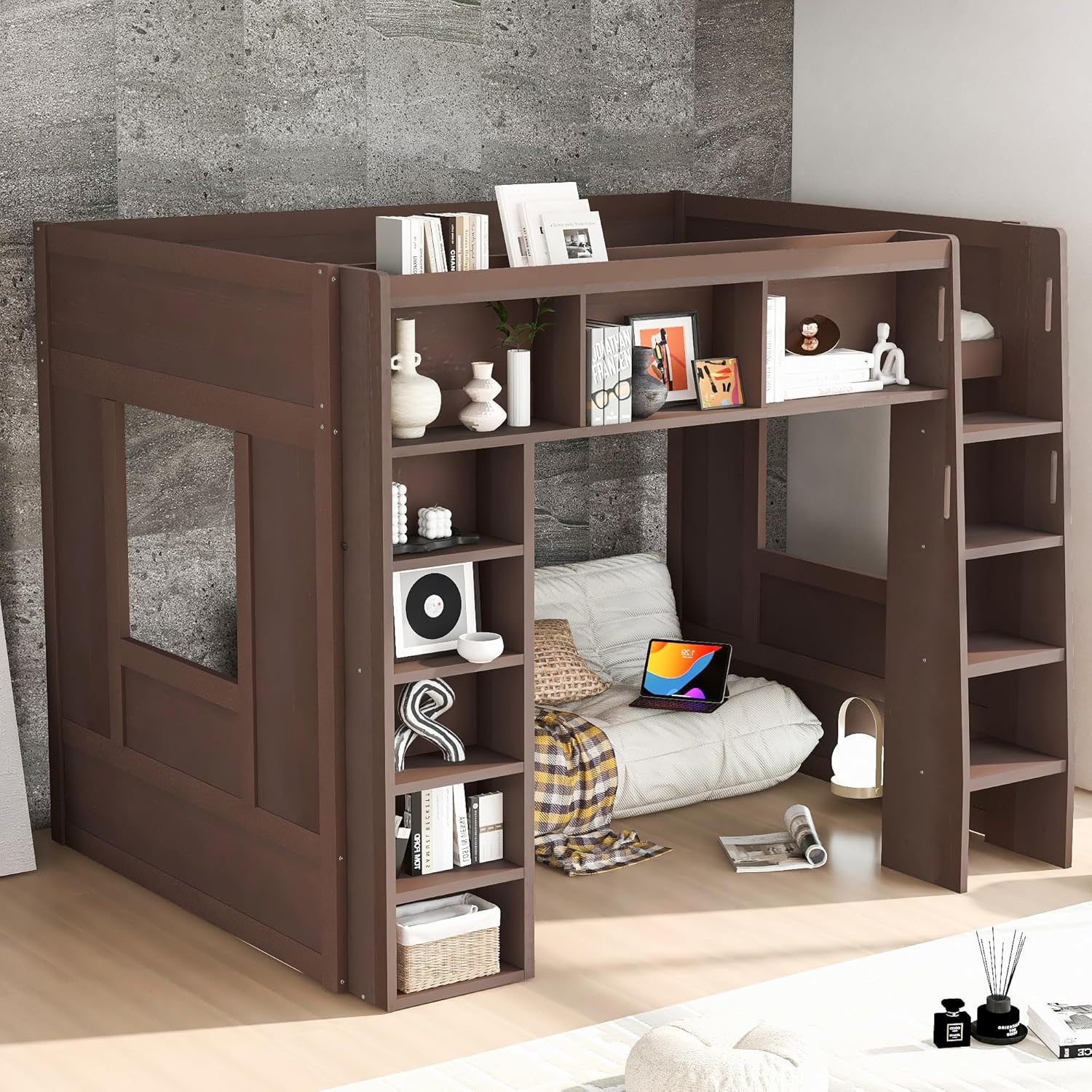
A studio or small flat where the bay becomes the living area. You want 60 inches or more of clear height so a person can sit on a sofa underneath comfortably, which pushes the frame to 78 to 84 inches overall and needs a high ceiling.
A room where the bay is storage or a desk. Forty-four to 50 inches is plenty and keeps the top deck at a height you can still make the bed at.
That last point is worth stating plainly: a deck at 60 inches means changing a queen duvet while standing on a ladder. It is the most common regret in the category and it does not show up in the specification anywhere.
Allow 30 inches between the mattress surface and the ceiling. Below that, sitting up in bed is not possible.
Access
A queen loft is climbed by adults, often at night, often carrying something.
Stairs are the right answer at this scale if the floor plan allows — they project 24 to 36 inches and are the only access you can use with your hands full.
An angled ladder is the usual compromise. Flat treads, not round rungs, and a handrail or a post to hold at the top.
A vertical ladder at six feet, climbed at 2am, is the arrangement people replace.
Check that whatever it is bolts to the frame and that there is something to hold at the top of the climb. A rail that stops short of the ladder opening leaves nothing to grab at the point you need it.
What it is made of
Solid hardwood — oak, birch, acacia, rubberwood — at 2.5 inches or more is what carries these ratings. The joint that matters is the rail-to-post bolt into a barrel nut, which can be pulled up annually for the life of the bed. See the hardwood hardness scale and the best wood for furniture.
Pine at adult loads wants a larger section and more frequent tightening.
Particleboard has no place under two adults six feet up.
Material terms are in what engineered wood actually is. Noise diagnosis is in why a wooden bed frame squeaks — a queen loft has more joints under more load than any other bed, so it is the frame most likely to develop one.
Before you order
- Measure the ceiling at the bed’s position, to the lowest fixture.
- Check you can make the bed. Stand at the height the deck will be and imagine changing a duvet.
- Check the rails fit up the stairs. An 80-inch rigid rail and a stair turn is the usual failure.
- Plan the anchor. A queen loft should be fixed to a stud, and you want to know where the stud is before assembly day.
With the frame
- T-handle hex key Adult-load joints need real torque and the supplied key is too short
- Anti-tip wall strap Tall, heavy and climbed nightly
- Centre support rail The part queen lofts most often omit
- Felt slat tape More joints under more load means more places to creak
What to buy


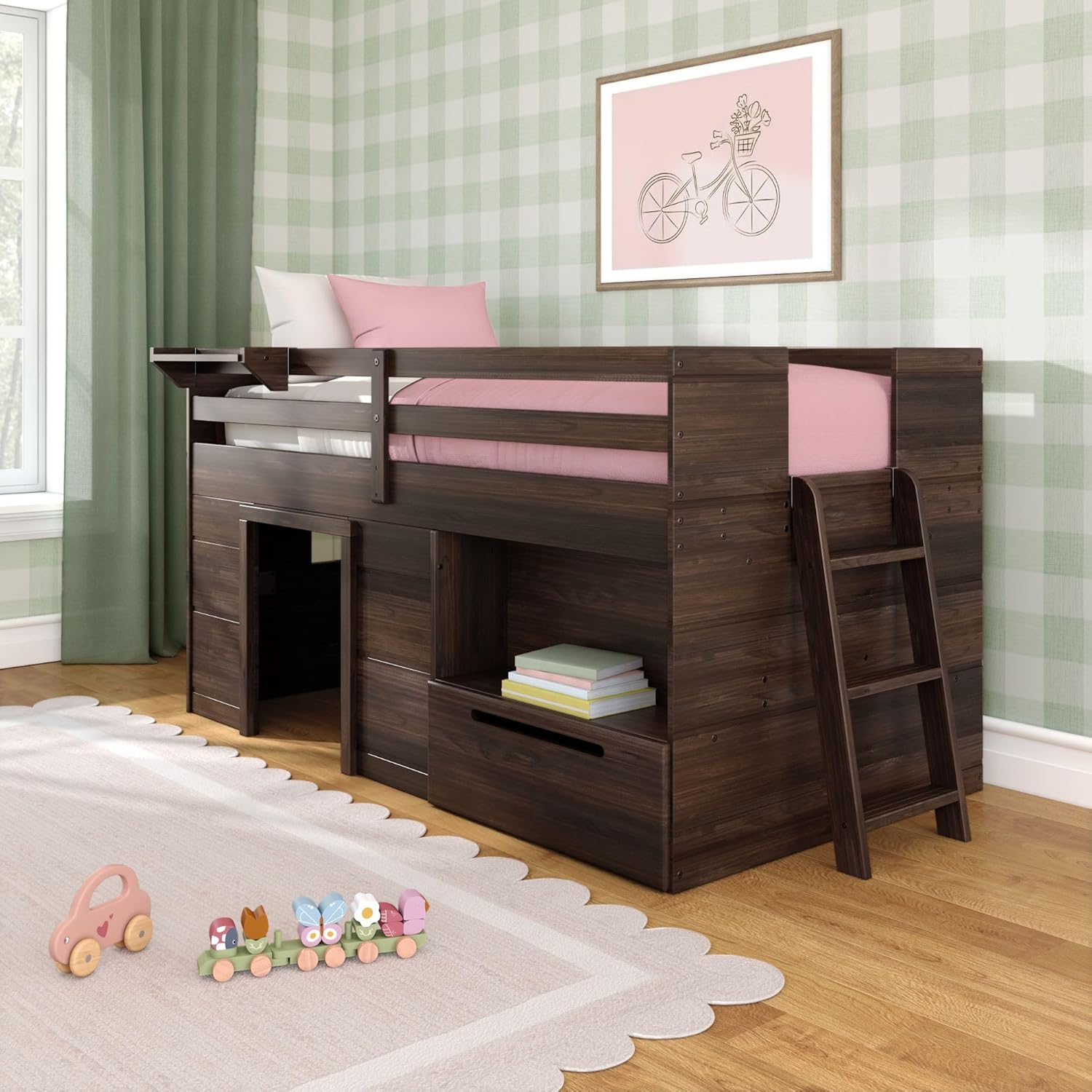
For a smaller version, see full size loft beds and twin over twin loft beds. If the ceiling is the constraint, low loft beds or a murphy bed. For floor-level storage instead, platform beds with storage and bed frames with drawers underneath. Sizing is in queen bed frames.
Questions we get asked
What weight rating does a queen loft bed need?
Six hundred pounds or more. A queen mattress plus two adults plus bedding is 385 to 555 lb of static load.
How thick should the posts be?
Two and a half to 4 inches square in solid hardwood. Under 2 inches, a six-foot post flexes when someone climbs.
Does it need a centre support?
Yes — 60 inches of slat span dips without one. On a loft it has to be a deep centre rail or a steel deck, because a leg to the floor would land in the bay.
How high should the bay be?
Forty-four to 50 inches for a desk or storage, 60 plus if someone will sit on a sofa underneath.
Is making the bed a problem?
At a 60-inch deck, yes — changing a queen duvet from a ladder is the most common regret and it is not in any specification.
Can I use a thick memory foam mattress?
Check the guard rail height and the weight rating together. A queen memory foam mattress is at the heavy end, around 130 lb, and it eats into both.