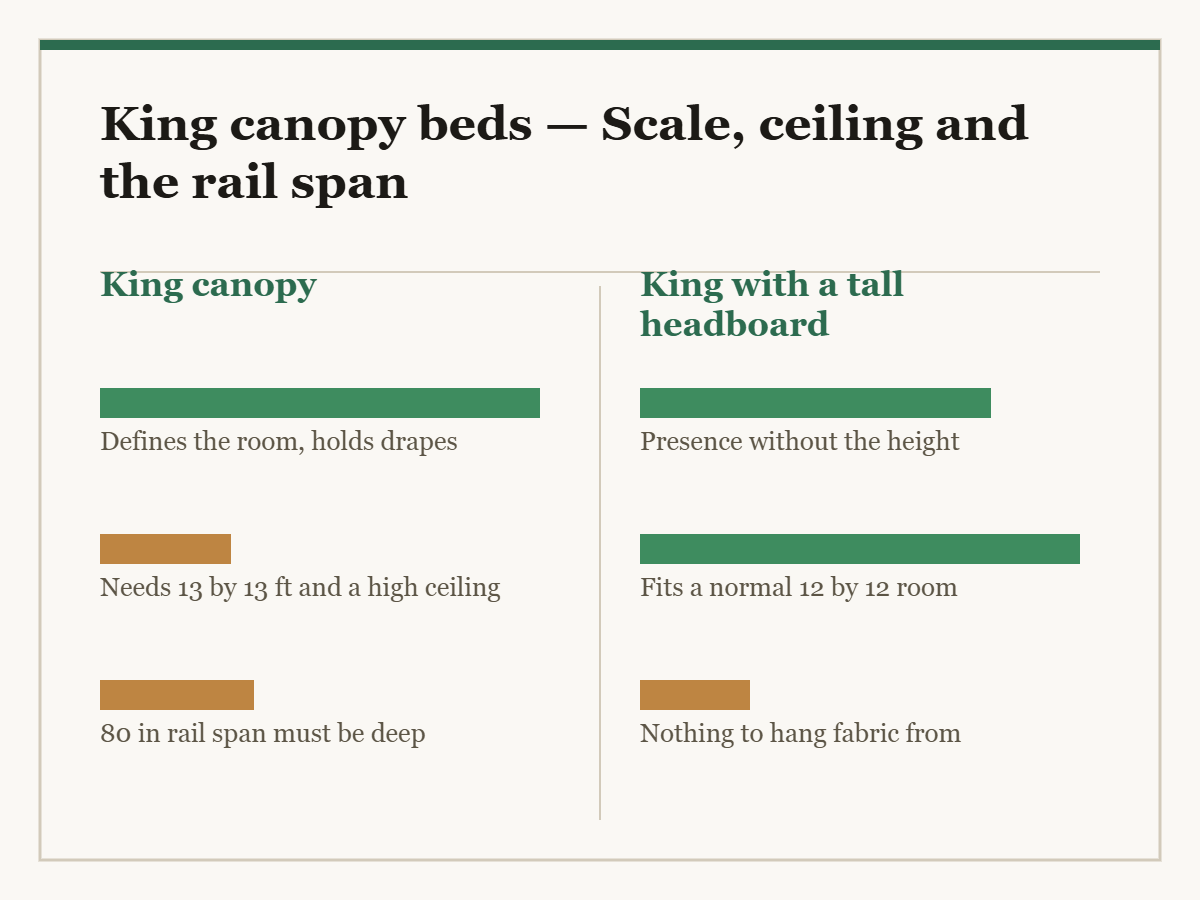
King canopy beds — Scale, ceiling and the rail span
The Wooden Stars is a participant in the Amazon Services LLC Associates Program. We may earn a commission when you buy through links on our site, at no extra cost to you.
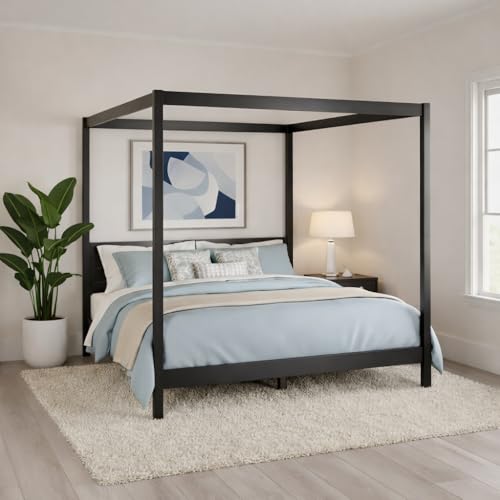
A king canopy bed is the largest piece of furniture most houses will ever contain. Seventy-six inches wide, eighty-six deep with the frame, and up to seven and a half feet tall — it is not a bed with posts, it is a structure that happens to hold a mattress.
At that scale two things stop being details. The canopy rails span a long way unsupported, and the room has to be big enough that the bed does not simply become the room.
A king canopy occupies about 82 × 86 inches of floor and stands 82 to 90 inches tall. The room wants to be at least 13 × 13 feet to leave 24 inches of walkway on both sides and 30 at the foot. The engineering point specific to king: the side canopy rails span 80 inches unsupported, so they need real depth — 3 inches or more — or they visibly bow. Posts want to be 3 to 4 inches square. And a king needs centre support under the mattress as well; 76 inches of slat span sags without it. Allow 6 inches of clear air above the top rail.
The room, before the bed
This is the part worth settling first, because a king canopy in a room that is slightly too small is not a bed you enjoy.
- Floor footprint: about 82 × 86 inches, which is 6 feet 10 by 7 feet 2.
- Walkway each side: 24 inches minimum, 30 comfortable.
- At the foot: 30 inches if it is a route, 36 if there is a chest of drawers there.
Add those and the room wants 13 feet wide by 13 deep as a minimum. In a 12 × 12 room you get 19 inches each side, which is a squeeze past a post at head height.
The height matters differently from a queen canopy: at 82 to 90 inches the bed reads as architecture. In a room with a 96-inch ceiling it fills the volume, which some people want and some discover they do not.
The rail span, which is the king-specific problem
On a twin or a full canopy, the top side rails span 75 to 80 inches and carry almost nothing. On a king they span the same 80 inches and carry the same nothing — but the rail is now being asked to hold the two posts at each side parallel across a wider bed, and any fabric hung on it loads the middle of that span.
What to look for:
Rail depth of 3 inches or more. A shallow rail over 80 inches sags under its own weight, visibly, and hanging anything makes it worse.
A centre cross member across the canopy, tying the two side rails together partway along. Not universal and very effective.
Bolted corners at every top joint. The canopy on a king is doing real work holding four posts in a rectangle, and a dry-fitted corner lets the whole frame lozenge.
| Measure | Typical | Note |
|---|---|---|
| Mattress | 76 × 80 in | Standard king, not California king |
| Floor footprint | 80 to 84 × 84 to 88 in | Posts sit outside the mattress |
| Overall height | 82 to 90 in | Allow 6 in above the top rail |
| Post section | 2.5 to 4 in | 3 in or more at king width |
| Canopy rail depth | 2 to 4 in | 3 in or more over an 80 in span |
| Room needed | 13 × 13 ft | For 30 in walkways |
| Canopy load rating | 10 to 25 lb | Check before hanging drapes |
Under the mattress, which a king makes harder
Seventy-six inches of slat span is the widest in ordinary furniture, and it will dip without support.
A centre rail with two legs to the floor is the standard answer at king width — one leg is not enough across 80 inches of length.
Slat spacing under 3 inches for foam, 4 for sprung. On a king the slats are long, so their own section matters: thin slats over 76 inches bow even between supports.
Both are covered in bed frame centre support legs and bed slat replacement and spacing. Mattress fit at king — including the difference from California king — is in king bed frame and mattress fit and cal king bed frames.
What you can hang from it
The canopy looks like it could hold anything. Most cannot.
Light curtains spread along a rail: fine on any canopy.
Full drapes on all four sides at king scale is a lot of fabric — 15 to 30 lb — concentrated at whatever the fabric attaches to. Check the stated rating, and spread the load with a rod rather than tying at points.
Anything rigid — a light fitting, a shelf — is outside what these frames are designed for.
One practical note: fabric on a king canopy means the bed is now a fabric box you have to get into. Leave the foot open unless you are certain.
Timber at this scale
A 3-inch-square post seven and a half feet long is a substantial piece of timber, and at king width there are four of them plus four long rails. Weight matters as much as strength.
Solid hardwood — oak, acacia, birch, rubberwood — gives the stiffness at a section that still looks right. An oak king canopy is genuinely heavy: 200 to 300 lb of frame.
Pine at king canopy scale wants a larger section for the same stiffness, which changes the proportions, and the joints want annual attention.
Veneered MDF posts appear even at this price level. They are the heaviest option and the one that does not hold a bolt under a sideways load, which is the load a canopy applies — what engineered wood actually is.
Species comparison is in the hardwood hardness scale, walnut against oak and the best wood for furniture.
Assembly, which is a two-person job at minimum
- The posts are 82 to 90 inches and rigid. Measure the diagonal of your stairwell before ordering; this is where king canopies stop.
- It builds upright and you need the room’s full height clear while you work.
- Two people, three is better. Holding an 80-inch rail at seven feet while someone starts a bolt is not a solo task.
- Level before final tightening. A canopy turns a floor dip into a visibly out-of-square rectangle at the top — levelling feet and glides.
- Re-tighten after a month. Every joint. Then annually — why a wooden bed frame squeaks.
With the bed
- Furniture bolts and barrel nuts The fixing that lets a canopy corner be pulled up for decades
- Centre support legs Two of them, across 80 inches of king length
- Levelling feet A canopy shows a floor dip as an out-of-square rectangle overhead
- Curtain rod for a canopy Spreads fabric load along the rail instead of at tie points
What to buy


For the smaller sizes and the general case, see canopy beds. For a king without the height, king size bed frames and wood bed frames in king. For presence from the headboard instead, wall-mounted headboards. Mattress fit is in king bed frame and mattress fit.
Questions we get asked
How big a room does a king canopy bed need?
Thirteen by 13 feet as a minimum, to leave about 30 inches of walkway each side and 34 at the foot.
How tall is it?
Eighty-two to 90 inches. Leave 6 inches of clear air above the top rail, measured to the lowest ceiling fixture.
Why do the canopy rails bow?
They span 80 inches unsupported. A rail under 3 inches deep sags under its own weight, and hanging fabric makes it worse.
Does a king canopy need centre support under the mattress?
Yes, and two legs rather than one — 76 inches of slat span across 80 of length is the widest deck in ordinary furniture.
Can I hang full drapes on all four sides?
Check the rating first. King-scale drapes are 15 to 30 lb, and many canopies are rated for 10 to 25 in total.
Will it fit up my stairs?
The posts are the problem — 82 to 90 inches and rigid. Measure the diagonal at the tightest turn before ordering.