Low loft beds — The height that suits a small child
The Wooden Stars is a participant in the Amazon Services LLC Associates Program. We may earn a commission when you buy through links on our site, at no extra cost to you.
A low loft bed is a loft that has given up half its height on purpose. The deck sits at 30 to 45 inches instead of 55 to 70, which puts the bay underneath at play height rather than desk height and puts the sleeping surface somewhere a small child can get into unaided.
That second point is the real reason to buy one, and it is the one listings talk about least.
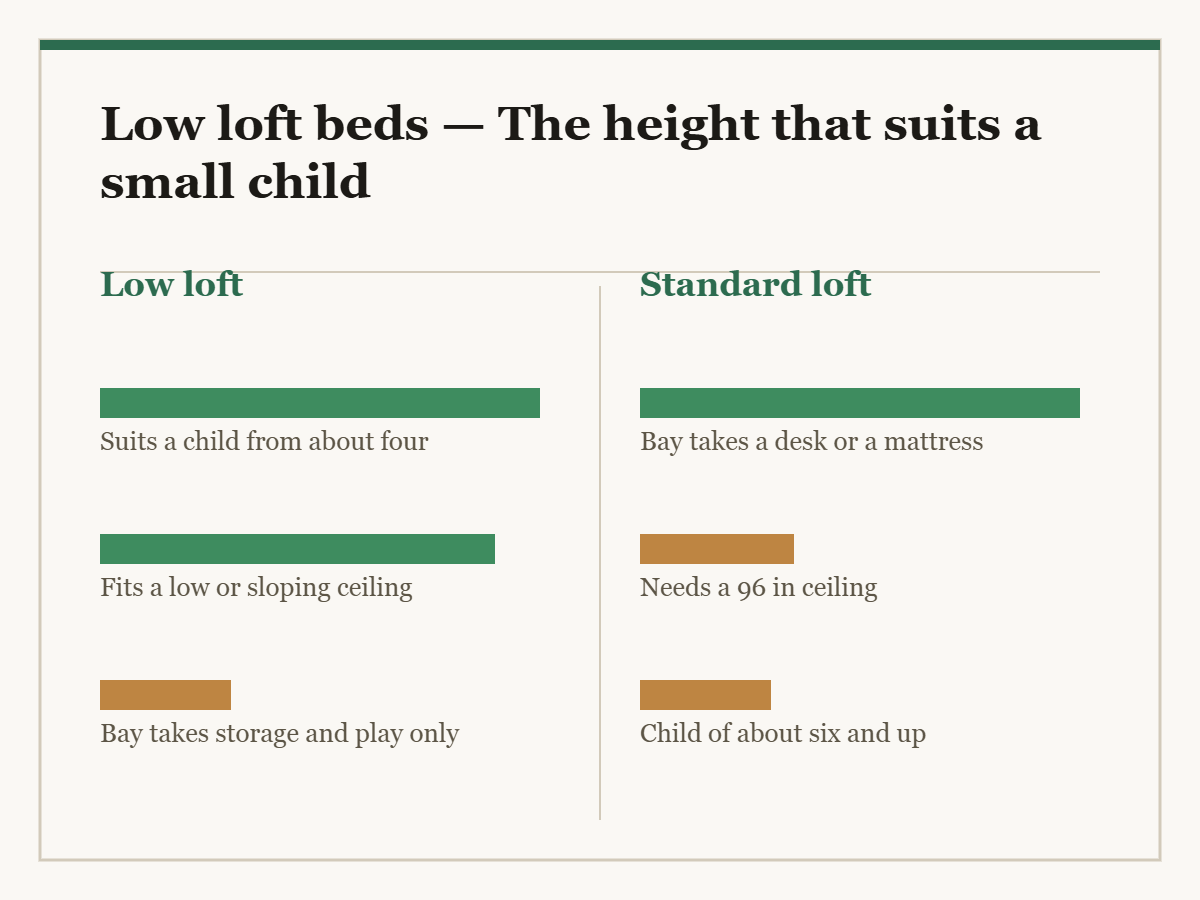
A low loft puts the sleeping deck at 30 to 45 inches from the floor, against 55 to 70 for a standard loft. That gives a clear bay of 22 to 36 inches — enough for toy storage, a play tent or a low desk, and not enough for a mattress with sitting-up room. The gains: a child aged four and up can climb in safely, it fits under a low or sloping ceiling, and the fall height is about half. Guard rails are still required and the 5-inch rule above the mattress still applies. Weight ratings run 200 to 400 lb, and the frame should still bolt rather than screw.
What the height buys you
A child can use it alone
Standard guidance is that a child should be six before sleeping on a full-height top bunk. A low loft at 36 inches is closer to a normal bed in fall height, and most manufacturers rate them from four.
That two-year difference is the whole product. A four-year-old in a low loft has a bed they can climb into and a den underneath; the same child in a standard loft has neither.
It fits a low or sloping ceiling
A standard loft wants 96 inches. A low loft at 40 inches of deck plus 5 of structure plus 6 of mattress puts the sleeping surface at 51, which leaves 30 inches of sitting-up room under a 81-inch ceiling.
In an attic room with a slope, this is often the only loft that works at all. Measure at the bed position, at the low side.
The fall is half
Nothing removes the need for guard rails, and a fall from 36 inches is a different event from a fall from 60.
What actually fits in a 22 to 36-inch bay
Be honest about this before ordering, because it is the thing people are disappointed by.
- Toy storage and boxes. Yes, and this is the main use.
- A play tent or a reading nook. Yes for a small child. A six-year-old sitting up needs about 30 inches.
- A low desk for a young child. A 22-inch desk with 10 inches above it is not usable. At a 36-inch bay with a 22-inch child’s desk you get 14 inches of head room, which works for colouring and not for homework.
- A second mattress. No. A child sitting up on a mattress needs 30 inches of clear height above it, and the mattress itself takes 6.
- A chest of drawers. Depends — measure what you own. Most are 30 to 36 inches tall, so only the tallest bays take one.
| Measure | Low loft | Standard loft |
|---|---|---|
| Deck height | 30 to 45 in | 55 to 70 in |
| Clear bay | 22 to 36 in | 40 to 60 in |
| Sleeping surface | 41 to 56 in | 66 to 81 in |
| Ceiling needed | 78 to 88 in | 96 in or more |
| Age suitable from | About 4 | About 6 |
| What the bay holds | Storage, play, a low desk | Desk, sofa, wardrobe, mattress |
The safety details that do not change
A lower bed is not a bed without rules.
Guard rails on all open sides, standing 5 inches above the mattress surface. Frames state a maximum mattress thickness, usually 6 inches, and exceeding it removes the rail’s function whatever the deck height.
No gap wider than 3.5 inches in the rail, at the ladder opening, or between the rail and the deck.
Anchor it to the wall. A low loft is shorter and it is also lighter, and it is climbed on from the side by children who are not using the ladder.
Nothing soft below. A rug under a loft is sensible; a beanbag directly under the open edge encourages jumping.
Access
At 38 inches, the access is a short climb rather than a ladder, and the good designs treat it that way.
Two or three wide steps, often with storage in them, are the best arrangement at this height. A small child manages them with a hand on the rail.
An angled ladder with flat treads works and projects less.
A vertical ladder with round rungs is overkill at 38 inches and harder for a four-year-old than steps.
Whichever, it should bolt to the frame rather than hook over the rail.
How long it lasts
A low loft has a shorter useful life than a standard one, and it is worth knowing that going in.
A child moves to a full-height loft or a normal bed somewhere around eight to ten, because the bay stops being a den and starts needing to be a desk. Two things extend the life:
- A frame that converts — some low lofts unbolt into a standard low bed, which is genuinely useful. Check that the conversion hardware is included.
- An adjustable deck — rarer, and it means the same frame can be raised as the child grows.
If neither applies, budget for it as a four-to-nine-year piece rather than a twenty-year one, and let that inform how much frame you buy.
What it is made of
Lower does not mean lighter duty. A low loft gets climbed on, jumped on and used as a fort, and the joints see the same cyclic load as any bunk.
Solid hardwood holds a bolt in end grain — the hardwood hardness scale and rubberwood, which is the common one in children’s furniture.
Pine is very common here, works, and is soft enough that the joints want checking twice in the first year.
Particleboard does not hold a screw under cyclic load, and a children’s bed is the most cyclically loaded thing in the house — what engineered wood actually is.
Slat spacing is the same as any bed: under 3 inches for foam — bed slat replacement and spacing. Creaks are joints first: why a wooden bed frame squeaks.
For a child's room
- Anti-tip wall strap A low loft is lighter and gets climbed from the side
- Bunk bed safety rail For an open side, or a frame whose rail sits low with a thick mattress
- T-handle hex key Soft timber joints want checking twice in the first year
- Under-bed storage bins A 22 to 36 inch bay is a storage bay, and bins make it usable
What to buy


For a full-height version, see twin over twin loft beds and full size loft beds. With a desk underneath, loft beds with a desk. For two sleepers, twin over twin bunk beds and wooden bunk beds. A standard child’s bed is in twin bed frames.
Questions we get asked
How high is a low loft bed?
The deck sits at 30 to 45 inches, against 55 to 70 for a standard loft. The sleeping surface lands at 41 to 56.
What age is a low loft suitable from?
Most makers rate them from about four, against six for a full-height top bunk. Check the specific frame.
Can I put a desk underneath?
Only a low child’s desk, and only in the taller bays. A 36-inch bay with a 22-inch desk leaves 14 inches of head room — fine for colouring, not for homework.
Can a second mattress go underneath?
No. A child sitting up on a mattress needs about 30 inches of clear air above it, plus the 6 the mattress takes.
Does it still need guard rails?
Yes, on every open side, standing 5 inches above the mattress surface. Lower is not the same as low enough.
What ceiling height does it need?
Seventy-eight to 88 inches, which is why it is often the only loft that works in an attic room. Measure at the low side of a slope.