Bunk bed vs two twin beds — What 22 square feet costs
The Wooden Stars is a participant in the Amazon Services LLC Associates Program. We may earn a commission when you buy through links on our site, at no extra cost to you.
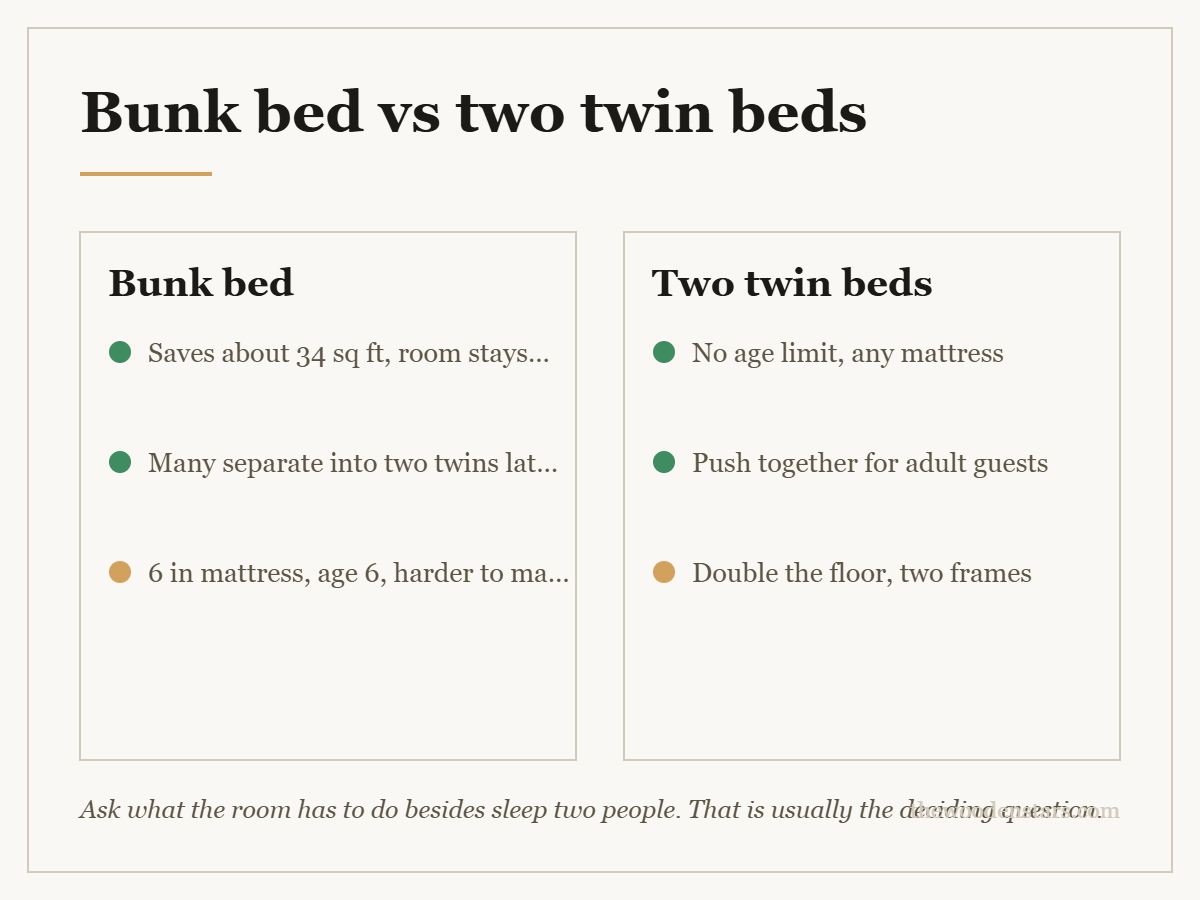
Bunk bed vs two twin beds comes down to one number: a bunk sleeps two people in 22 square feet, two twins need 44 plus a gap between them.
If the room has the floor, two twins win on almost every other count. If it does not, the bunk is the only answer — and there are good reasons it is worth choosing even when both fit.
Two twin beds side by side occupy about 44 square feet plus a 24-inch walking gap, so call it 60 in practice. A bunk does the same job in 22. Beyond floor area, two twins win on mattress thickness (no rail cap), bed-making, safety (no age limit, nothing to fall from) and flexibility — they can be pushed together into a king-ish surface for adult guests. The bunk wins on floor, on keeping the rest of the room free, and on the fact that children usually want one. Many bunks also separate into two twins later, which resolves the argument.
Bunk bed vs two twin beds: the floor arithmetic
A twin mattress is 38 × 75 inches; a frame makes it about 40 × 80, so 22 square feet each.
- Two twins side by side: 80 × 80 inches if touching — 44 square feet. With the 24-inch gap people actually leave, 100 × 80, or 56 square feet.
- Two twins in an L against two walls: more floor again, because neither can be pushed fully into a corner.
- A bunk: 40 × 80 — 22 square feet — plus the ladder’s 14 inches if it is angled.
In a 10 × 10 room — 100 square feet — two twins with a gap take more than half of it. A bunk takes a fifth.
| Measure | Bunk bed | Two twin beds |
|---|---|---|
| Floor used | 22 sq ft | 44 to 56 sq ft |
| Mattress thickness | Top capped at 6 in | Any |
| Minimum age | 6 for the top bunk | None |
| Bed-making | Awkward up top | Easy |
| Can be joined | No | Yes, into a king-ish surface |
| Separates later | Many models do | Already separate |
| Cost | One frame | Two frames |
| Noise | One sleeper hears the other | Independent |
What two twins are quietly better at
Mattress choice. No guard rail means no 6-inch cap. Both sleepers get whatever thickness suits them, which over a decade of use is not a small thing.
Making the beds. Anyone who has changed a fitted sheet on a top bunk at arm’s length knows this one.
Safety. Nothing to fall from, no age rule, no ladder, no anchor strap. In a household with a four-year-old this often decides it — what age a bunk bed is safe for.
Guest flexibility. Push two twins together and you have a sleeping surface close to a king. A bunk cannot do this at all, and for a spare room that occasionally takes a couple it is the whole argument.
Independence. On a bunk, one sleeper feels and hears the other move. Two frames do not share a structure.
What the bunk is better at, beyond floor
Keeping the rest of the room usable. This is the real point and it is not the same as square footage. Thirty-four extra square feet of contiguous floor is a desk and a play area; the same area split into strips between two beds is circulation.
Children want it. Worth saying plainly. A bunk gets used enthusiastically in a way a sensible pair of twins does not.
One frame to buy and build. Often cheaper than two decent twin frames, and one delivery.
It can become two twins. A large share of wooden bunks separate into two standalone beds — see wooden bunk beds. That converts the decision from permanent to provisional, and if it matters to you it is worth confirming before buying, because the ones that do not separate look identical in photographs.
The middle options
Two answers sit between them and are often better than either.
A trundle. One bed in the room, the second stored under it and pulled out for the nights it is needed. No ceiling demand, no age limit, and the floor is free most of the time — trundle bed against bunk bed.
An L-shaped or low bunk. A low bunk keeps the fall distance down; an L-shaped arrangement puts the lower bed at right angles and opens a corner. Both are in low loft beds.
If you choose two twins, buy them as a pair
Two frames that will be pushed together occasionally need to match in deck height — a difference of more than an inch makes a ridge nobody can sleep across. Check the deck figure, not the headboard height.
Details in twin bed frames. And for a pair of twins in a guest room, a twin daybed each is worth a look — it gives the room a use during the day, which is what two plain twins cannot do.
Either arrangement
- Bed connector strap Holds two twins together as one surface for adult guests
- T-handle hex key A bunk frame wants its joints pulled up annually
- Anti-tip wall strap For the bunk, and the fixing that fails silently
- Under-bed storage bins Recovers the floor a twin frame is sitting on
What to buy

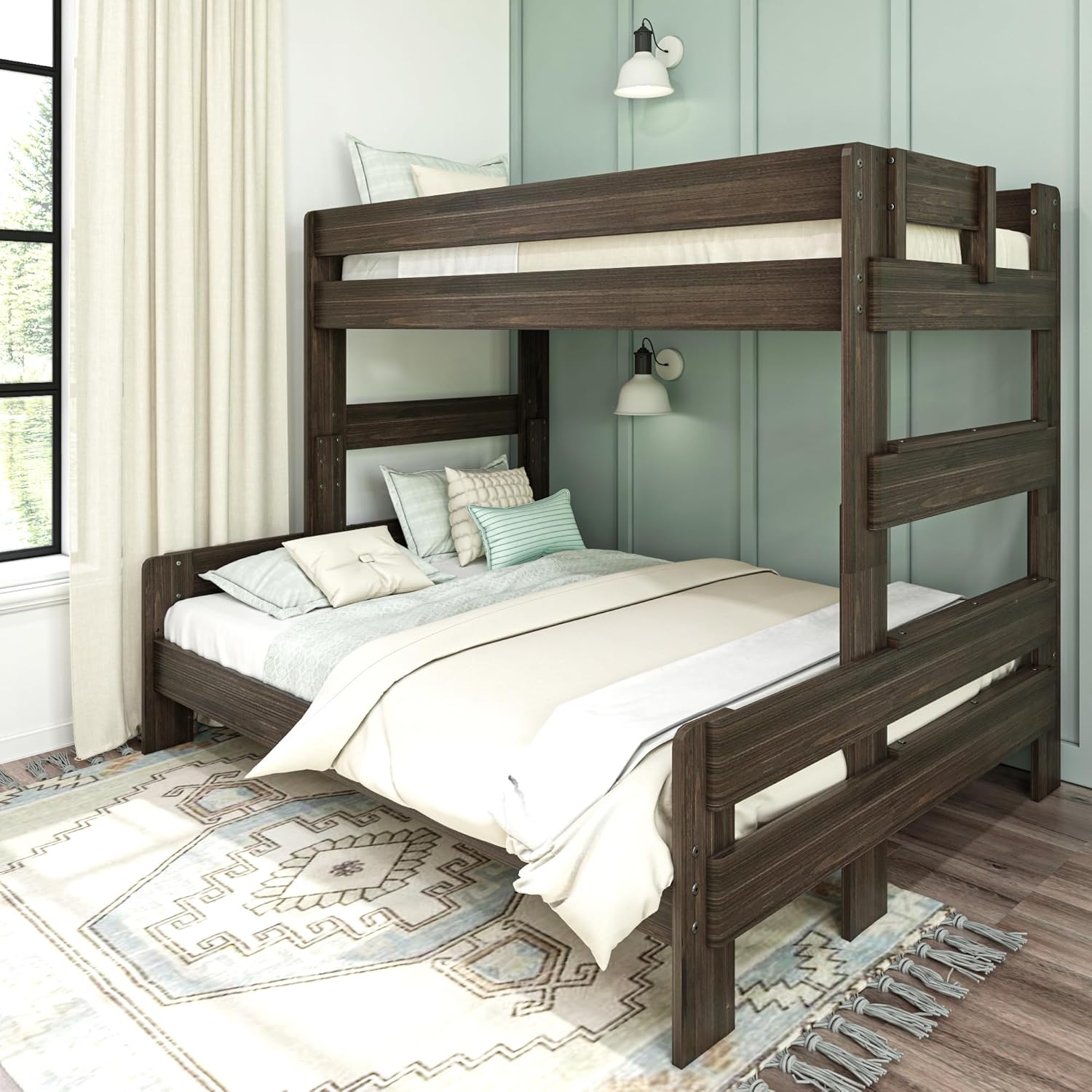


For bunks, see wooden bunk beds, twin over twin and twin over full. For single frames, twin bed frames. For the middle routes, daybeds with a trundle and low loft beds.
Questions we get asked
How much space does a bunk bed save over two twin beds?
About 34 square feet in practice — 22 against 56 once you allow a walking gap between the two twins.
Are two twin beds safer than a bunk?
Yes. There is nothing to fall from, no ladder, no age limit and no anchor strap to check.
Can two twin beds be pushed together?
Yes, into a surface close to a king. Match the deck heights — more than an inch of difference leaves a ridge.
Does a bunk bed separate into two beds?
Many wooden models do, and many do not. Confirm it before buying, because they look identical in photographs.
Which is cheaper?
Usually the bunk, since it is one frame and one delivery rather than two decent twin frames.
Which is better for a guest room?
Two twins, because they can be joined for a couple. A bunk cannot do that at all.