Dining Table Top Cracking at the Seams? Check the Fasteners First
The Wooden Stars is a participant in the Amazon Services LLC Associates Program. We may earn a commission when you buy through links on our site, at no extra cost to you.
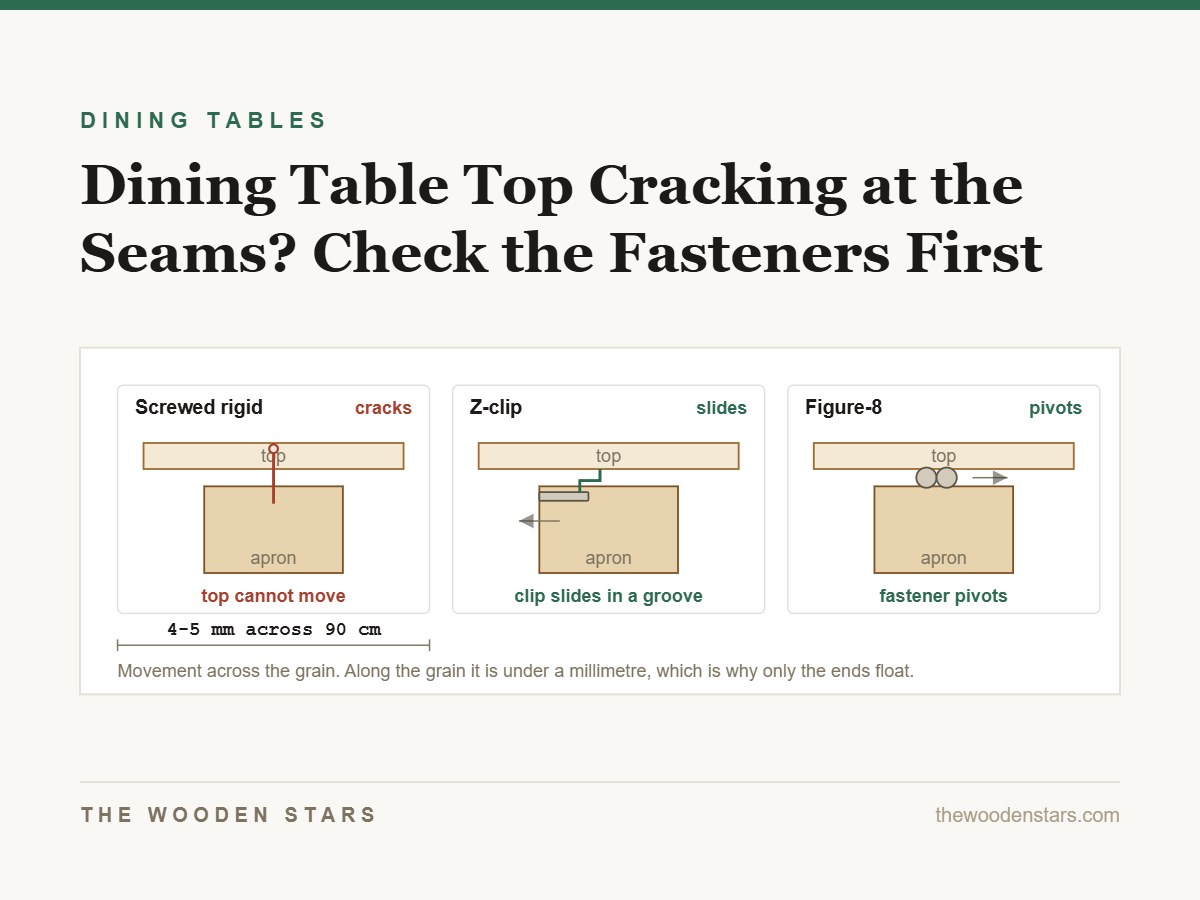
A solid wood dining table that develops a crack, or whose glue lines open into visible seams, is almost never a table made from bad wood. It is a table whose top was screwed down rigidly. Wood moves across the grain with the seasons — a 90 cm wide oak top moves several millimetres between a humid August and a dry February — and if the top cannot move, something has to give. Usually a glue line.
The part responsible costs about the same as a coffee, is invisible once fitted, and is the most under-appreciated component in furniture.
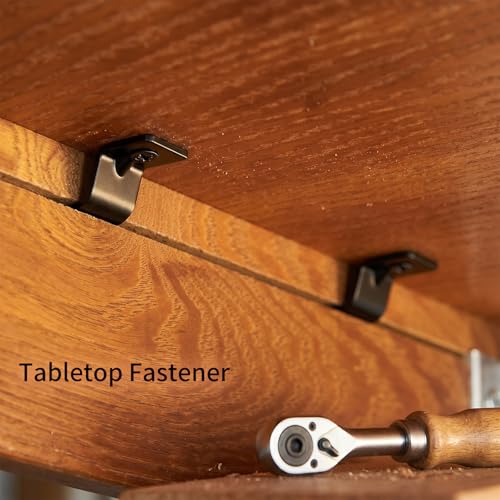
Solid wood tops must be attached with fasteners that let the top slide across its width — Z-clips (which sit in a groove and float) or figure-8 fasteners (which pivot). A top screwed directly through the apron cannot move, so seasonal movement opens the glue lines instead. Replacing the fixings will not close an existing crack, but it stops the next one.
Start here: Z-clips are the fix if your apron already has the groove, and most aprons do even when the maker then used screws anyway.
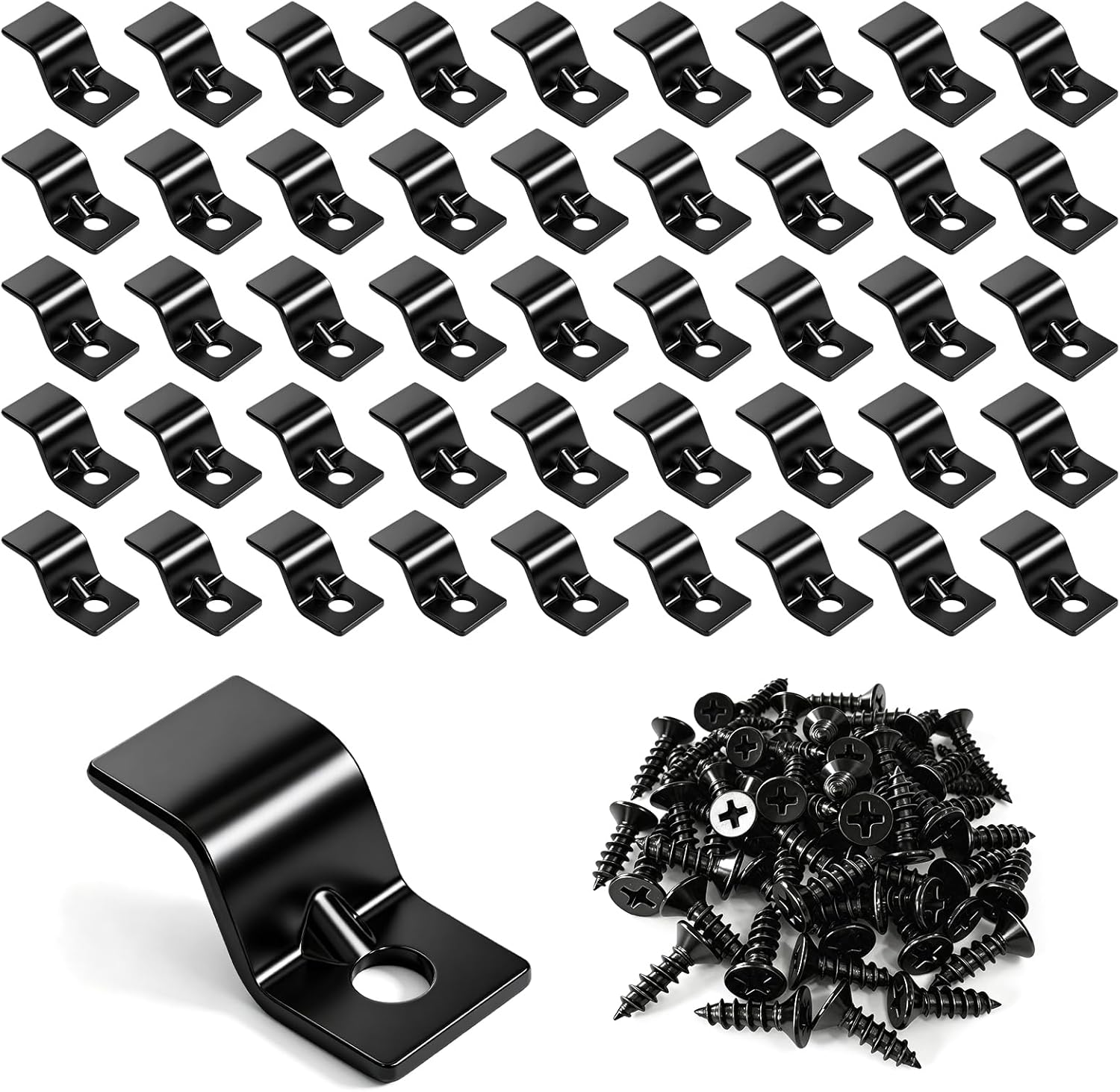
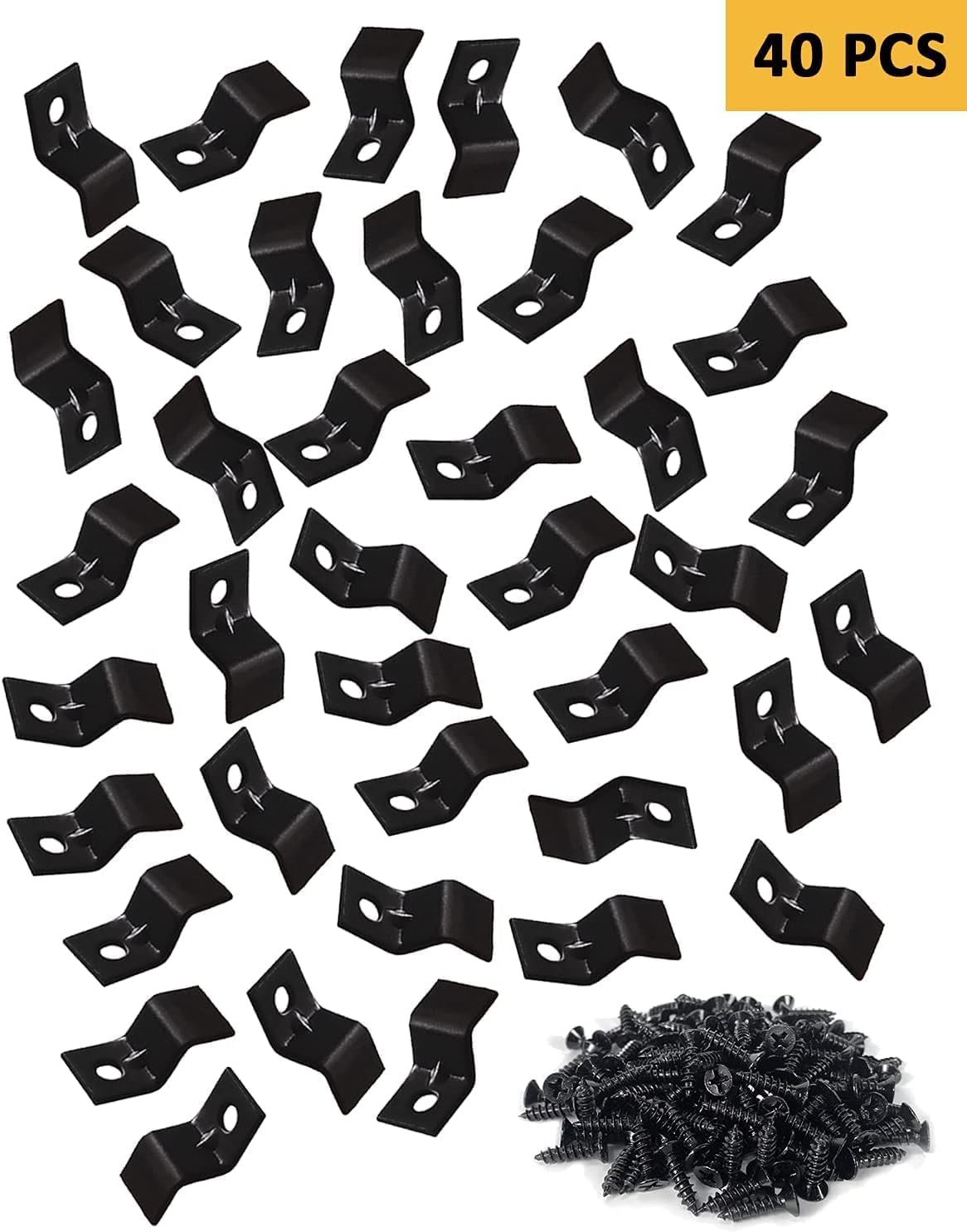
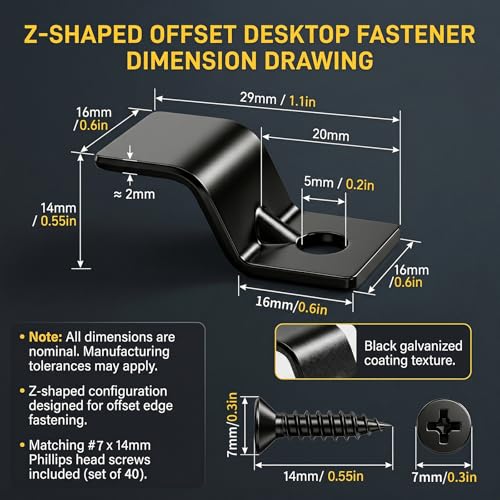
Prime Table Top Fasteners, Z Clips for Table Tops 40 Packs (Black)


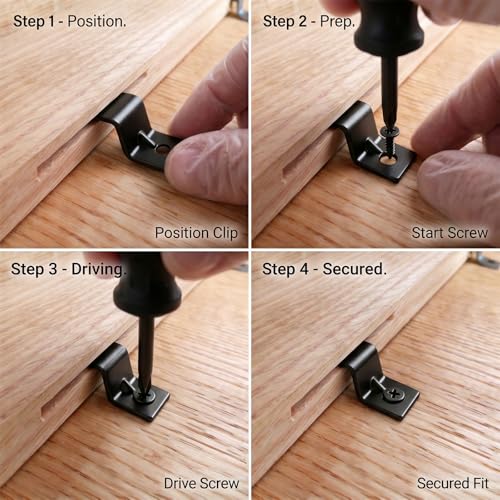
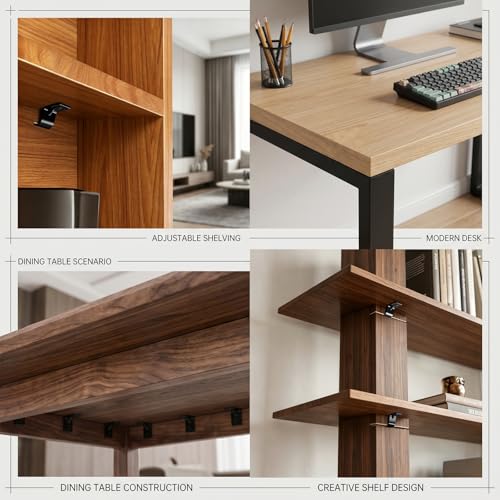
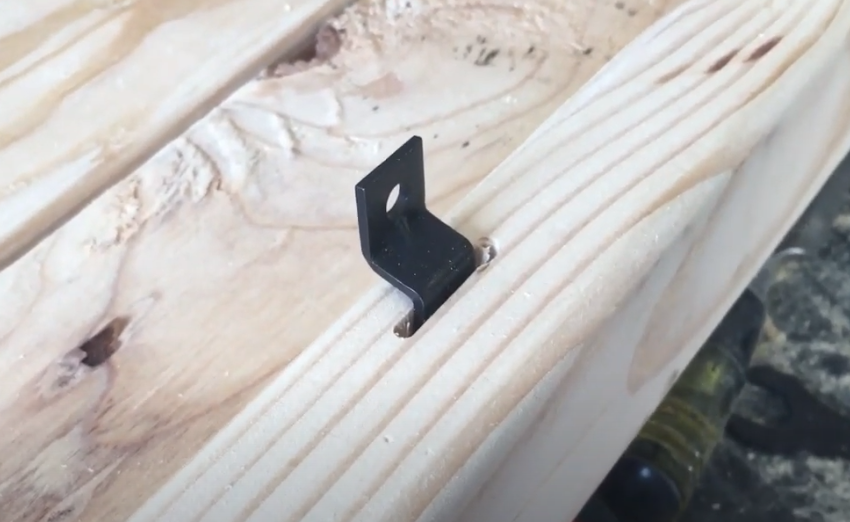
Why wood cracks when you hold it still
Wood barely changes length along the grain and changes noticeably across it. The rough figures worth carrying in your head:
| Species | Typical movement | Notes |
|---|---|---|
| White oak | 4–5 mm | Unusually stable for its density |
| Red oak | 5–6 mm | Slightly more movement, more open pores |
| Hard maple | 5–6 mm | Pale, close grain, shows the gap clearly |
| Walnut | 3–4 mm | One of the most stable furniture hardwoods |
| Beech | 6–7 mm | Moves a lot; common on budget tables |
| Acacia | 4–5 mm | Varies with how well it was dried |
| Pine | 4–6 mm | Soft, so it also compresses instead of splitting |
Those numbers are the difference between summer and winter in a normally heated home. A rigid fixing has to absorb every millimetre, and it cannot — so the weakest glue line does, and opens.
This is also why the crack usually appears in winter. The top shrinks, and shrinkage under restraint pulls joints apart. A crack that appears in a dry January in a house with the heating on is not a defect; it is physics meeting a bad fixing.
Check what is holding your top down
Turn the table on its side — do not turn it upside down onto the top — and look at where the top meets the apron or the base. There are four things you might find.
- Z-clips in a groove. A small steel Z sits in a saw-kerf inside the apron and screws to the underside of the top. Correct. The clip slides in the groove as the top moves.
- Figure-8 fasteners. A steel figure of eight, one loop recessed into the apron, the other screwed to the top. Correct. The fastener pivots.
- Elongated slots in a wooden or metal cleat, with the screw in the middle. Correct, provided the screw is not done up tight.
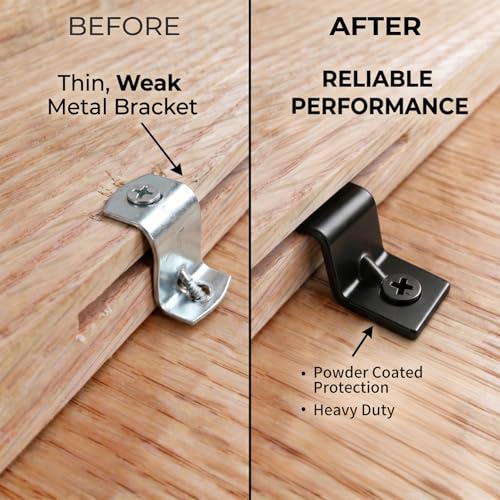
- Screws straight through into the top. Wrong. This is the cause. It is also extremely common on imported furniture, including expensive imported furniture.
There is a fifth, worse case: screws through a solid wood cleat glued across the grain, or breadboard ends glued solid along their whole length. Both hold the top’s width fixed at a point and both crack tops reliably. Breadboard ends are supposed to be pinned in elongated holes with only the centre glued.
The fix
1. Free the top
Remove the offending screws. If they were driven into a top that is now under stress, you may hear the top relax as they come out. That is a good sign.
2. Choose Z-clips or figure-8s
Z-clips need a groove in the inside face of the apron, cut with a biscuit joiner or a router — about 10 mm down from the top edge. If your apron already has that groove (many do, even when the maker then used screws anyway), this is a ten-minute job.
Figure-8 fasteners need a shallow recess drilled with a Forstner bit at the top edge of the apron, so they sit flush. No groove required, which makes them the better choice on a table with no apron groove or on a thick trestle base.
| Base type | Use | Spacing |
|---|---|---|
| Four legs with an apron, groove present | Z-clips | Every 25–30 cm, all four sides |
| Four legs with an apron, no groove | Figure-8 fasteners | Every 25–30 cm |
| Trestle base | Figure-8s or slotted cleats | 2 per trestle top rail |
| Pedestal | Slotted metal plate | Follow the plate; centre screw snug, outer screws loose |
| Bench or console, narrow top | Figure-8s | One near each end per side |
3. Let the ends float
Along the two ends of the table (across the width of the boards) the fixing must be free to slide. Along the two long sides (along the grain) movement is negligible and fixings there can be snug. Getting this backwards — snug at the ends, loose at the sides — achieves nothing.
4. Do not fill the crack rigidly
An open seam in winter will close, partially or fully, in summer. Fill it hard in February and it will bulge or split elsewhere in July. If the gap is small, leave it and watch it through one full year. If it is genuinely permanent — the boards have separated for good — the real repair is to take the top apart at that glue line, re-joint the edges and re-glue, which is a workshop job.
What this repair actually takes
- Table top Z-clips with screws For an apron that already has a groove On Amazon →
- Z-clips, 40 pack Enough for a large table plus spares On Amazon →
- Figure-8 fasteners, 30 pack No groove needed, just a shallow recess On Amazon →
- Forstner bit to suit the fastener Cuts the flat recess a figure-8 needs
- Biscuit joiner or a router with a slot cutter Only if you are cutting a new Z-clip groove
What to buy
Z-clips if there is a groove in the apron; figure-8 fasteners if there is not, since those only need a shallow recess.

Cracks that are not a fastener problem
A check at the very end of a board — a short split running in from the end grain — is a drying defect from before the table was built. It is stable and cosmetic. Fill with epoxy if it bothers you.
A crack running through a knot is the knot moving differently from the wood around it. Also stable, also cosmetic, and a candidate for a bow-tie inlay if you want it to look deliberate.
A cupped top — the width has curled rather than cracked — is a moisture problem, not a fastening problem: one face is sealed and the other is not. The fix is to finish the underside, which our guide to choosing a table top finish covers.
A top that has split right along a glue line, cleanly, with no wood torn means the glue joint failed rather than the wood. That is repairable properly — clean both faces and re-glue, as in our guide to re-gluing a loose joint.
Questions we get asked
Will replacing the fasteners close the crack I already have?
Partly, sometimes, and only over a season. Freeing the top lets it move back toward its natural width, and a gap opened by restraint often narrows. What it definitely does is stop the crack getting worse and stop the next one appearing. Do not expect it to disappear.
How many fasteners does a dining table need?
One every 25 to 30 cm around the perimeter, so a 180 × 90 cm top wants roughly twelve to fourteen. Fewer than that and the load per fastener rises enough to tear the screw out of the underside; many more and you are just doing extra work.
Is a metal apron or a steel base better, since metal does not move?
It is worse, not better, unless it is slotted. Metal not moving is exactly the problem — the wood still moves and now has something completely unyielding to fight. Steel bases for solid tops should have elongated slots, and plenty do not.
My table is engineered wood or veneer. Do I need this?
Much less. Plywood and MDF move a fraction of what solid wood does, which is precisely why factory furniture is often screwed down rigidly and gets away with it. If your top is a veneered panel, rigid fixings are fine. Check which you have before you spend an afternoon on it — the edge test on our wood types hub takes seconds.
Should I keep the table away from the radiator?
Yes, and away from underfloor heating and air-conditioning vents. Rapid local humidity change is worse than a low humidity level, because it puts one part of the top under stress relative to the rest. A room humidity between 40 and 55 per cent, reasonably stable, is what solid wood furniture is designed for.