Full bed frames — 54 × 75 inches, and who it actually suits
The Wooden Stars is a participant in the Amazon Services LLC Associates Program. We may earn a commission when you buy through links on our site, at no extra cost to you.
A full mattress is 54 inches wide and 75 inches long. It is also called a double, and the two words mean exactly the same thing — which is the first confusion to clear, because listings use both, sometimes in the same title.
The full is the size people dismiss without measuring. It is 16 inches wider than a twin, 6 inches narrower than a queen, and — the part that matters most — five inches shorter than either a queen or a twin XL.
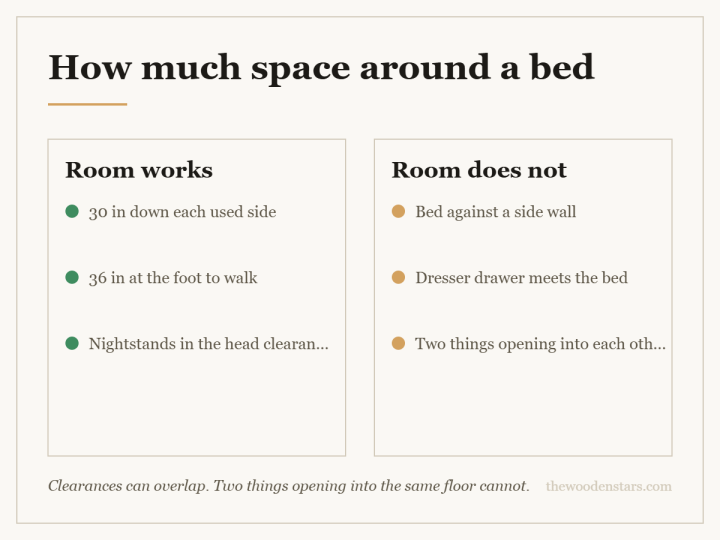
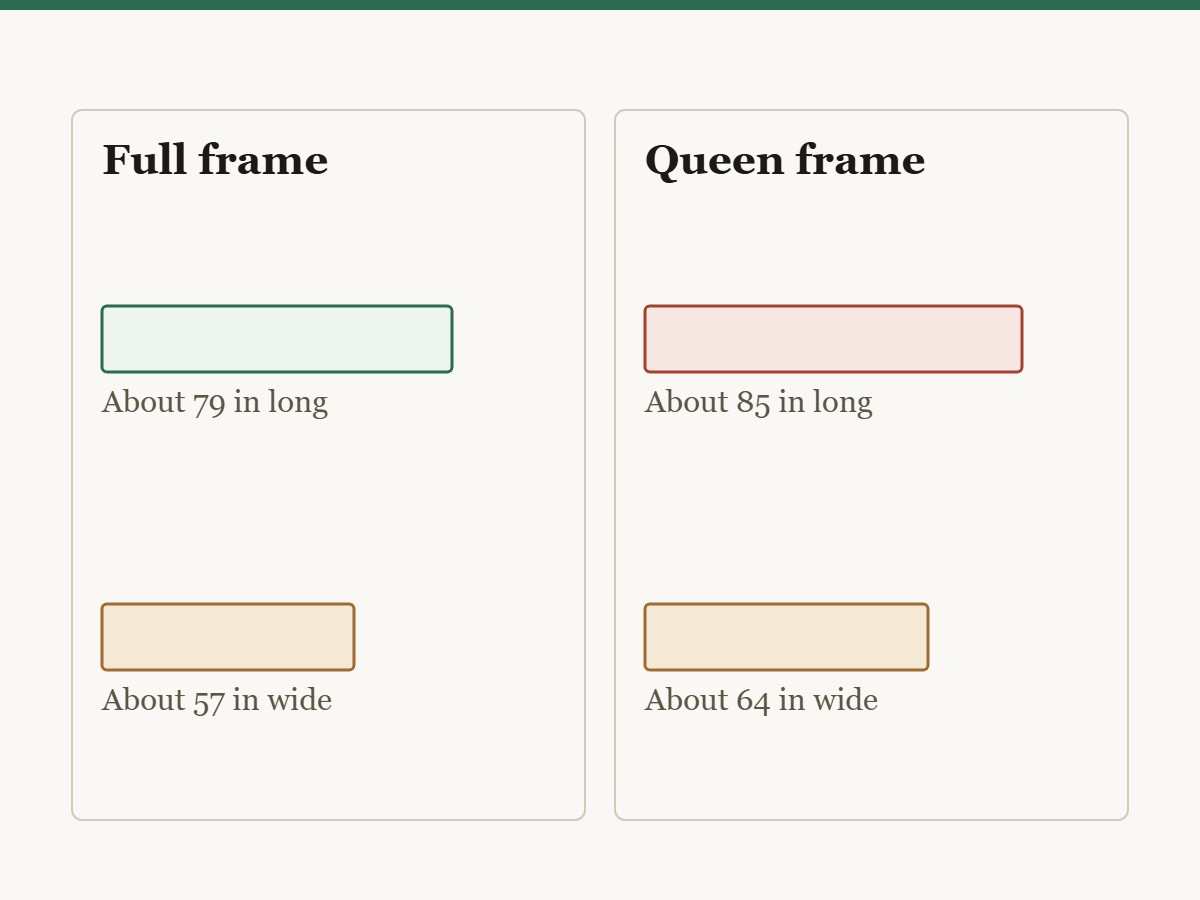
A full mattress is 54 × 75 inches; the frame is typically 57 to 60 inches wide and 78 to 81 inches long. It needs a centre rail with one leg to the floor. Allow 24 to 30 inches of walkway, so it suits a room about 9 × 10 feet. For one adult it is generous; for two it gives 27 inches each, narrower than a single bed. The strongest practical case for a full is a room where 80 inches of length does not exist — the full is 75, and that five-inch difference decides plenty of rooms.
The numbers, and where the five inches matter
| Size | Mattress | Width per sleeper if two | Frame length |
|---|---|---|---|
| Twin | 38 × 75 in | Not intended for two | About 79 in |
| Full (double) | 54 × 75 in | 27 in each | About 79 in |
| Queen | 60 × 80 in | 30 in each | About 85 in |
| King | 76 × 80 in | 38 in each | About 85 in |
Read the last column. Twin and full are both 75 inches of mattress; queen and king are both 80. The length changes exactly once in the whole range.
So a room with a fitted wardrobe, a radiator, a chimney breast or a doorway 80 inches out from the wall cannot take a queen and can take a full — which is only six inches narrower. Anyone comparing 54 against 60 concludes the full is a compromise. In a length-limited room it is not a compromise; it is the biggest bed that fits.
Who the size actually suits
- One adult who spreads out. Fifty-four inches to yourself is generous, in a footprint six inches narrower than a queen. This is the strongest case for the size.
- A teenager. Outgrown a twin, does not need a queen, and the room usually cannot take one anyway.
- A guest room for occasional couples. Two nights a year on a full is fine. Two nights a month is not.
- A length-limited room. The geometry case above, and the reason to measure before dismissing the size.
Who it does not suit is two adults sharing regularly. Twenty-seven inches each is narrower than the single beds most people grew up in, and the six extra inches of a queen is the difference people notice. The full comparison is in full against queen.
What to check on the frame
One centre leg, not none
At 54 inches the slats need help. A full requires a centre rail head to foot with at least one leg to the floor — fewer than a queen, more than a twin. Frames that skip it flex under every movement and work their joints loose within a year.
Slats
Twelve to fourteen is typical. Gaps under 3 inches for most foam and hybrid mattresses; that limit is usually written into the mattress warranty. Check the slats sit captive in a groove rather than resting loose on a ledge.
Joints
Bolts into threaded metal inserts, not wood screws into end grain. A frame is designed to be dismantled, and end-grain screws hold the first time, hold less the second, and strip the third.
Material where the load goes
Solid timber and plywood hold a fixing indefinitely; particleboard enlarges its hole and cannot be cleanly repaired. That matters at the rails and posts specifically. Panel elsewhere is fine — the vocabulary on the listing is decoded in what engineered wood actually is.
Height, calculated before you order
Deck height plus mattress thickness gives the height you sit on. Around 22 to 26 inches suits most adults. A 12-inch platform frame under a 10-inch mattress gives 22, which is fine; under a 14-inch mattress it gives 26, which is at the top of comfortable.
For a teenager’s room, a slightly higher frame buys usable storage underneath, which a full-size bed in a small room will need.
Full or double, and other naming traps
Full and double are the same size. Both mean 54 × 75 inches in the US.
Full XL is 54 × 80 — same width, queen length. It is rare, mostly appears in dormitory furniture, and a standard full frame will not take it.
UK and European doubles differ. A UK double is 135 × 190 cm, which is about 53 × 75 inches — close but not identical, and bedding does not swap cleanly. Buy the mattress and frame in the same market.
Platform or box spring
Most full frames sold now are platform frames with slats, correct for foam and hybrid mattresses. Some assume a box spring and have only a perimeter rail — and they photograph identically.
Putting a foam mattress on a box-spring frame without the box spring leaves the middle unsupported, and the sag is permanent. If the listing states a required foundation, believe it.
For assembly and after
- Hex key set Better than the folded key in the box; saves rounded bolt heads
- Threadlocker On the rail bolts and the centre-leg fixing, before the squeak starts
- Felt pads Under all legs including the centre one
- Tape measure 75 in of length is the number that decides full against queen
What to buy


If the room takes the extra five inches of length, price the queen too. If it does not, the full is the answer and this comparison explains why. The four checks that apply at every size are in wood bed frames.
Questions we get asked
What are the dimensions of a full bed frame?
The mattress is 54 × 75 inches; the frame is usually 57 to 60 inches wide and 78 to 81 inches long.
Is a full bed the same as a double?
Yes. Full and double are two names for the same 54 × 75-inch mattress, and listings use both.
Is a full bed big enough for two adults?
For occasional use, yes — 27 inches each. For regular sharing it is narrower than a single bed apiece, and a queen is the size that fixes it.
Does a full bed frame need a centre support?
Yes, one centre rail with at least one leg to the floor. Only a twin gets away without it.
Can I put a queen mattress on a full frame?
No — six inches too wide and five too long. Frames are built around one mattress size.
What size room fits a full bed?
About 9 × 10 feet with a walkway on both sides. In a shorter room, the full’s 75-inch length is exactly why it is chosen over a queen.