Twin daybeds — Sofa by day, bed by night, badly or well
The Wooden Stars is a participant in the Amazon Services LLC Associates Program. We may earn a commission when you buy through links on our site, at no extra cost to you.
A daybed is a twin bed with three sides. It stands against a wall like a sofa, takes a standard twin mattress, and in a spare room it is the only piece of furniture that is genuinely two things rather than a compromise between them.
Where it goes wrong is seating. A bed is 38 inches deep and a sofa seat is 21, so a daybed used as a sofa is either full of cushions or you sit on the front edge of a mattress with nothing behind your back.
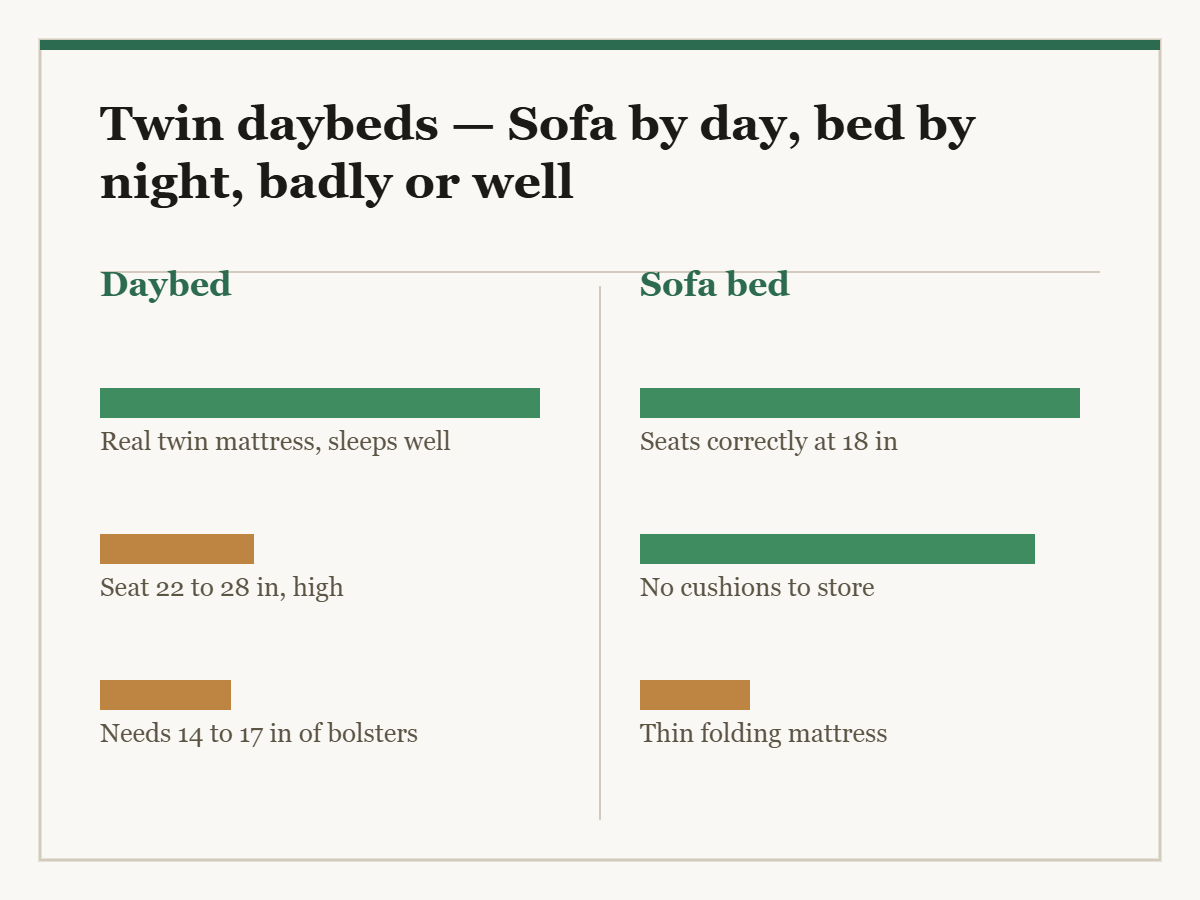
A twin daybed takes a standard 38 × 75 inch mattress and stands about 80 inches long and 42 deep with the frame. Seat height with the mattress on is usually 22 to 26 inches — higher than a sofa, which sits at 17 to 19 — so it perches rather than lounges. Two things decide whether it works as seating: mattress thickness, where 6 to 8 inches keeps the seat height sensible and 12 makes it a perch, and bolster cushions, because 38 inches of depth needs 14 to 17 inches of cushion at the back before it seats like a sofa. Check whether the support is slats or a wire grid — a grid sags.
Seat height, and the mattress that sets it
This is the number that decides whether the daybed becomes a sofa or stays a bed with a back.
A daybed deck sits at 14 to 18 inches. Add the mattress:
- 6-inch mattress: seat at 20 to 24 inches. Close to a dining chair — you sit upright, feet flat, and it works as seating.
- 8-inch mattress: 22 to 26. Still workable.
- 12-inch mattress: 26 to 30. That is bar-stool height. It sleeps beautifully and it is not a sofa.
A sofa seat is 17 to 19 inches, so a daybed will always sit higher. The choice is how much higher, and it is made entirely by the mattress you buy.
If the daybed is mainly for guests and occasionally for sitting, buy the thicker mattress. If it is a sofa that sometimes sleeps someone, buy 6 to 8 inches and put a good topper on it for the nights it is used.
Depth, and the cushion problem
A twin mattress is 38 inches deep. A sofa seat is 21 to 24.
So sitting back against the daybed’s back rail puts you 38 inches from the front edge — your knees are nowhere near the edge and your feet are off the floor. The fix is bolsters, and the amount needed surprises people: 14 to 17 inches of cushion depth at the back, which is two large bolsters or a row of firm cushions.
Two practical points:
- Buy firm cushions. Soft ones compress to nothing under a back and you end up at 30 inches again.
- The cushions have to live somewhere when the daybed is a bed. This is the thing nobody plans for, and it is why daybeds in spare rooms end up with cushions on the floor.
| Measure | Typical | Note |
|---|---|---|
| Mattress | 38 × 75 in | Standard twin, not twin XL |
| Overall length | 78 to 82 in | Frame adds to the mattress |
| Overall depth | 40 to 44 in | Deeper than any sofa |
| Deck height | 14 to 18 in | Before the mattress |
| Seat height | 20 to 30 in | Entirely set by mattress thickness |
| Back and arm height | 30 to 36 in | Above the floor |
| Bolster depth needed | 14 to 17 in | To seat like a sofa |
Slats or a wire grid
This is the specification that separates a daybed that lasts from one that dips in the middle within a year.
Timber slats spaced under 3 inches for a foam mattress. Rigid, replaceable, and they carry the load into the side rails properly — see bed slat replacement and spacing.
A steel wire grid is the traditional daybed deck and it is the cheap one. Under a person sleeping every night it sags into a hammock shape, and it cannot be fixed. It is fine under a daybed used twice a year and poor under one used daily.
A solid platform works and holds moisture against the underside of the mattress. If the deck is solid, stand the mattress up occasionally.
Whichever it is, a 75-inch span still wants support in the middle. Many daybeds have a centre leg; check for one — bed frame centre support legs.
Three sides, and which one matters
A daybed has a back and two ends. The ends are what stop it racking along its length, so they are structural rather than decorative.
Panelled or closely slatted ends triangulate the frame. Two posts and a rail do not, and a daybed with open ends will develop a sway you feel when you sit down.
The back should be bolted into the end frames, not screwed into the edge of a panel. That joint takes the load every time someone leans back, which on a daybed used as seating is constantly.
What goes underneath
A daybed deck at 14 to 18 inches leaves a real void. Three ways to use it:
A trundle — a second mattress on castors that rolls out. Turns one twin into two. Covered in daybeds with a trundle, including the difference between pop-up and roll-out.
Drawers — 2 to 3 cubic feet each, and the same carpet question as any under-bed drawer: castors on the floor stall in pile, runners on the frame do not. See daybeds with storage.
Nothing — open, which keeps the piece looking light and gives you somewhere for the bolsters when it is a bed.
You cannot have a trundle and drawers in the same frame. The void is one void.
What it is made of
A daybed takes a very different load pattern from a bed: people sit on the front edge, lean on the back, and drop onto it.
Solid hardwood holds the back-to-end joints under that repeated leaning — the hardwood hardness scale and the best wood for furniture.
Pine works and the joints want checking annually.
Particleboard ends fail exactly where the back rail bolts in, because that joint sees a lever every time someone leans back — what engineered wood actually is.
Noise diagnosis, if it develops, is in why a wooden bed frame squeaks.
Making it work as seating
- Firm bolster cushions You need 14 to 17 inches of depth, and soft ones compress to nothing
- Mattress topper Lets you use a thin mattress for seat height and still sleep on it
- Slat roll Replaces a sagging wire grid deck with proper timber slats
- Levelling feet A daybed against a wall shows a floor dip as a rock when you sit
What to buy


For a wider one, see full size daybeds and queen daybeds. For a second sleeping place, daybeds with a trundle. For storage instead, daybeds with storage. If the room needs the bed to disappear entirely, murphy bed against sofa bed.
Questions we get asked
What size mattress does a twin daybed take?
A standard twin, 38 × 75 inches. Not twin XL — check, because the frames are not interchangeable.
How high does a daybed sit?
Twenty to 30 inches to the top of the mattress, set almost entirely by mattress thickness. A sofa seat is 17 to 19.
How thick should the mattress be?
Six to 8 inches if it will be used as seating. Twelve sleeps better and puts the seat at bar-stool height.
How many cushions does it need?
Enough to fill 14 to 17 inches at the back, and they need to be firm. Soft cushions compress and you are back to sitting 38 inches from the edge.
Slats or a wire grid?
Slats. A wire grid sags into a hammock under nightly use and cannot be fixed.
Can it have both a trundle and drawers?
No. There is one void under the deck and you choose what goes in it.