Queen vs king bed frame — 16 inches, and the room
The Wooden Stars is a participant in the Amazon Services LLC Associates Program. We may earn a commission when you buy through links on our site, at no extra cost to you.
Queen vs king bed frame is a decision about 16 inches of width — and about whether your room can give up two feet of floor to get them.
The mattresses are the same length. Everything that differs comes from that one measurement, including the things nobody warns you about.
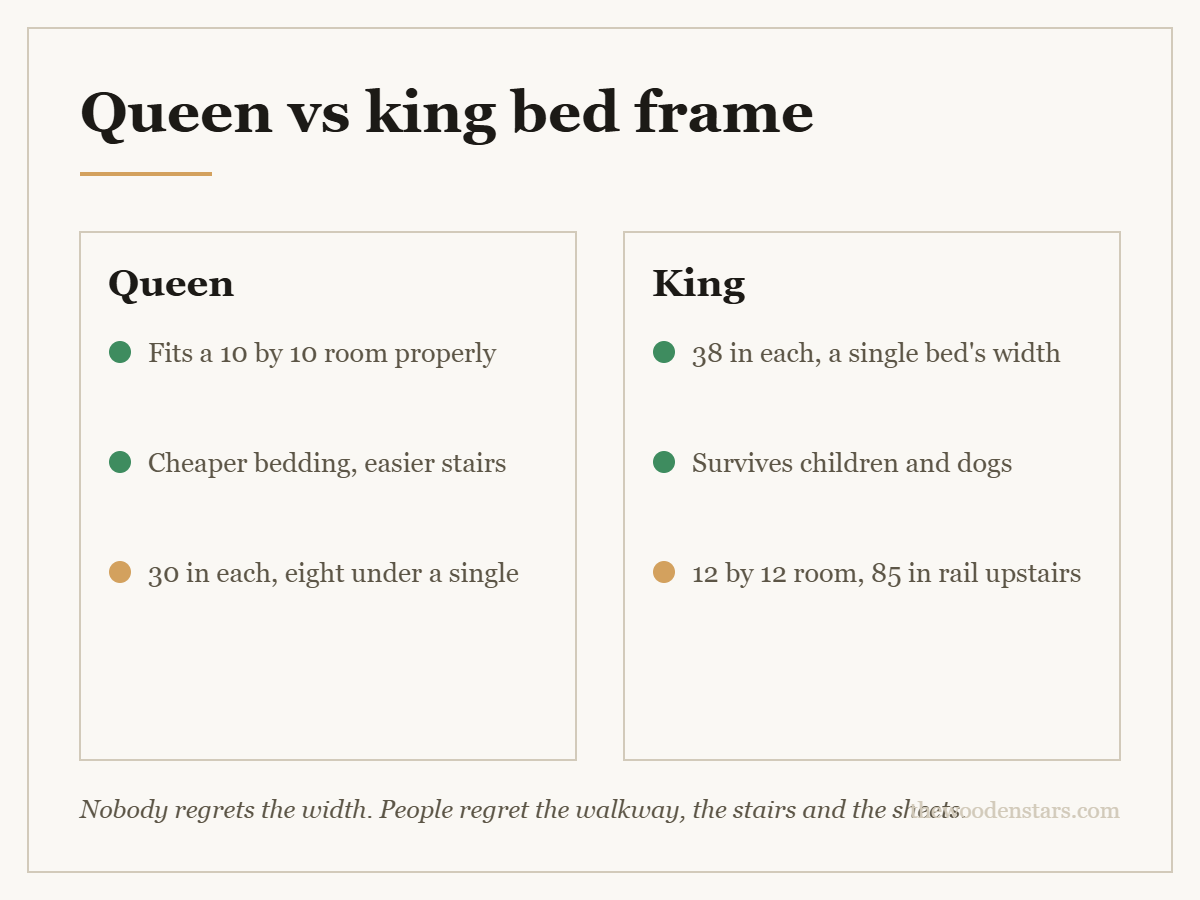
A queen mattress is 60 × 80 inches, a king is 76 × 80. Same length, 16 inches more width. Split between two sleepers that is 30 inches each on a queen against 38 on a king — the width of a single bed each. The frame adds 2 to 5 inches all round, so plan on 64 × 85 against 80 × 85. For circulation you want 30 inches down each side, which means a queen works in a 10 × 10 room and a king really wants 12 × 12. Both need a centre support; the king needs a better one.
Queen vs king bed frame: what 16 inches actually buys
Per sleeper, the numbers are stark:
- Queen, two people: 30 inches each.
- King, two people: 38 inches each.
- A single bed is 38 inches wide. So a king gives each person a twin’s worth of space; a queen gives each person eight inches less than that.
That is the whole argument, and it is why people who move from a queen to a king rarely move back. It is also why the decision is usually made by the room rather than by preference.
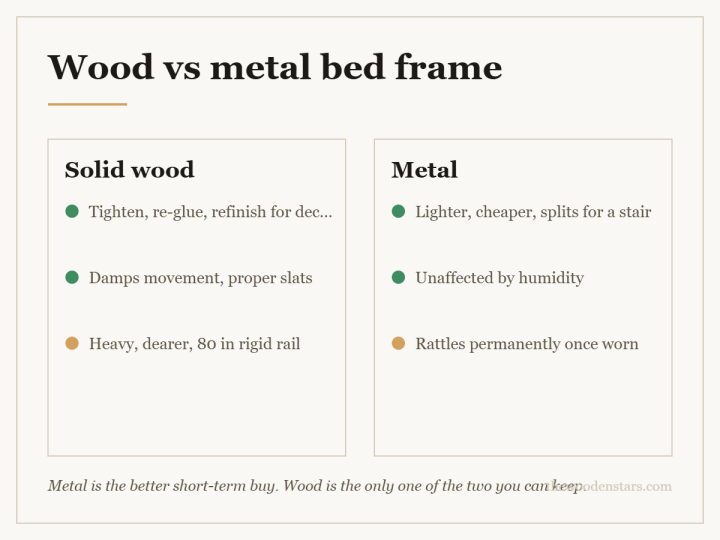
Length is identical at 80 inches, so neither helps a tall sleeper. For that you want a California king — 72 × 84, four inches longer and four narrower. The comparison is in cal king against king bed frames.
| Measure | Queen | King |
|---|---|---|
| Mattress | 60 × 80 in | 76 × 80 in |
| Width per sleeper | 30 in | 38 in |
| Frame footprint | 64 × 85 in | 80 × 85 in |
| Room that works | 10 × 10 ft | 12 × 12 ft |
| Centre support | Required | Required, heavier |
| Slat count | 13 to 15 | 15 to 18 |
| Bedding | Cheaper, widely stocked | Dearer, fewer options |
| Getting it upstairs | Manageable | The rails are the problem |
The room decides it, and here is the arithmetic
Work from circulation, not from whether the bed fits.
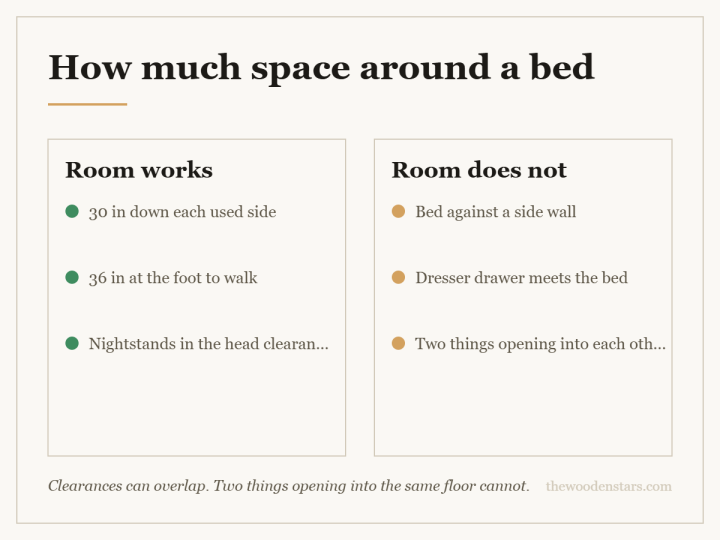
You want 30 inches of clear floor down at least one side to walk and make the bed, and 24 on the other if it is used. At the foot, 36 inches if you pass by, less if you do not.
- 10 × 10 room (120 inches wide): a queen frame at 64 inches leaves 56 — 30 and 26 down the sides. Works.
- 10 × 10 with a king at 80 inches leaves 40 — 20 each side. You edge past furniture.
- 12 × 12 (144 inches): a king leaves 64, so 32 each side. Comfortable.
Then subtract what else is in the room. Two nightstands at 20 inches deep do not take floor from the sides, but a dresser opposite the foot takes 20 inches plus the drawer pull-out. The full method is in how much space around a bed.
What the king costs beyond the floor
Bedding. King sheets, duvets and mattress protectors cost more and come in fewer choices. Over a decade of replacements this is not trivial.
Delivery and stairs. A king side rail is about 85 inches of rigid timber. That is the part that will not turn a tight stair, and it is a fixed dimension you cannot design around. Measure the diagonal at your worst turn before ordering.
Support. A 76-inch span needs a stiffer centre rail and usually two legs rather than one. A king frame sold without a centre support is not a bargain — see bed frame centre support legs.
Mattress handling. A king mattress is genuinely a two-person lift, and turning it in a 10-foot room is an exercise.
Where the king wins outright
Two adults of different sizes or sleep habits. Thirty inches is enough until one person moves. Thirty-eight absorbs it.
Anyone else in the bed. A child who comes in at 5am, or a dog, takes width from the middle. On a queen that leaves two people with 20 inches each.
A room that is already big. A queen in a 14-foot room looks undersized, and the bed is the one piece in a bedroom that is allowed to be large.
Where the queen wins outright
A 10-foot room. Stated plainly: a king in a 10 × 10 is a bed with two corridors, and the room stops working.
One sleeper. Sixty inches is already generous for one person, and the extra 16 is floor you have given away.
A guest room. Guests are not there long enough to notice the width, and you keep the floor for a desk or a wardrobe.
Anywhere the stairs are tight. Sizing detail is in queen bed frames and king bed frame and mattress fit.
What the frame itself needs, at either size
- A centre support. Mandatory at queen and above. One leg at queen, two at king — centre support legs.
- Slat spacing under 3 inches for a foam mattress, up to 4 for sprung. Most mattress warranties specify it — slat spacing.
- Bolts into barrel nuts, not cam locks. A wider frame levers harder on its corners, so a king benefits more — bed frame brackets.
- Solid hardwood rails. At 80 inches a rail carries real load; particleboard splits at the bracket — what engineered wood actually is.
If an existing frame has started talking, the cause is usually slats or a loose bracket: why a wooden bed frame squeaks.
At either size
- Centre support leg Required at queen and above, and often not in the box
- Furniture bolts and barrel nuts What lets a wide frame be pulled up for decades
- Felt slat tape Stops the slat rub that is most bed-frame noise
- Bed frame levelling glides A wide frame turns a floor dip into a rock
What to buy
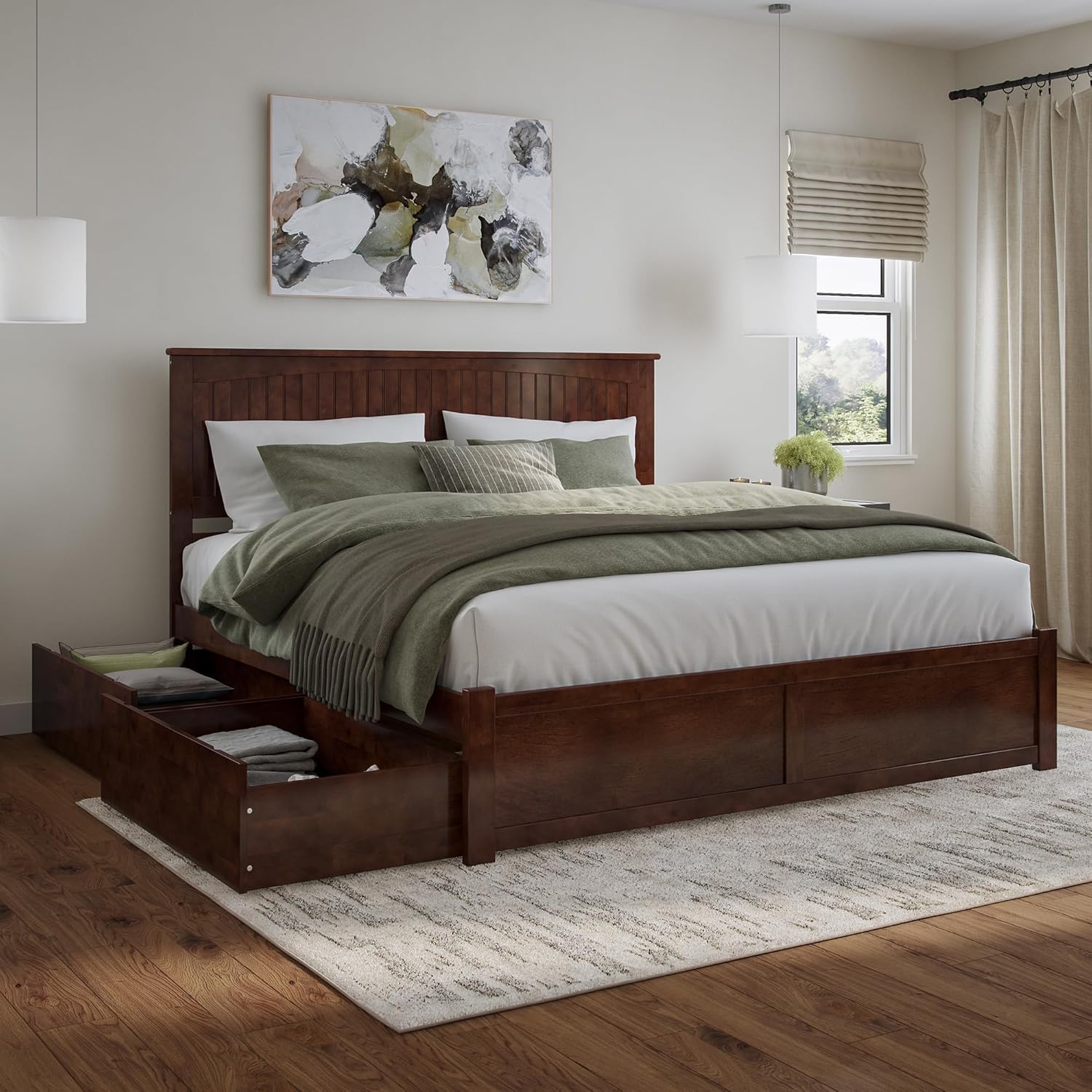


For frames by size, see queen bed frames, king size bed frames and wood bed frames. For the size below, full against queen. For the long version, cal king against king. For storage underneath, bed frames with drawers.
Questions we get asked
What is the difference between a queen and a king bed frame?
Sixteen inches of width. A queen mattress is 60 × 80 inches, a king is 76 × 80. The length is identical.
How much room does each sleeper get?
Thirty inches on a queen, 38 on a king. For reference, a single bed is 38 inches wide.
What size room does a king need?
About 12 × 12 feet to keep 30 inches of walkway down each side. A queen does that in 10 × 10.
Is a king longer than a queen?
No, both are 80 inches. For extra length you want a California king at 84.
Does a king frame need more support?
Yes. A 76-inch span wants a stiffer centre rail and usually two legs rather than one.
What stops a king going upstairs?
The side rail, which is about 85 inches of rigid timber. Measure the diagonal at your tightest stair turn before ordering.