Loft beds with a desk — Two clearances, one bay
The Wooden Stars is a participant in the Amazon Services LLC Associates Program. We may earn a commission when you buy through links on our site, at no extra cost to you.
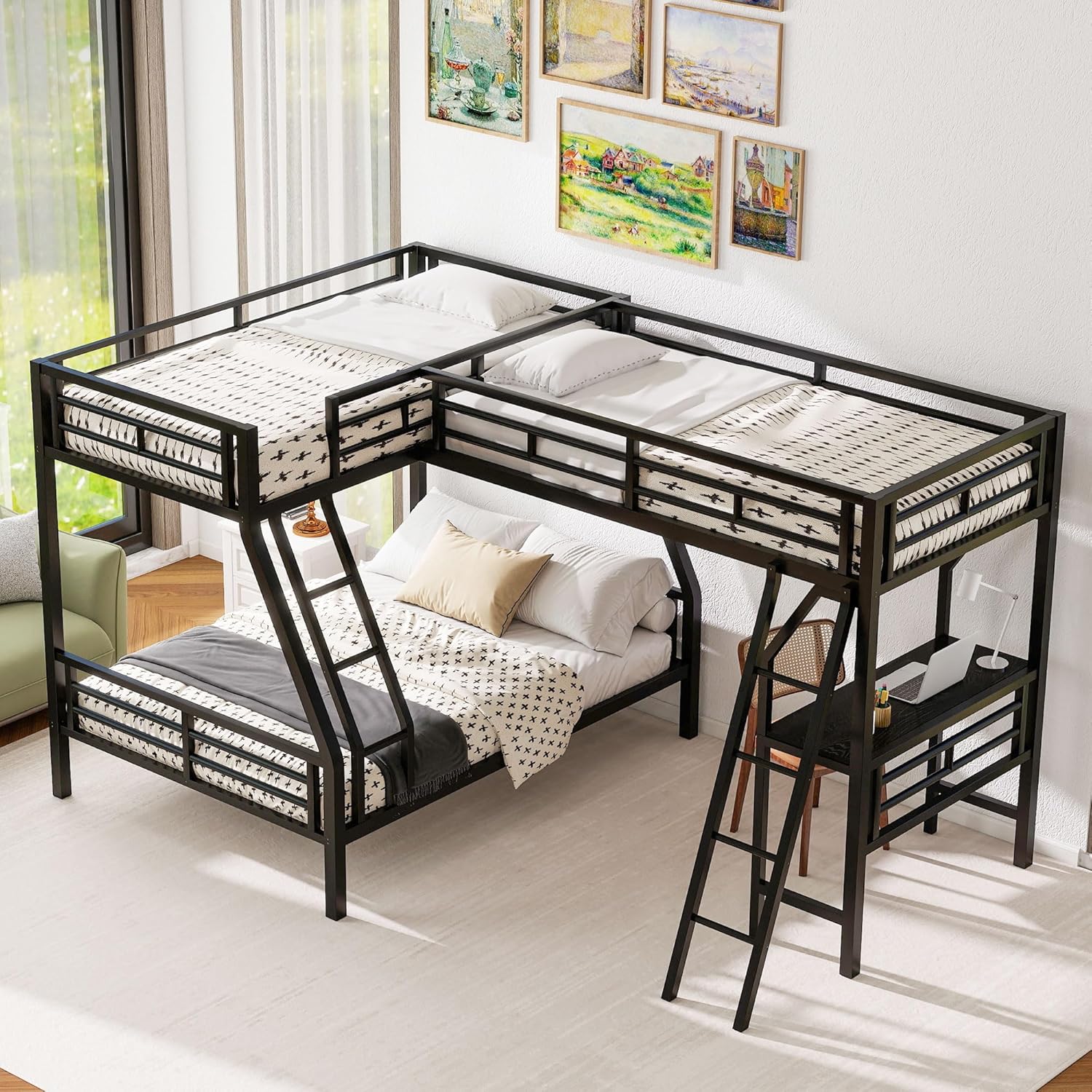
Putting a desk under a loft bed is the oldest small-room trick there is, and it works. What goes wrong is almost never the bed — it is that a desk needs two clearances at once, and the bed only guarantees one of them.
Get the numbers right and it is the best use of floor area in a small bedroom. Get them wrong and you own a very expensive place to hit your head.
A desk needs 24 to 26 inches of knee clearance under the top and enough head height above the desk surface to sit upright — which for an adult is about 36 inches measured from the desk top to whatever is above. A desk top at 29 inches plus 36 of head room means the underside of the bed deck has to be at 65 inches, which is a high loft. Most integrated loft desks solve this by sitting the desk lower than standard — 26 to 28 inches — and accepting that you sit with less head room than at a normal desk. Check the desk depth too: under 20 inches suits a laptop and puts a monitor too close.
The two clearances, and why they conflict
A desk has a fixed relationship to a person sitting at it:
- Knee clearance: 24 to 26 inches from the floor to the underside of the desk top.
- Desk height: 28 to 30 inches, paired with a seat at 17 to 19.
- Head room above the desk: a seated adult’s eye level is about 45 inches from the floor, and their head goes to roughly 50. So from a 29-inch desk top you want about 36 inches of clear air to sit comfortably, and 30 is the point where it starts to feel like a cave.
Add desk height and head room: 29 + 36 = 65 inches from the floor to the underside of the bed deck. Add the deck structure and the top mattress and you are at 76 to 78 inches of frame — which needs a ceiling well over 96 to leave sitting-up room on top.
Very few loft beds give 65 inches of clear bay. Most give 40 to 50, and the desk is designed to suit.
How manufacturers solve it
A lower desk
The integrated desk sits at 26 to 28 inches rather than 29 to 30, which buys back 2 to 4 inches of head room. It works, and it suits children better than adults — an adult at a 26-inch desk sits with their shoulders slightly raised.
A desk that pulls out
The desk slides out from under the bed so you sit at the open edge with full head room above. The best answer for an adult, and it needs floor space in front to pull into.
A desk at the end rather than under
An L-shaped arrangement where the desk projects past the bed footprint. Full head room, more floor used.
A high loft with a standard desk
The honest solution — a bay of 60 inches or more. It puts the sleeping deck at 70-plus inches, so it needs a high ceiling and it makes the bed hard to make.
| Bay clear height | Desk top | Head room above desk | Suits |
|---|---|---|---|
| 40 in | 26 in | 14 in | Nothing, too low |
| 46 in | 26 in | 20 in | Storage, not a desk |
| 52 in | 27 in | 25 in | A child at a laptop |
| 58 in | 28 in | 30 in | A teenager, workable |
| 65 in | 29 in | 36 in | An adult, comfortable |
Desk depth, the second thing people miss
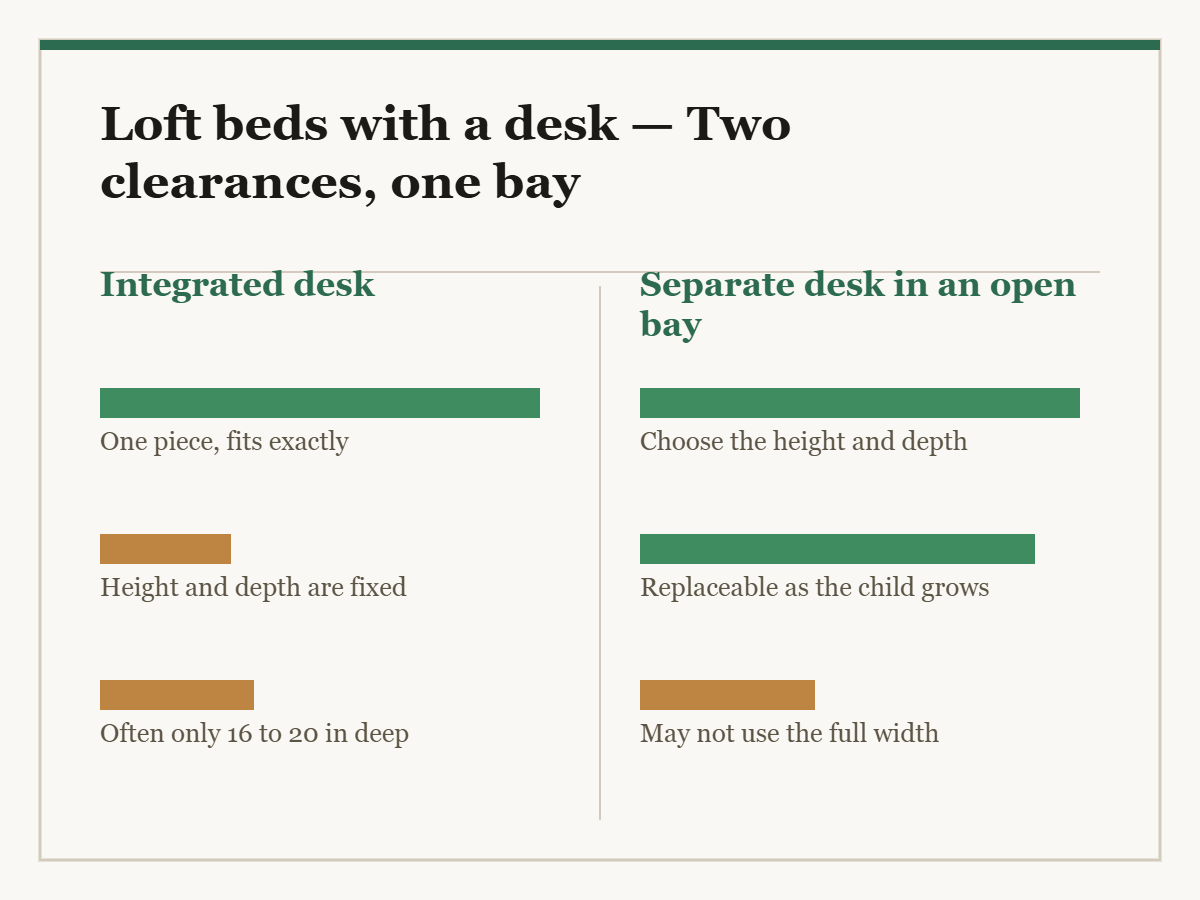
An integrated loft desk is often 16 to 20 inches deep, because it has to fit inside the bed’s footprint.
A comfortable desk is 24 to 30 inches deep. Under 20 and a monitor sits too close for the eye to focus comfortably — a laptop is fine, a 24-inch screen is not.
If a monitor is going under there, check the depth before the height. A monitor arm helps by pushing the screen back over the desk edge, but only if there is somewhere for the clamp — see desks with a hutch and drawers, which has the same clamp problem for a different reason.
Light, which nobody budgets for
A desk under a loft bed is in a box with a solid ceiling. Whatever the room’s main light does, it does not reach the desk surface.
Three fixes, in order of how well they work:
- A strip light fixed to the underside of the bed deck. Even, no shadow from your own hands, and it gets the light source out of the way. This is the right answer.
- A clamp lamp on the desk edge. Takes no desk space and casts a shadow from one side.
- A desk lamp. Takes up a third of a 20-inch-deep desk.
Whichever, plan the cable route at assembly. Cables from under a loft have to reach a socket, usually behind or past a post, and a grommet through the desk top is the tidy answer — sizes in desk grommets.
The bed half still has to be right
Everything that applies to a loft bed applies here, and the desk does not change any of it.
Weight rating. Two hundred pounds is a child; 400 and up means solid hardwood with bolted joints. The desk adds nothing to the deck rating.
Mattress thickness is capped by the guard rail, usually at 6 inches.
Head room above the top mattress wants 30 inches. A high-bay loft with a standard desk under it eats this first.
Bracing. An open bay with a desk in it still has no lower frame tying the posts, so the end panels or diagonals are doing the work — see twin over twin loft beds.
Slat spacing and noise are covered in bed slat replacement and spacing and why a wooden bed frame squeaks.
What it is made of
The desk top takes forearms and a monitor foot; the frame carries a sleeper.
Solid hardwood for the frame, because the rail-to-post bolts have to hold under cyclic load — the hardwood hardness scale.
For the desk top specifically, a solid or butcher-block surface can be sanded when a child gets creative with it, and it takes a threaded insert if you ever fit a monitor arm. Fitting one is in mounting a butcher block desktop.
Laminate over particleboard on the desk is fine in use and cannot be repaired. On the frame it is not fine — what engineered wood actually is.
Making the bay work
- Under-shelf LED strip The only light that reaches a desk inside a box, without shadows
- Monitor arm Pushes a screen back over the desk edge when the desk is only 20 inches deep
- Desk grommet A cable route out of the bay that does not run over the desk edge
- T-handle hex key The frame still needs its joints pulled up annually
What to buy



For the bed side of the decision, see twin over twin loft beds and full size loft beds. Under a low ceiling, low loft beds. For a standalone desk instead, corner desks for small spaces and wooden desk legs. Wobble is diagnosed in how to fix a wobbly desk.
Questions we get asked
How much clear height do I need for a desk under a loft?
Desk height plus head room. A 28-inch desk with 30 inches above it needs a 58-inch bay; a proper 29-inch desk with 36 inches above needs 65.
Why do loft desks sit lower than normal?
To buy back head room. Twenty-six to 28 inches is common, which suits a child better than an adult.
How deep are integrated loft desks?
Sixteen to 20 inches, because they fit inside the bed footprint. That suits a laptop and puts a monitor too close.
Is a separate desk better than an integrated one?
Usually, if the bay is open. You choose the height and depth, and you can replace it as the child grows.
How do I light it?
A strip light fixed to the underside of the bed deck. A desk lamp eats a third of a shallow desk and a clamp lamp casts a shadow.
Does the desk affect the bed’s weight rating?
No. The top deck rating is the top deck rating — 200 lb is a child, 400 and up is hardwood with bolted joints.