Daybed vs twin bed — The same mattress, a different room
The Wooden Stars is a participant in the Amazon Services LLC Associates Program. We may earn a commission when you buy through links on our site, at no extra cost to you.
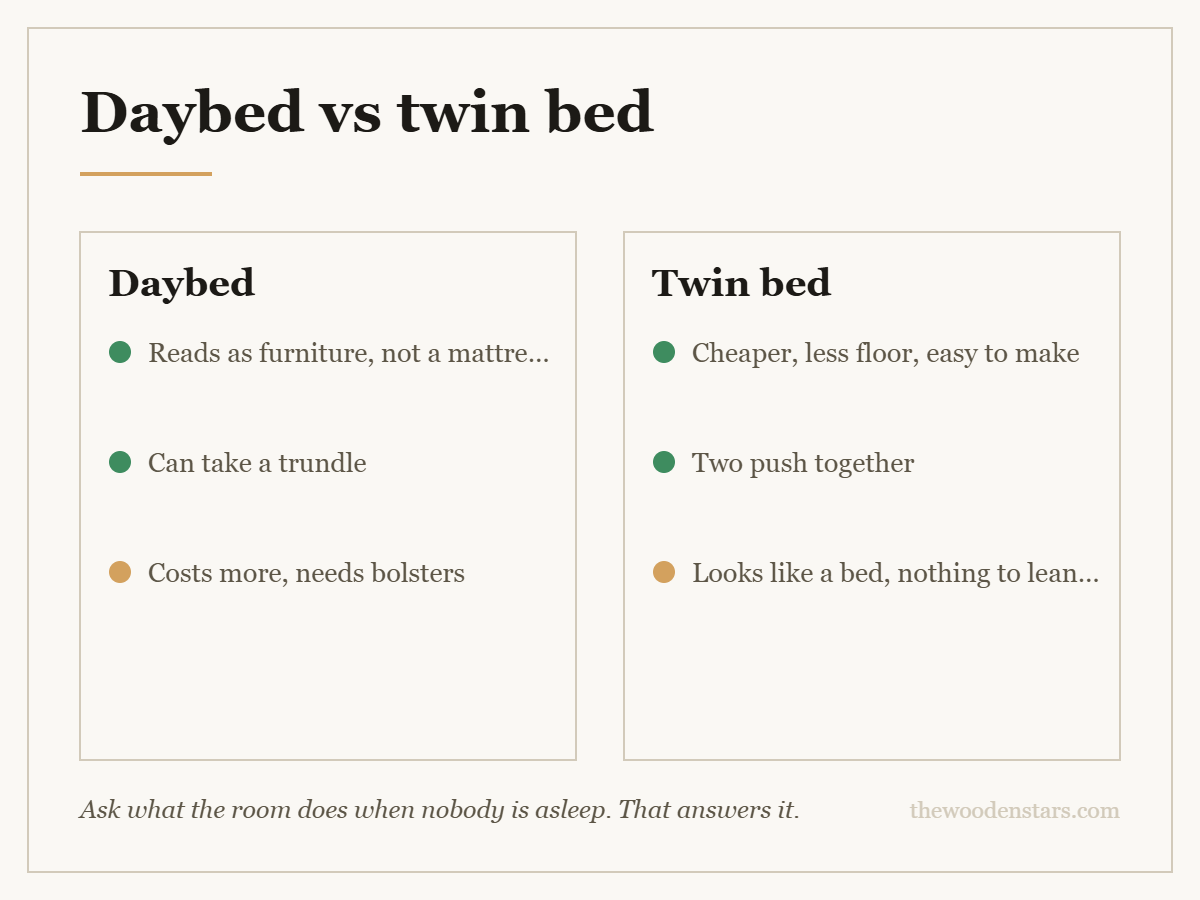
Daybed vs twin bed is not a mattress question — both take the same 38 × 75-inch twin mattress. It is a question about what the piece does for the other sixteen hours of the day.
A twin bed is a bed. A daybed is a bed with a back and two ends, which lets it read as seating when nobody is asleep on it. That framing costs money, depth and comfort, and in the right room it is worth all three.
A daybed vs twin bed comparison starts from the same mattress. The daybed adds a back rail and two end panels, which does three things: it lets the piece sit against a wall and read as a sofa, it adds 4 to 6 inches to the footprint in each direction, and it means you need 14 to 17 inches of firm bolster cushion before it seats like anything. A plain twin costs less, takes less room and is easier to make. Choose the daybed only if the room is used for something other than sleeping.
Daybed vs twin bed: what the three sides buy you
Strip away the styling and a daybed is a twin frame with a back and two ends at 30 to 36 inches. That structure does three jobs:
- It defines the piece against a wall. A twin mattress pushed against a wall looks like a mattress. The same mattress inside three panels looks like furniture.
- It gives you something to lean on. Sitting on a plain twin means leaning on a wall or a pile of pillows.
- It contains the bedding. Small, and people notice it.
What it costs: depth, cushions, money, and a little ease of bed-making — a fitted sheet inside three rails is fiddlier than on an open frame.
| Measure | Daybed | Twin bed |
|---|---|---|
| Mattress | 38 × 75 in | 38 × 75 in |
| Footprint | 44 × 82 in | 40 × 80 in |
| Back and ends | 30 to 36 in tall | Headboard only, if any |
| Seats | With 14 to 17 in of bolsters | Not really |
| Underneath | Trundle or drawers | Drawers, or nothing |
| Typical price | Higher | Lower |
| Bed-making | Fiddlier, three rails | Easy |
When a plain twin is the better buy
In a room that is only ever a bedroom, the daybed’s frame is paying for a function nobody uses. A twin frame with a decent headboard costs less, is easier to make up, and leaves more floor.
Two situations where the twin clearly wins:
A child’s room. The bed gets slept in and jumped on; nobody sits on it with a cup of tea. Money is better spent on the mattress or on a frame that takes under-bed drawers — see twin bed frames.
Where two beds go side by side. Daybed ends make two beds into a wall of panelling. Twins push together.
When the daybed earns its keep
A spare room that is also an office or a snug. This is the case the daybed was designed for, and it works — provided the cushions get bought.
A studio or a landing. Anywhere a bed would look out of place standing on its own.
Where two people occasionally stay. A daybed can take a trundle, turning one twin into two — and a pop-up version brings the second mattress level with the first. A plain twin frame rarely offers this. See daybeds with a trundle.
Seat height is where daybeds disappoint
A daybed deck sits at 14 to 18 inches, so the mattress decides the seat:
- 6-inch mattress: seat at 20 to 24 inches — near chair height, works.
- 12-inch mattress: 26 to 30 — sleeps well, perches badly.
A sofa seat is 17 to 19. So a daybed always sits high; the question is how high. If the room is seating-first, buy the thin mattress and add a topper for the nights it is used. The full arithmetic is in twin daybeds.
Underneath: both can store, differently
A daybed deck at 14 to 18 inches leaves about 10 cubic feet. That becomes a trundle or drawers — one or the other, because it is one void. See daybeds with storage.
A twin frame can take drawers too, and the same rule applies: runners fixed to the frame work on carpet, castors rolling on the floor stall in pile and cut tracks. Covered in bed frames with drawers underneath.
What to look at on a daybed specifically
The joint where the back rail meets the end panels takes a lever every time somebody leans back — and on a daybed that is constant, unlike a bed.
- Panelled or closely slatted ends, not two posts and a rail. The panel triangulates the end and stops an 80-inch frame racking along its length.
- The back bolted into the ends, not screwed into a panel edge.
- Timber slats under 3 inches apart, not a steel wire grid — a grid sags into a hammock under nightly use and cannot be fixed. See bed slat replacement and spacing.
- A centre support leg across the 75-inch length — bed frame centre support legs.
Material terms are in what engineered wood actually is; particleboard ends fail exactly at that back-rail bolt.
Whichever you pick
- Firm bolster cushions Only for the daybed, and you need 14 to 17 inches of depth
- Mattress topper Lets a thin mattress keep the seat height and still sleep well
- Centre support leg Seventy-five inches of span wants a leg in the middle either way
- Under-bed storage bins The cheap way to use the void without buying drawers
What to buy


For daybeds by size, see twin daybeds, full size daybeds and queen daybeds. For the plain frame, twin bed frames. Against a sofa bed, daybed against sofa bed. For two sleepers in one footprint, daybeds with a trundle.
Questions we get asked
Does a daybed use a twin mattress?
Yes — a standard twin, 38 × 75 inches. The mattress is identical; only the frame differs.
Is a daybed bigger than a twin bed?
Slightly. The back and end panels add about 4 inches of width and 2 of length, so roughly 44 × 82 against 40 × 80.
Can you sleep on a daybed every night?
Yes. It takes a full-thickness mattress on slats, so it sleeps exactly like a twin bed.
Is a daybed comfortable as a sofa?
Only with 14 to 17 inches of firm bolster behind you, and those have to go somewhere when it is a bed.
Which is better for a child’s room?
Usually a plain twin. Nobody sits on a child’s bed with a cup of tea, and the money is better spent on the mattress or on under-bed drawers.
Can a twin bed take a trundle?
Rarely — trundles are mostly a daybed feature, because the daybed’s ends give the rolling frame somewhere to hide.