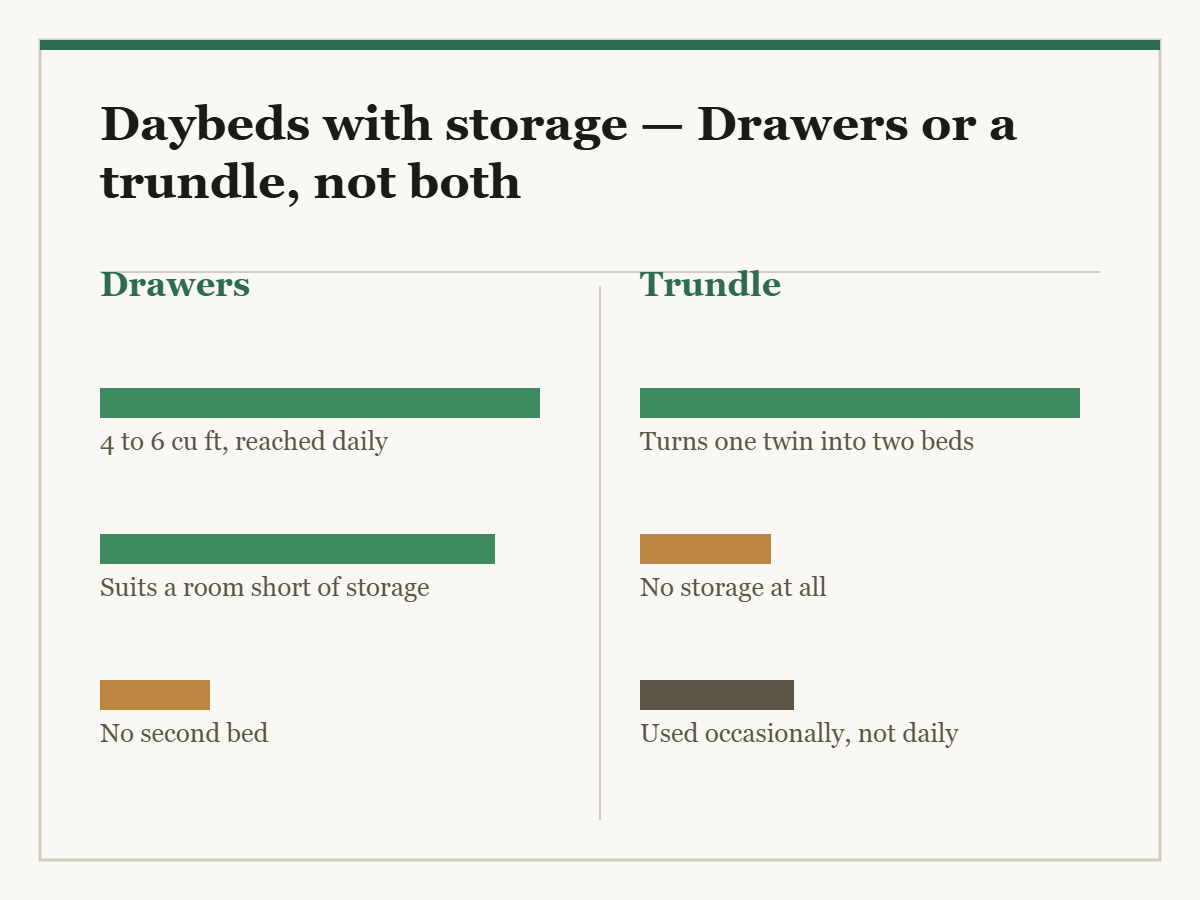
Daybeds with storage — Drawers or a trundle, not both
The Wooden Stars is a participant in the Amazon Services LLC Associates Program. We may earn a commission when you buy through links on our site, at no extra cost to you.
The void under a daybed is about 10 cubic feet of nothing, at a height where you can actually reach it. Putting drawers in it is the obvious move, and the reason it sometimes disappoints has nothing to do with the drawers.
It has to do with what else wanted that space, and with what your floor is made of.
Drawers under a twin daybed hold 2 to 3 cubic feet each, so a two-drawer frame gives you 4 to 6 — about a chest of drawers. The decision that matters: drawers on runners fixed to the frame work on carpet, boards or tile; drawers on castors that roll on your floor stall in carpet pile and cut tracks in it. Allow 44 inches of clear floor on the drawer side — the drawer projects 18 to 24 and someone has to stand behind it. And know that you cannot have drawers and a trundle: it is one void, and the trundle is the alternative use for it.
Runners or castors — the whole decision
Castors rolling on the floor
The drawer box has small wheels underneath and rolls on whatever the daybed stands on. Cheap, simple, and on a hard floor entirely fine.
On carpet it is not fine. The wheels sink into the pile, the drawer needs a shove, and over a year or two they cut visible tracks you only find when the bed moves. A daybed in a spare room usually stands on carpet.
Runners fixed to the frame
Metal or timber runners mounted to the daybed rails, so the drawer hangs from the frame and never touches the floor. The floor type stops mattering and the drawer pulls with one finger.
This is most of the price difference between daybeds that photograph identically. If a listing does not say, assume castors — makers who fit proper runners mention it.
Clearance, the measurement people miss
A drawer under a twin daybed is as long as the daybed is deep, minus the rail — so it projects 18 to 24 inches when fully open. Under a full daybed, more.
Add somewhere for a person to stand and you need 44 inches of clear floor on the drawer side. A spare-room walkway is usually 24 to 30, so this is almost double what feels adequate standing in the room.
Practical points:
- Pick the drawer side before ordering. Many daybeds are handed. A drawer facing a wardrobe is a drawer you will never open.
- A daybed in a corner loses the drawers on the wall side entirely.
- The cushions also have to go somewhere when the daybed becomes a bed, and the floor in front is where they land — the same floor the drawer wants.
| Type | Volume | Works on carpet | Access |
|---|---|---|---|
| Drawers on frame runners | 2 to 3 cu ft each | Yes | Daily |
| Drawers on floor castors | 2 to 3 cu ft each | Poorly | Daily, with a shove |
| Trundle | A whole second mattress | Not applicable | Occasional |
| Open, with bins | 1 to 2 cu ft each | On a hard floor | Weekly |
| Solid plinth, no access | None | — | — |
Drawers or a trundle — you get one
The void under a daybed is one void. A trundle fills it with a second mattress on a rolling frame; drawers fill it with drawers. No frame gives both.
Choose the trundle if the daybed’s job is to sleep two occasionally. It turns one twin into two and that is a capability storage cannot match — see daybeds with a trundle.
Choose drawers if the daybed sleeps one and lives in a room short of storage. Four to 6 cubic feet in a spare room usually beats a second bed used twice a year.
A third option exists and is worth knowing: a plain daybed with rolling under-bed boxes. Less tidy, cheaper, and the boxes move to the next house.
What actually fits
Under-daybed drawers are wide and shallow — typically 6 to 9 inches inside.
- Spare bedding: the natural fit, and the reason most people buy them.
- Out-of-season clothes: yes, flat.
- The daybed’s own cushions: only if they are flat-backed. A 17-inch bolster does not go in a 9-inch drawer, which is the trap in a spare room.
- Anything with height: no.
A vacuum bag turns 3 cubic feet of drawer into a useful amount of duvet, and it is the accessory that makes shallow under-bed drawers worth having.
The daybed underneath still has to be right
Adding drawers does not change anything about the bed half, and the bed half is what you will live with.
Seat height is set by mattress thickness: 6 to 8 inches keeps it near 22 to 26, 12 makes it a perch. A storage frame usually sits a little higher to clear the drawer boxes, which pushes this further — see twin daybeds.
Cushion depth: 14 to 17 inches for a twin, 26 to 30 for a full — full size daybeds.
The deck: timber slats under 3 inches apart, not a wire grid. A storage frame has more structure under the deck, which sometimes means a solid platform — good for rigidity, worse for letting the mattress dry. See bed slat replacement and spacing.
Centre support: 75 inches of length still wants a leg in the middle, and a drawer box is not a substitute — bed frame centre support legs.
The drawer boxes themselves
A drawer under a bed is pulled by its front, often by someone kneeling, often when it is full of bedding.
Solid timber or plywood boxes stay square. Particleboard with a stapled front loosens, and once the front moves the drawer racks in its opening and jams — which then gets blamed on the runner. The distinctions are in what engineered wood actually is.
If a drawer already sticks, the diagnosis order is in when a drawer will not slide, and runner sizing in how to measure drawer slides.
Worth buying with it
- Vacuum storage bags Turns a shallow 3 cu ft drawer into real duvet capacity
- Felt glides For castor drawers on a hard floor, instead of plastic on timber
- Drawer runners Side-mounted, if you are retrofitting rather than buying
- Slat roll Replaces a wire grid deck with proper timber slats
What to buy


For the bed itself, see twin daybeds, full size daybeds and queen daybeds. For a second mattress instead of drawers, daybeds with a trundle. For under-bed storage on a normal bed, bed frames with drawers underneath.
Questions we get asked
How much do daybed drawers hold?
Two to 3 cubic feet each, so 4 to 6 in total — about a chest of drawers, and shallow at 6 to 9 inches inside.
Do they work on carpet?
Only if they run on runners fixed to the frame. Castors that roll on the floor stall in pile and cut tracks over time.
How much floor space do I need to open them?
About 44 inches on the drawer side — 18 to 24 for the drawer plus room to stand.
Can I have drawers and a trundle?
No. There is one void under the deck and each option uses all of it.
Will the daybed’s own cushions fit in the drawers?
Only flat-backed ones. A 17-inch bolster does not go into a 9-inch drawer, which catches people out in a spare room.
Does a storage daybed sit higher?
Usually a little, to clear the drawer boxes. That pushes the seat height up on top of whatever the mattress adds.