Wood bed frame for a queen — The five things to check before ordering
The Wooden Stars is a participant in the Amazon Services LLC Associates Program. We may earn a commission when you buy through links on our site, at no extra cost to you.

Two queen wood bed frames can look identical in a listing photograph and behave completely differently after eighteen months. One stays silent and square; the other develops a creak that no amount of tightening cures.
The difference is always in the same five places, and all five are readable from the listing before you spend anything. This is that checklist, in the order worth reading it.
Check these five, in this order. 1. Slats — 13 to 16 for a queen, gaps under 3 inches, captive in a groove. 2. Centre support — a centre rail with two legs to the floor; without it the frame flexes and the joints loosen. 3. Joints — bolts into threaded metal inserts, not wood screws into end grain. 4. Material at the load points — solid timber or plywood at the rails, posts and centre rail; panel elsewhere is fine. 5. Overall footprint and deck height — the frame is 3 to 6 inches bigger than the mattress each way, and deck plus mattress should land near 22 to 26 inches.
1. Slats
The slats carry the mattress and everyone on it, so they are the first thing to read and the most commonly under-specified.
- Count. A queen wants 13 to 16. Fewer means longer gaps and more bend per slat.
- Gap. Under 3 inches for most foam and hybrid mattresses. This limit is usually written into the mattress warranty, and a sagging mattress over an over-wide gap is not a claim you will win.
- Thickness. Thin slats bow across a 60-inch span and a bowed slat does not spring back.
- Captive or loose. Slats sitting in a routed groove or fixed to a webbing roll stay put. Slats resting on a ledge walk sideways over months and eventually drop through.
If a listing gives a weight rating but no slat count, assume the count is unremarkable.
2. Centre support
A queen spans 60 inches, and that is beyond what slats carry unaided with two adults on them. The frame needs a centre rail running head to foot with at least two legs down to the floor.
This is the single most common omission on inexpensive queen frames, and its absence causes a specific chain of events: the slats flex, the flex racks the frame, the racking works the rail bolts loose, and the loose bolts squeak. Tightening helps for a fortnight.
Look for the words “centre rail” or “centre support legs” and a leg count. A stated weight capacity with no centre leg is a number the frame cannot actually hold.
3. Joints
A bed frame is designed to be taken apart, which means the rail-to-post joint is a fastening rather than a glued joint. There are two versions and they behave very differently over time.
Good: a machine bolt passing into a threaded metal insert set into the timber, or a steel bracket and hook system. Both can be tightened indefinitely and survive repeated assembly.
Bad: a wood screw driven into end grain. It holds the first time, holds less the second, and strips the third. If you ever move house, this is the detail that decides whether the frame comes with you.
Traditional joinery elsewhere — mortise and tenon in a headboard, dovetails on storage drawers — is a good sign of general build quality, but it is not what holds the bed together.
4. Material, but only where it matters
Three places take load: the rails, the posts where the rails bolt in, and the centre support. Those want solid timber or good plywood, because both hold a threaded fixing indefinitely and can be re-tightened.
Particleboard enlarges its hole under cyclic load, and once it has, there is no clean repair — you are into glue and dowels, and the joint is never the same.
Everywhere else, engineered panel is fine and is often the correct choice: flat, stable, and free of the seasonal movement a wide solid panel would have. A veneered headboard panel in a solid frame is good construction, not a cost cut. The vocabulary is decoded in what engineered wood actually is.
5. Footprint and height
Two numbers the listing gives separately from the mattress size.
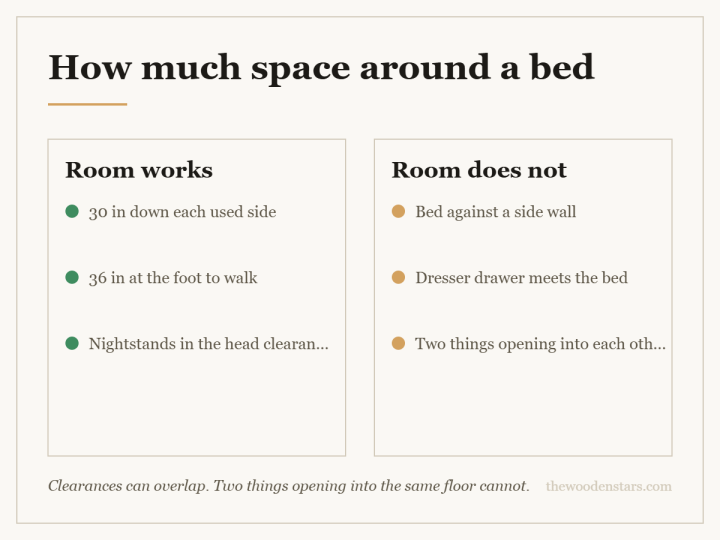
Overall footprint. A queen frame is typically 63 to 66 inches wide and 84 to 86 inches long. That is what your room has to take, plus 24 to 30 inches of walkway on each side you use.
Deck height. Floor to the top of the slats. Add your mattress thickness; aim for 22 to 26 inches total, which is a comfortable height to sit on. A 12-inch frame under a 12-inch mattress lands at 24. The same frame under a 6-inch mattress is low enough to be awkward.
Two more things worth thirty seconds
Does it need a box spring?
Platform frames support the mattress on slats and need nothing else. Frames designed for a box spring have only a perimeter rail, and they photograph identically. A foam mattress on one of those, without the box spring, has nothing under its middle.
Will it get into the room?
Queen rails are about 84 inches and do not bend. Measure the tightest turn on the route against the longest single component. One-piece headboards are about five feet wide and rigid; split headboards that bolt together are much easier, and the listing will say which it is.
| Check | Good | What happens if not |
|---|---|---|
| Slats | 13 to 16, under 3 in gaps, captive | Mattress sags between slats, warranty void |
| Centre support | Rail with 2 legs | Flex, then squeak, then loose joints |
| Joints | Bolt into metal insert | Strips on the second or third assembly |
| Material at load points | Solid timber or plywood | Hole enlarges, no clean repair |
| Footprint and height | Measured before ordering | No walkway, or a bed you climb into |
For assembly and after
- Hex key set Better than the folded key in the box, and it saves rounded heads
- Threadlocker On every rail and centre-leg bolt at assembly, not after the squeak
- Felt pads Under all legs, centre legs included
- Tape measure Overall footprint, deck height, and the tightest turn on the stairs
What to buy


For the room and size numbers, see queen bed frames. For the species question, hardwood against softwood, and for the different looks at this size, four styles of queen wood frame.
Questions we get asked
What should I look for in a wood bed frame?
Slat count and gap, a centre rail with legs, bolts into metal inserts, solid timber at the rails and posts, and an overall footprint your room can take.
How do I know if a bed frame is well made from the listing?
It states slat count and gap, names the centre support and its leg count, and gives section sizes rather than only a species name. Silence on those is itself the answer.
Why do wood bed frames squeak?
Loose bolts and slats moving in their seats, almost always. Threadlocker at assembly and captive slats prevent nearly all of it.
Is plywood acceptable in a bed frame?
Yes — good plywood holds a screw as well as solid timber and is more stable. It is particleboard at the load points that causes trouble.
How much bigger than the mattress is a queen frame?
Typically three to six inches each way: about 63 to 66 inches wide and 84 to 86 long for a 60 × 80 mattress.
Can I add a centre support to a frame that has none?
Sometimes, with an adjustable steel centre bar. It is a genuine fix, but check the rails have somewhere solid to accept it before relying on it.