Daybed vs futon — One is a bed, one is a compromise
The Wooden Stars is a participant in the Amazon Services LLC Associates Program. We may earn a commission when you buy through links on our site, at no extra cost to you.
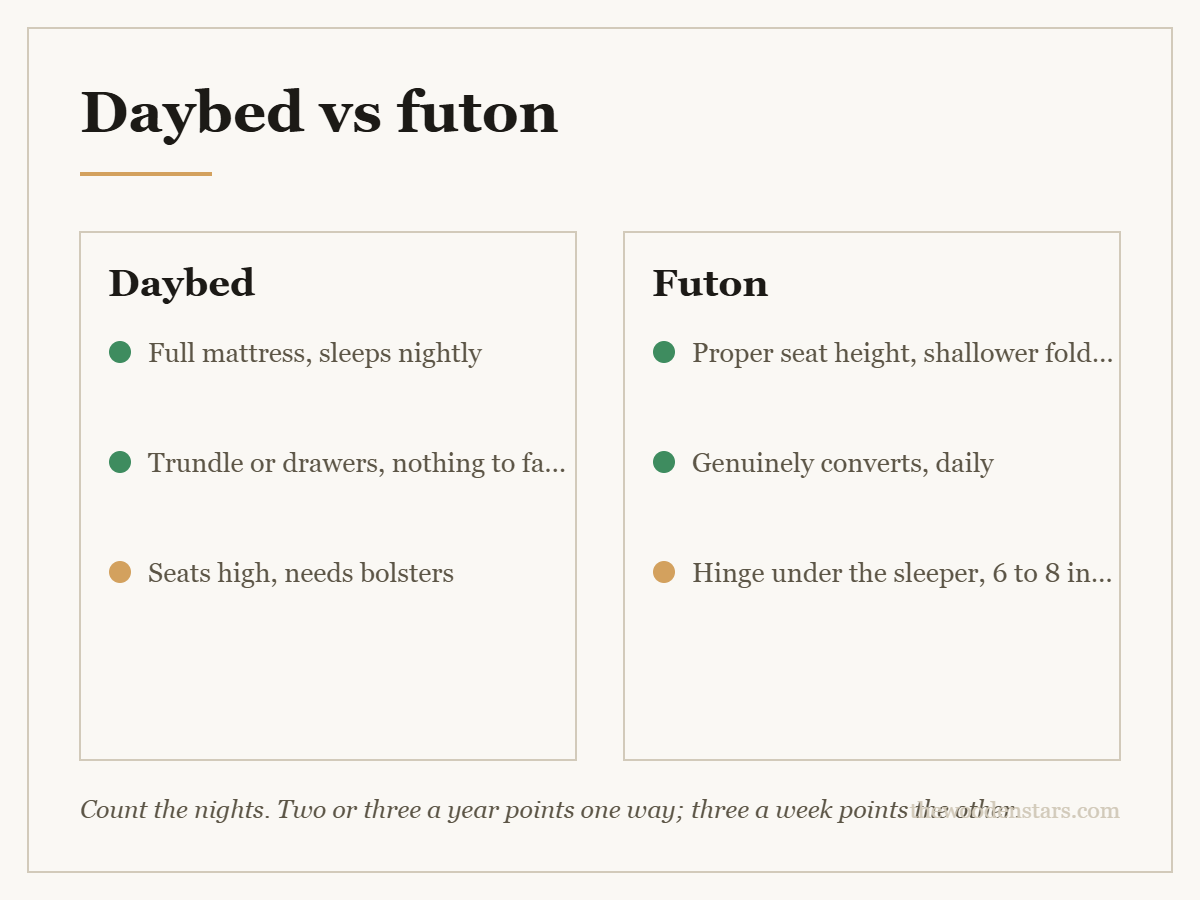
Daybed vs futon is a choice between a bed shaped like a sofa and a sofa that unfolds into a bed. They look like alternatives on a listing page and they behave nothing alike.
The daybed keeps a real mattress on slats and asks you to accept a high seat. The futon gives a proper seat height and asks you to sleep on a folding pad.
A daybed is a twin frame with a back and two ends. It takes a standard 38 × 75-inch mattress on slats, so it sleeps like a bed and seats badly — the deck plus mattress puts the seat at 20 to 30 inches against a sofa’s 17 to 19, and you need bolsters. A futon folds flat: the seat sits at proper sofa height and the sleeping surface is a 6 to 8-inch folding pad over a hinge, which most people find acceptable for guests and tiring nightly. Daybed for sleeping, futon for sitting.
Daybed vs futon: the hinge is the whole difference
A daybed has no mechanism. It is a frame, slats, and a mattress that never moves. Everything good and bad about it follows from that.
A futon has a hinge across the middle. In sofa position the back is up and the seat is at 17 to 19 inches; folded flat it becomes a sleeping surface with a joint running across it.
So:
- Daybed: sleeps like a bed, sits like a bed pushed against a wall.
- Futon: sits like a sofa, sleeps like a folded pad.
Neither does both well, and any listing that claims otherwise is describing the one it is selling.
| Measure | Daybed | Futon |
|---|---|---|
| Sleeping surface | Full mattress on slats | 6 to 8 in pad over a hinge |
| Seat height | 20 to 30 in | 17 to 19 in |
| Needs cushions to sit | Yes, 14 to 17 in of bolsters | No |
| Nightly sleeping | Yes | Tiring for most people |
| Size | Twin, full, queen | Full is the common size |
| Underneath | Trundle or drawers | Usually open |
| Converts | No, it is always a bed | Yes, daily if you like |
What the futon gets right
Seat height. This is the honest advantage. A futon seats at sofa height without accessories. A daybed does not seat properly without buying bolsters, and those bolsters have to live somewhere when it is a bed.
Depth when folded. A futon in sofa position is about 35 inches deep. A daybed is 40 to 44 whatever it is doing.
It genuinely converts. For a room that alternates between living space and guest room, the futon does a job the daybed cannot — the daybed always looks like a bed with a back on it.
What the futon gets wrong
The hinge. Folded flat, there is a joint across the middle of the sleeping surface. A good pad disguises it; nothing removes it, and it is under your hips.
Pad thickness. Six to 8 inches, and it must fold — so it cannot be a supportive innerspring. Fine for two or three nights. Nightly use is where futons lose people.
Mechanism wear. The hinge is the part that fails, and on cheap frames it is the part built cheapest. A daybed has nothing to fail.
What the daybed gets right, and wrong
Right: it is a real bed. A standard mattress on properly spaced slats, replaceable with any mattress you like. Somebody can sleep on it every night for years. See twin daybeds.
Right: it can take a trundle. That turns one twin into two beds, and a pop-up trundle brings the second level with the first. A futon offers nothing equivalent — daybeds with a trundle.
Right: storage. Drawers underneath, on a frame that is not going anywhere — daybeds with storage.
Wrong: the seat. A 6-inch mattress on a 16-inch deck gives 22 inches, which is perchable. A 12-inch mattress gives 28, which is not. If the room is seating-first, buy the thin mattress and add a topper for the nights it is used.
How to choose
- Count the nights. Under about fifteen a year, the futon’s pad is fine. Weekly or nightly, buy the daybed.
- Count the hours of sitting. If the piece is a sofa most of the time, the futon’s seat height is worth more than the daybed’s mattress.
- Measure the depth. Thirty-five inches against 44 decides some rooms outright.
- Ask whether two guests ever come. Only the daybed answers that, via a trundle.
- Look at what fails. A futon hinge wears; a daybed frame does not have one.
If the answer is “mostly a bed, occasionally seating”, that is the daybed — and the comparison against a plain bed is in daybed against twin bed. If it is “mostly seating, occasionally a bed”, look at daybed against sofa bed too, since a proper sofa bed does that job better than a futon.
Frame quality, on either
On a daybed, the joint to watch is where the back rail meets the end panels — it takes a lever every time somebody leans back. Look for panelled ends and bolted joints, and timber slats under 3 inches apart rather than a wire grid: bed slat replacement and spacing.
On a futon, watch the hinge hardware and the arms, which get sat on. Solid hardwood arms hold a bolt; particleboard ones split at exactly that fixing — what engineered wood actually is.
Making either one work
- Firm bolster cushions What turns a daybed into something you can actually sit on
- Two-inch mattress topper Covers a futon hinge, or lets a daybed keep a thin mattress
- Centre support leg Seventy-five inches of daybed slat span wants one
- Felt slat tape Stops the slat rub that makes a daybed creak
What to buy

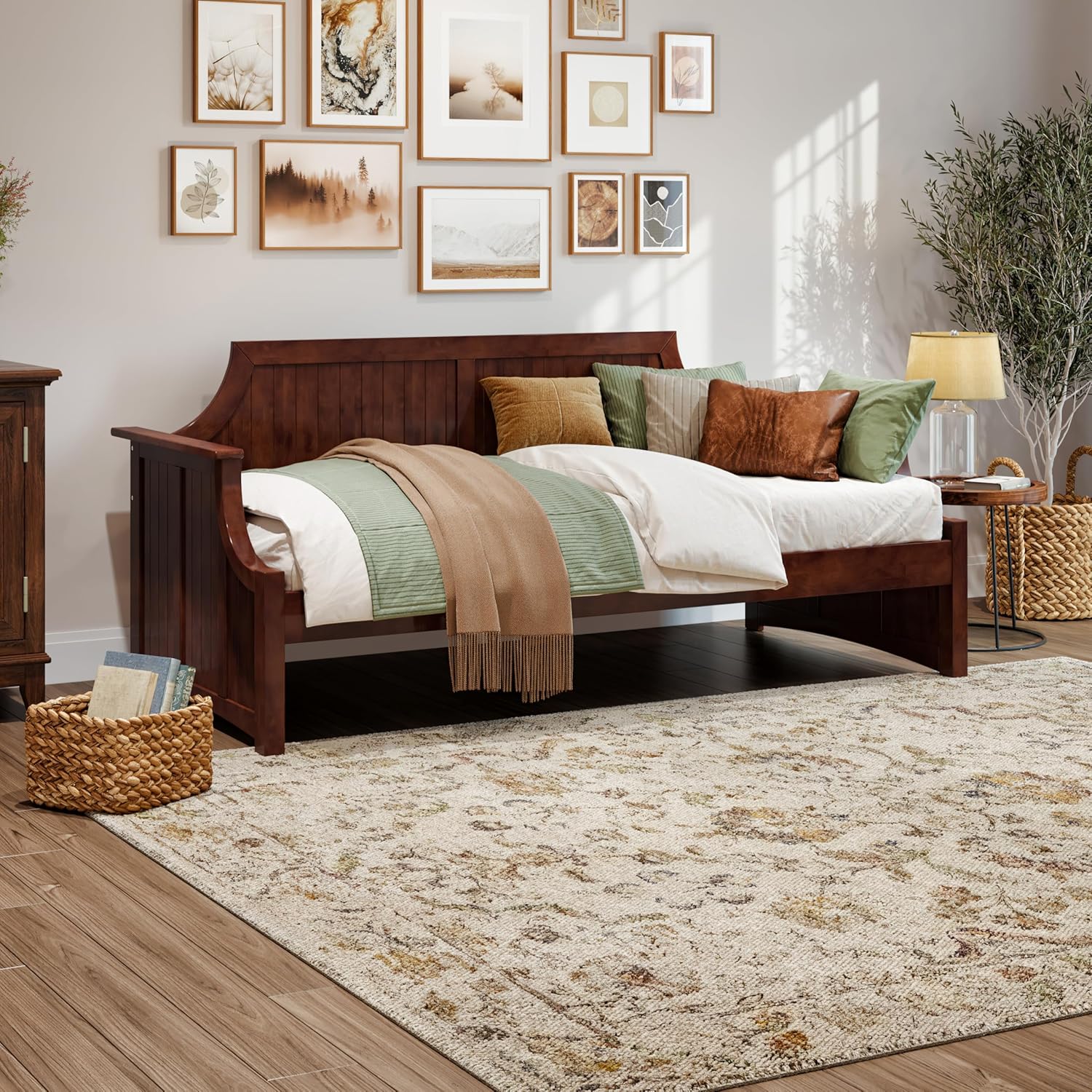


For daybeds by size, see twin daybeds, full size daybeds and queen daybeds. For the storage versions, daybeds with storage and daybeds with a trundle. For the seating-first route, daybed against sofa bed.
Questions we get asked
What is the difference between a daybed and a futon?
A daybed is a twin frame with a back and two ends, holding a fixed mattress. A futon folds on a hinge from sofa to bed.
Which is more comfortable to sleep on?
The daybed, clearly. It takes a full mattress on slats; a futon gives you a 6 to 8-inch folding pad with a hinge across the middle.
Which is more comfortable to sit on?
The futon. It seats at 17 to 19 inches without accessories, while a daybed sits at 20 to 30 and needs bolsters.
Can you sleep on a futon every night?
Some people do, but most find the folding pad and the hinge tiring past a couple of weeks. For nightly use, buy the daybed.
Which takes less room?
The futon, when folded — about 35 inches deep against 40 to 44 for a daybed.
Can either sleep two people?
The daybed can, with a trundle underneath. A futon has no equivalent, beyond buying a full-size one and sharing the pad.