Trundle bed vs bunk bed — Floor space against ceiling height
The Wooden Stars is a participant in the Amazon Services LLC Associates Program. We may earn a commission when you buy through links on our site, at no extra cost to you.
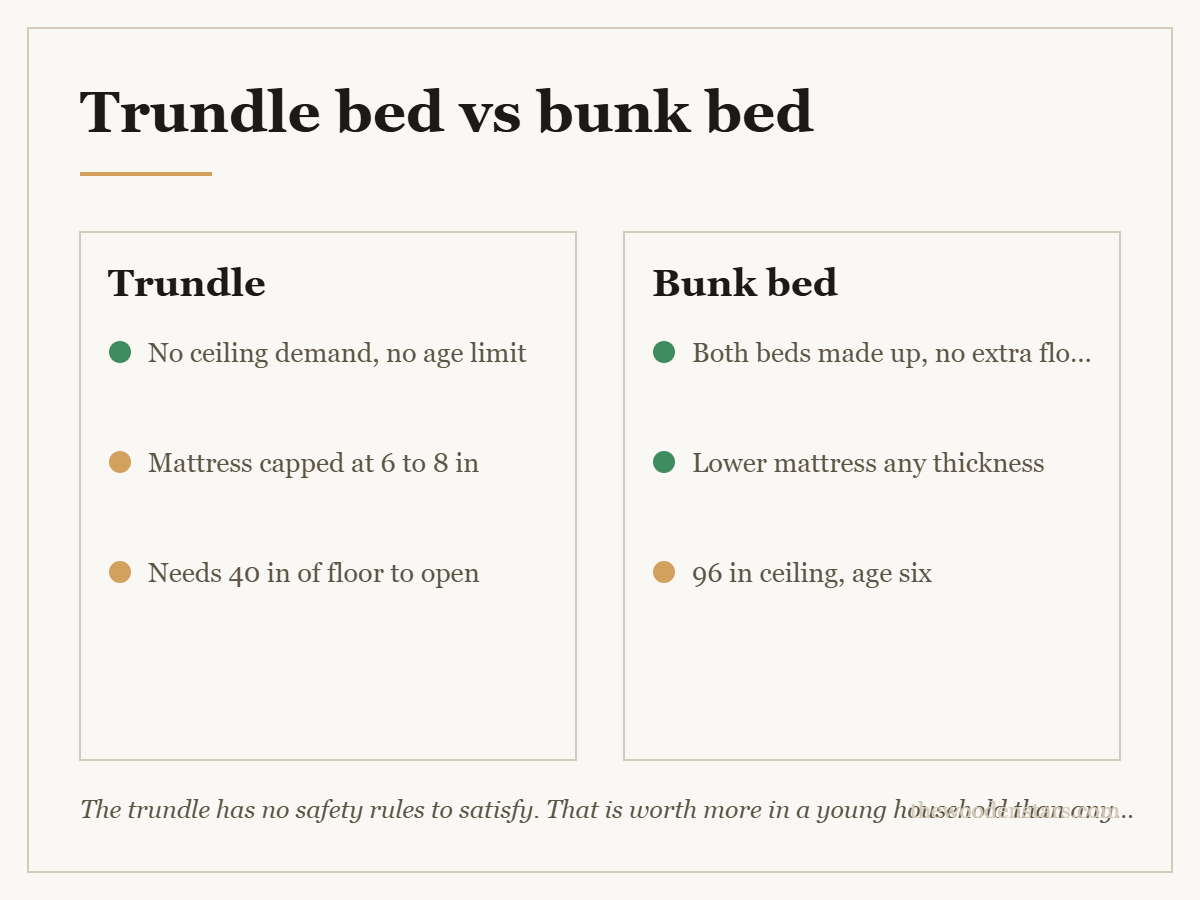
Trundle bed vs bunk bed is a choice between spending floor area and spending ceiling height. Both sleep two people; one lays the second bed sideways, the other stacks it.
Which is right depends entirely on which dimension your room is short of, and that is usually obvious once you measure.
A trundle is a second mattress on a rolling frame stored under the first one. It needs 38 to 44 inches of clear floor alongside to pull out, and no extra ceiling. A bunk bed stacks the second mattress and needs about 96 inches of ceiling but no extra floor. The trundle mattress is capped at 6 to 8 inches by the clearance under the deck; a pop-up version lifts level with the main bed, a roll-out stays at 8 to 14 inches off the floor. Bunks suit permanent sharing; trundles suit occasional guests.
Trundle bed vs bunk bed: which dimension you are short of
The trundle spends floor
Closed, it takes exactly the footprint of one bed. Open, it needs its own width again beside the bed plus room to walk — call it 38 to 44 inches.
That is fine in a room used one way at a time: the trundle is out overnight and back under by morning. It is not fine where the floor is permanently committed.
The bunk spends ceiling
Two mattresses in 23 square feet, permanently. Nothing has to be pulled out, and both beds can be made up all the time.
The cost is 96 inches of ceiling and a lower bunk that lives under a deck. The full arithmetic is in twin over twin bunk beds.
| Measure | Trundle | Bunk bed |
|---|---|---|
| Ceiling needed | None beyond a normal bed | About 96 in |
| Floor needed to use | 38 to 44 in alongside | None extra |
| Second mattress | 6 to 8 in, capped by clearance | Same as the first |
| Both beds made up | No, one is stored | Yes |
| Second sleeper height | 8 to 14 in, or level if pop-up | 56 to 64 in up |
| Suits | Occasional guests | Permanent sharing |
Pop-up or roll-out changes the answer
This is the detail that decides whether a trundle competes with a bunk at all.
A roll-out trundle stays low — the mattress ends up 8 to 14 inches off the floor. Fine for a child, a floor-level manoeuvre for an adult.
A pop-up trundle lifts on a scissor mechanism to the height of the main bed, so you get two beds at the same level that can be pushed together into one large sleeping surface. For adult guests this is the version worth paying for, and it is what makes a daybed-plus-trundle a genuine alternative to a bunk. The mechanism is covered in daybeds with a trundle.
Mattress thickness: both are capped, differently
A trundle mattress is limited by the clearance under the main deck — typically 11 to 14 inches, minus a 3 to 5-inch frame, leaving 6 to 8 inches. Thicker will not slide back under.
A bunk top mattress is limited by the guard rail, which must stand 5 inches above the sleeping surface — again usually 6 inches. The lower bunk has no such cap, which is one quiet advantage of the bunk: at least one of the two sleepers gets a full-thickness mattress.
The rail rule is worked through in how thick a bunk bed mattress can be.
Safety: the bunk has rules, the trundle mostly does not
A trundle sits at floor level. There is nothing to fall from, no guard rail to specify, no minimum age.
A bunk has all three. The usual guidance is age six for the top bunk, rails on both sides standing 5 inches proud of the mattress, no gap wider than 3.5 inches, and the frame anchored to a stud. The reasoning is in what age a bunk bed is safe for.
For a household with a four-year-old, that difference alone often settles it — or pushes you to a low loft bed, which splits the difference.
Castors, which is where trundles disappoint
A trundle rolls on castors on your floor — there is no alternative, because it has to move.
On hard floors this works; look for a soft tread rather than bare plastic, which marks timber. On carpet, small hard wheels sink into the pile and the trundle becomes something you avoid using. Larger-diameter castors ride over pile and are usually replaceable.
A bunk has no equivalent failure mode. Its complaints are noise and joints, both fixable — why a wooden bed frame squeaks.
What each is made of
For the bunk, material is a safety question: solid hardwood with bolts into barrel nuts is what produces 400 lb-plus ratings — wooden bunk beds and the hardwood hardness scale.
For the trundle, the fixings that matter are the castor mounts, which take a shear load every time it is pulled out. Particleboard fails there first — what engineered wood actually is.
Either way
- Large-diameter castors Small hard wheels sink into carpet, and they are usually replaceable
- Mattress topper A trundle mattress is capped at 6 to 8 inches, and a topper fixes the night
- T-handle hex key A bunk frame wants its joints pulled up annually
- Anti-tip wall strap For the bunk, which is tall and gets climbed from the side
What to buy


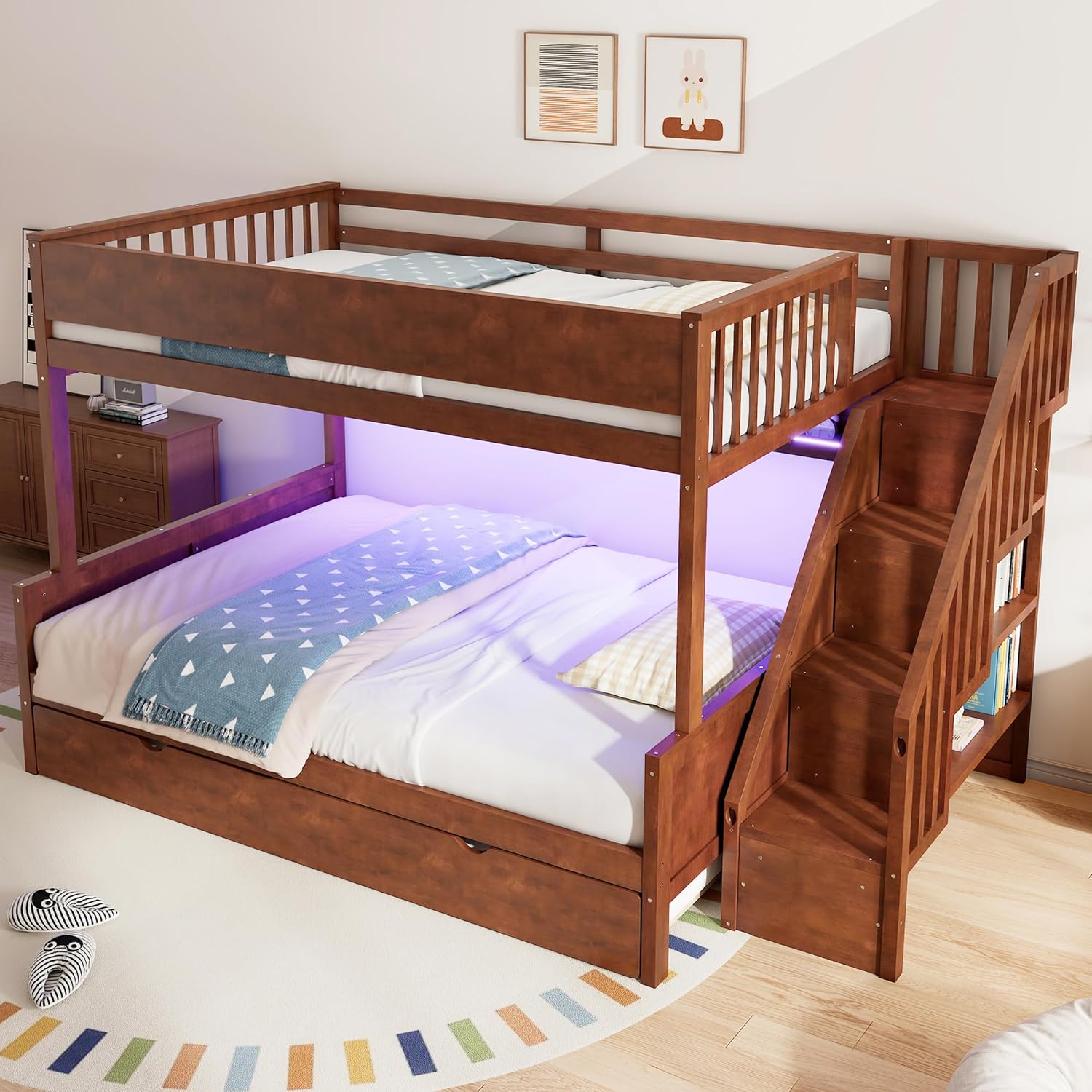
For the trundle route, see daybeds with a trundle and twin daybeds. For the bunk route by size, twin over twin, twin over full and wooden bunk beds. For a middle path, loft bed against bunk bed.
Questions we get asked
Does a trundle bed need less space than a bunk bed?
Less ceiling, more floor. A trundle needs 38 to 44 inches beside the bed to pull out; a bunk needs about 96 inches of ceiling and no extra floor.
How thick can a trundle mattress be?
Six to 8 inches, limited by the clearance under the main deck. Thicker will not slide back under.
Is a trundle comfortable for an adult?
A pop-up trundle, yes — it lifts level with the main bed. A roll-out leaves the mattress 8 to 14 inches off the floor, which most adults find low.
Which is safer for young children?
The trundle. It sits at floor level, so there is no guard rail to specify and no minimum age. Bunks are usually rated from about six for the top bunk.
Can both beds stay made up?
On a bunk, yes. A trundle has to be pushed back under, so the second bed is stored rather than standing ready.
Will a trundle roll on carpet?
With large-diameter castors, yes. Small hard wheels sink into the pile — and they are usually replaceable.