Bed frames with drawers underneath — Carpet, clearance and slides
The Wooden Stars is a participant in the Amazon Services LLC Associates Program. We may earn a commission when you buy through links on our site, at no extra cost to you.
Under a bed is the largest unused volume in most homes — roughly 20 cubic feet under a queen. Building drawers into the frame is the obvious way to claim it, and the reason it does not always work has nothing to do with the bed.
It has to do with your floor, and with where the drawer goes when it comes out.
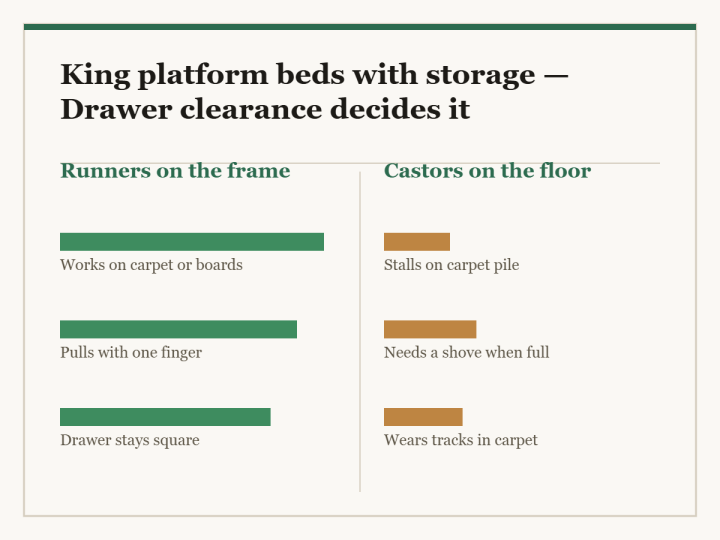
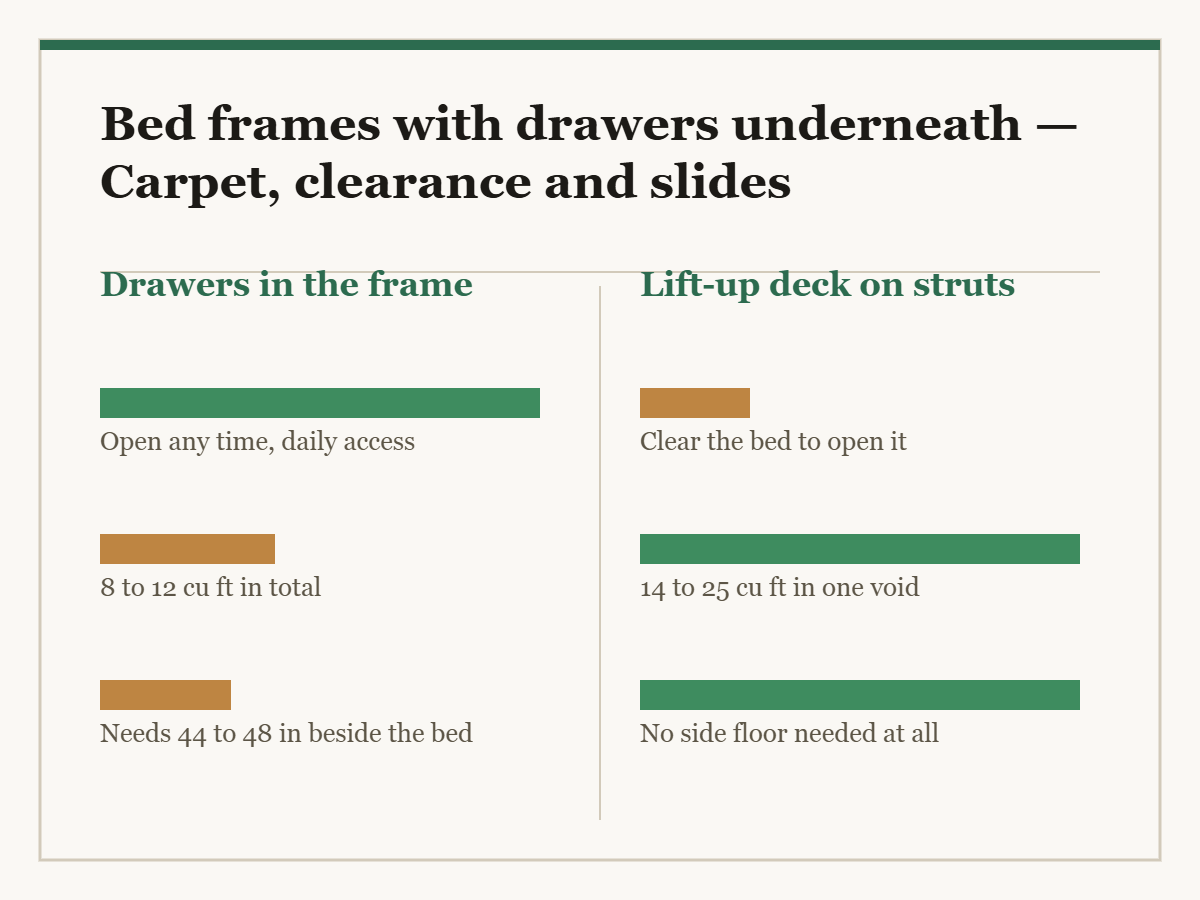
Drawers in a bed frame run one of two ways, and the difference decides everything. Runners fixed to the frame keep the drawer off the ground, so it works on carpet, boards or tile and pulls with one finger. Castors that roll on your floor are cheaper and stall in carpet pile, needing a shove and cutting tracks over time. Each drawer holds 2 to 3 cubic feet. Allow 44 to 48 inches of clear floor on the drawer side — the drawer projects 18 to 24 and somebody has to stand behind it. The base also rises: a storage deck sits at 14 to 18 inches rather than 10 to 12, so pick the mattress thickness to suit.
Runners or castors — the one thing to check
Castors running on the floor
The drawer box has small wheels underneath and rolls on whatever the bed stands on. This is what most budget storage frames use, and on a hard floor it is fine.
On carpet it is not. The wheels sink into the pile and the drawer stops being something you open casually. Worse, over a year or two the castors cut visible tracks, which you only see when the bed moves.
Runners mounted to the frame
Metal or timber runners fixed to the bed rails, so the drawer hangs from the frame and never touches the floor. Floor type stops mattering entirely.
This is what separates frames that photograph identically. If a listing does not say, assume castors — manufacturers who fit proper runners mention it.
Clearance, which is the measurement people miss
A drawer under a bed projects 18 to 24 inches when fully open — the drawer is as long as the bed is deep, minus the rail.
Add room for a person and you need 44 to 48 inches of clear floor on the drawer side. A bedroom walkway is typically 24 to 30, so this is roughly double what feels adequate when you stand in the room.
Practical consequences:
- Pick the drawer side before ordering. Many frames are handed, and a drawer facing a wardrobe is a drawer you will never open.
- Footboard drawers need the same projection at the foot, which in most bedrooms is the main route past the bed.
- A bed against a wall on one side loses those drawers entirely unless the frame has them on both sides.
| Type | Volume | Works on carpet | Floor needed |
|---|---|---|---|
| Drawers on frame runners | 2 to 3 cu ft each | Yes | 44 to 48 in on that side |
| Drawers on floor castors | 2 to 3 cu ft each | Poorly | 44 to 48 in on that side |
| Lift-up deck on gas struts | 14 to 25 cu ft | Not applicable | Room to clear the bed |
| Plain frame plus rolling boxes | 1 to 2 cu ft each | On a hard floor | Same as drawers |
| Divan base with drawers | 2 to 3 cu ft each | Usually castors | 44 to 48 in |
Bed height, and how to control it
A plain platform deck sits at 10 to 12 inches. A storage deck has to clear the drawer boxes, so it sits at 14 to 18.
Add the mattress and that is your sitting height. A comfortable bed for most adults is 24 to 25 inches to the top of the mattress — feet flat on the floor, thighs level.
- 16-inch deck + 8-inch mattress = 24 inches. Comfortable.
- 16-inch deck + 12-inch mattress = 28 inches. High.
- 18-inch deck + 14-inch mattress = 32 inches. You climb in.
The lever is mattress thickness, and it is worth deciding the two together rather than in sequence.
Centre support, the failure nobody plans for
A queen deck spans 60 inches and a king 76. Slats over that span need support in the middle, and the standard answer is a centre rail on legs down to the floor.
On a storage frame those legs land where the drawers go. Manufacturers either route the rail around the bays — which is correct — or carry it at the head and foot only, which is not. A rail unsupported across 80 inches sags, and the mattress follows within a year.
Look for a centre support leg in the parts list and check where it lands relative to the drawers. The background is in bed frame centre support legs, slats in bed slat replacement and spacing, and the joints that carry all of it in bed frame brackets.
Ventilation, which matters more than it sounds
A mattress loses moisture downwards. A plain slatted frame lets it go; a frame with drawer boxes filling the void underneath does not, and a solid deck over sealed boxes is the worst case.
Two things help. Slats rather than a solid panel over the drawer bays, and a gap at the back of the drawer boxes. If the frame has a solid deck, standing the mattress up a few times a year is a sensible habit rather than a fuss.
What it is made of
The drawer front and sides take a lever every time a loaded drawer is pulled by one corner.
Solid timber or plywood boxes stay square. Particleboard with a stapled front loosens, and once the front moves the drawer racks in the opening and jams — the runner usually gets blamed. The distinctions are in what engineered wood actually is.
For the frame, see wood bed frames and what to check on a queen wood frame. A frame that already creaks is diagnosed in why a wooden bed frame squeaks — storage frames creak more because there are more joints.
With the frame
- Bed frame centre support leg The part storage frames most often leave out
- Felt glides For castors on hard floors, instead of plastic on timber
- Bed frame brackets More joints means more load through the rail connections
- Vacuum storage bags Makes 2 cubic feet hold a duvet rather than two jumpers
What to buy


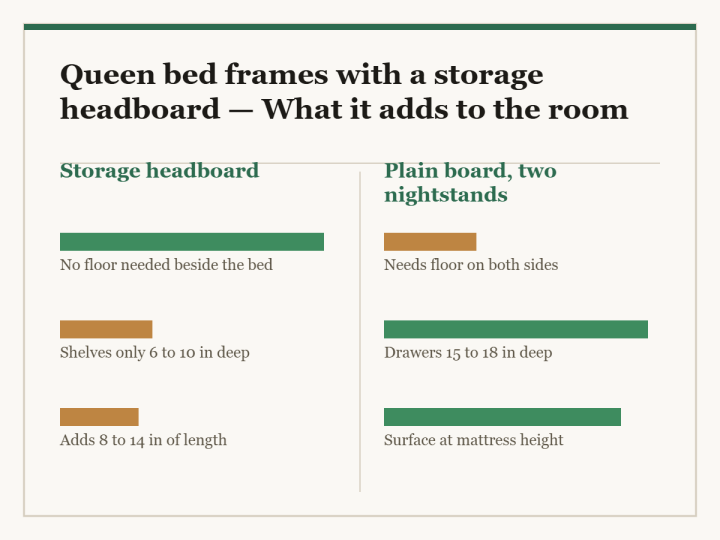
For the king version, see king platform beds with storage. To put the storage at the head end instead, queen bed frames with a storage headboard. If the bed itself should disappear, murphy beds with storage. Sizing is in queen bed frames.
Questions we get asked
Do under-bed drawers work on carpet?
Only if they run on runners fixed to the frame. Drawers on castors that roll on the floor stall in carpet pile and cut tracks in it.
How much do they hold?
Two to 3 cubic feet each. Four drawers gives 8 to 12 — roughly a chest of drawers.
How much floor space do I need?
Forty-four to 48 inches on the drawer side: 18 to 24 for the drawer plus room to stand.
How high will the bed be?
The deck sits at 14 to 18 inches. Pick the mattress thickness so the top lands near 24 to 25.
Does a storage frame still need a centre support?
Yes, and it is the part most often left out because the drawers occupy the space where the leg belongs.
Is ventilation a problem?
It can be. Prefer slats over the drawer bays and a gap at the back, and stand the mattress up occasionally if the deck is solid.