How much weight can a bunk bed hold? Ratings, read properly
The Wooden Stars is a participant in the Amazon Services LLC Associates Program. We may earn a commission when you buy through links on our site, at no extra cost to you.
How much weight can a bunk bed hold? Between 150 and 1,000 lb per deck, and the spread is so wide that the number on the listing tells you more about the frame than any other specification.
It is also the figure most often quoted for only one of the two decks, and most often quoted without saying that a mattress counts towards it.
Typical top-bunk ratings: 150 to 250 lb on metal and particleboard children’s frames, 250 to 400 lb on decent pine or rubberwood, and 400 to 1,000 lb on solid hardwood frames with bolted joints. The rating includes the mattress, which is 40 to 70 lb on a twin and 60 to 100 on a full. Ratings are static figures, and people do not apply static loads — so a frame rated at exactly your sleeper’s weight is the wrong frame. Bottom-bunk ratings are usually higher and quoted separately; if only one number is given, assume it is the top.
How much weight can a bunk bed hold once the mattress is counted
Work out what actually sits on the deck before comparing ratings.
- Twin mattress: 40 to 70 lb. Memory foam is at the heavy end.
- Full mattress: 60 to 100 lb.
- Queen mattress: 70 to 130 lb.
- Bedding: 10 to 25 lb.
So a 200 lb-rated twin bunk with a 55 lb mattress and bedding has about 130 lb left for a person. That is a child, and not a large one.
A 400 lb frame with the same mattress leaves 330 — a teenager or an adult with margin.
| Top deck rating | Frame | Suits |
|---|---|---|
| 150 to 250 lb | Thin metal tube or particleboard | A child, and only a child |
| 250 to 400 lb | Pine or light rubberwood, screwed | A teenager |
| 400 to 600 lb | Solid hardwood, bolted joints | One adult, or a twenty-year frame |
| 600 to 1,000 lb | Heavy hardwood or thick-wall steel | Two adults, rentals, holiday houses |
Static rating against real use
Published ratings are static: the load a frame holds without deflecting past a limit. Children do not apply static loads. Neither do adults getting into bed.
Sitting down hard on the edge of a bunk can momentarily apply two to three times body weight at one corner. That is why the rule of thumb is rate for roughly double the sleeper’s weight, not for their weight.
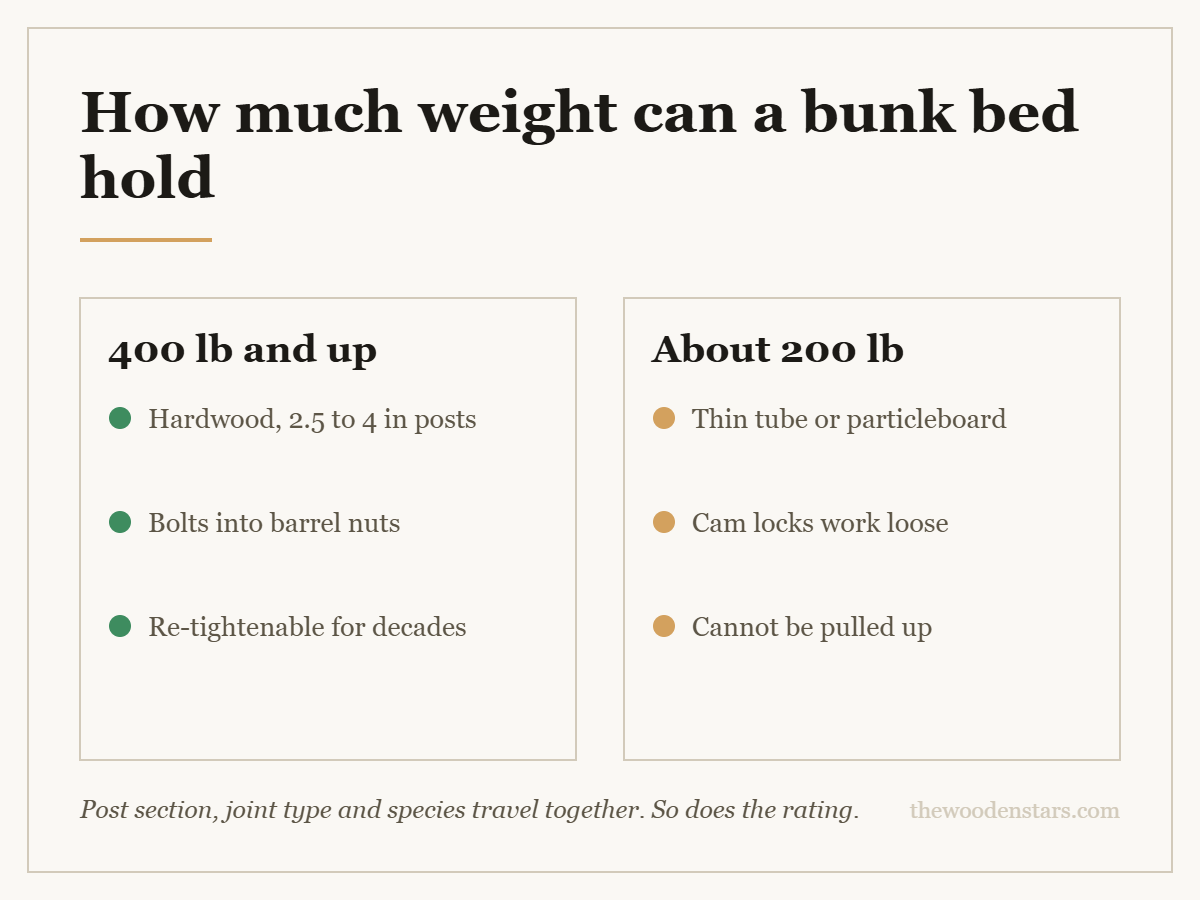
It is also why the joint type matters as much as the number. A frame rated 400 lb on cam locks loosens under repeated peak loads; the same rating on bolts into barrel nuts can be pulled up annually and stays true. The comparison is in wooden bunk beds.
Where the rating actually comes from
Three things set it, and they travel together:
Post section. Under 2 inches square a six-foot post flexes when someone climbs. Two and a half is the sensible minimum in hardwood; 3 to 4 is what the adult-rated frames use.
Joint type. Bolts into barrel nuts, not screws into end grain and not cam locks. This is what makes a high rating survive year three.
Species. Solid hardwood — rubberwood, birch, acacia, oak — holds a bolt in end grain under cyclic load. Particleboard does not, at any stated rating. See the hardwood hardness scale and what engineered wood actually is.
If a listing quotes 500 lb on 1.5-inch posts with cam locks, treat the number sceptically.
The part the rating does not cover: the slats
A deck rating assumes the slats are in place and correctly spaced. Slats are also the cheapest thing to skimp on.
- Spacing under 3 inches for a foam or hybrid mattress, up to about 4 for sprung.
- Solid timber of a real section, not thin sprung ply — ply slats are fine on an adult bed at floor level and are the first thing to break on a bunk that gets jumped on.
- Fixed at each end, not resting in a groove. A loose slat rubs, and that rub is most of the noise a bunk makes.
Details in bed slat replacement and spacing. At full and queen widths the deck also needs a centre rail — bed frame centre support legs.
Keeping the rating over time
- Tighten every joint after the first month, then annually. On a bolted frame this is ten minutes with a T-handle key; the supplied L-key is too short to torque properly.
- Do not exceed the stated mattress thickness — usually 6 inches. A thicker mattress adds weight and leaves the guard rail level with the sleeping surface — see how thick a bunk bed mattress can be.
- Anchor the frame to a stud. Not a load rating, but it is the failure that hurts.
- Level it. A bunk rocking between diagonal corners puts all its load through two posts instead of four — levelling feet and glides.
Keeping the frame at its rating
- T-handle hex key The supplied L-key cannot torque a bunk joint properly
- Felt slat tape Stops loose slats rubbing, which is most bunk-bed noise
- Anti-tip wall strap The failure that a weight rating says nothing about
- Levelling feet A rocking frame loads two posts instead of four
What to buy


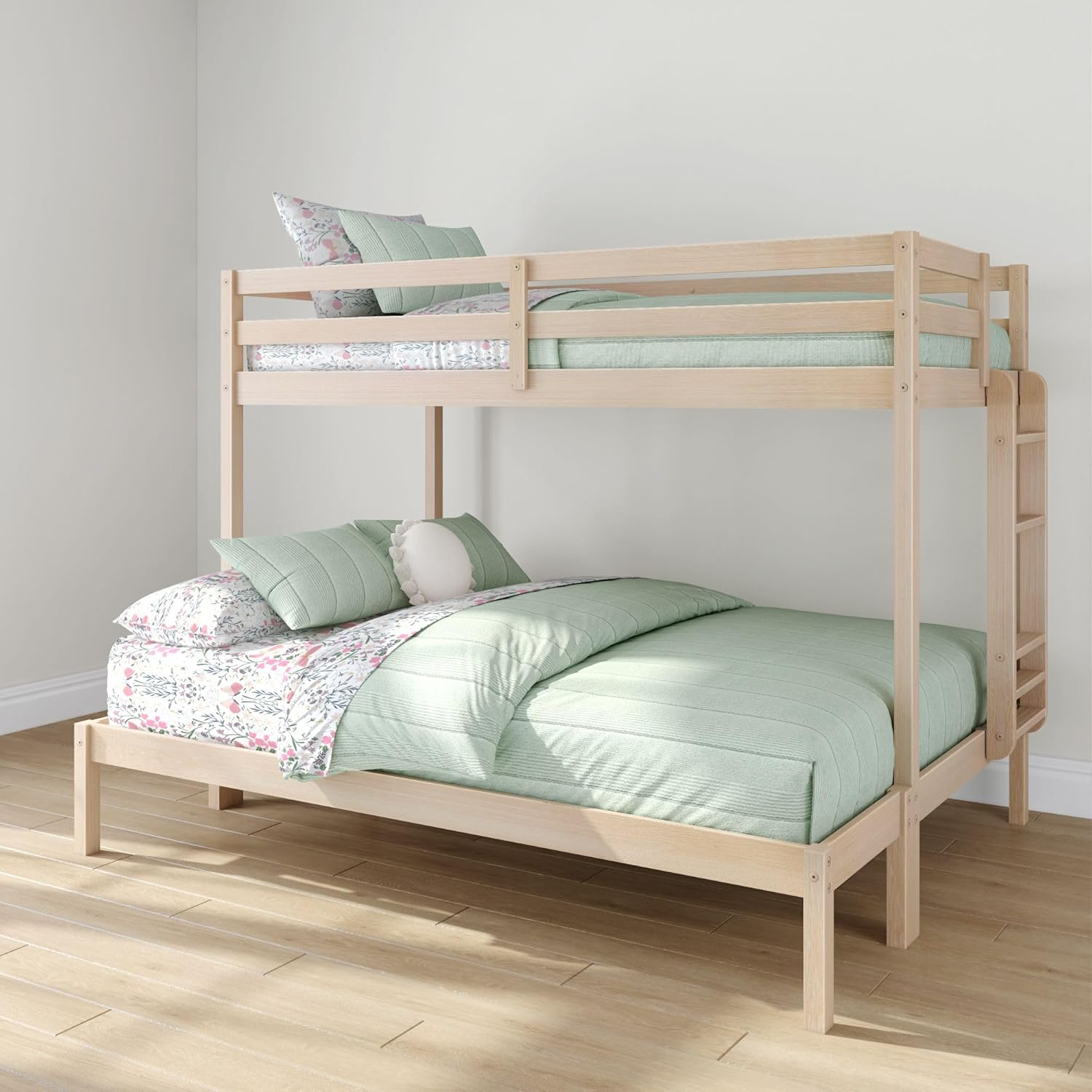

For adult-rated frames, see full size bunk beds and queen bunk beds. For construction and joints, wooden bunk beds. On whether adults should be up there at all, can adults sleep on a bunk bed. For the age question, what age a bunk bed is safe for.
Questions we get asked
How much weight can a bunk bed hold?
Between 150 and 1,000 lb per deck depending on the frame. Children’s metal and particleboard frames sit at 150 to 250; solid hardwood with bolted joints reaches 400 to 1,000.
Does the rating include the mattress?
Yes. Subtract 40 to 70 lb for a twin mattress and 10 to 25 for bedding before working out what is left for the sleeper.
Is the bottom bunk rated the same as the top?
Usually higher, and it should be quoted separately. If a listing gives only one figure, assume it is the top deck.
How much margin should I leave?
Rate for roughly double the sleeper’s weight. Published figures are static, and getting into bed applies two to three times body weight momentarily.
Can I trust a high rating on a cheap frame?
Check the post section and joint type. Five hundred pounds quoted on 1.5-inch posts with cam locks does not survive year three.
Do the slats affect the rating?
The rating assumes correct slats. Spacing under 3 inches for foam, solid timber rather than thin ply, and fixed at both ends.