Queen Murphy beds — What the cabinet costs you in wall and floor
The Wooden Stars is a participant in the Amazon Services LLC Associates Program. We may earn a commission when you buy through links on our site, at no extra cost to you.

A queen Murphy bed is the size most people picture when they picture a wall bed, and it is the size where the numbers stop being forgiving. A queen mattress is 60 inches wide and 80 inches long, and both of those dimensions have to exist somewhere in the room whether the bed is up or down.
The cabinet takes the width off a wall permanently. The length becomes floor you can never fill. Everything else about choosing one follows from those two facts.
A queen Murphy cabinet needs a clear wall wider than 60 inches — usually well over 70 once you count the cabinet sides — and 80 inches of clear floor in front of it that stays clear every night. It must be anchored into studs. The one number people miss is the maximum mattress thickness, which every cabinet states and which decides what mattress you are allowed to buy. Vertical mount is the default; if your ceiling is low, look at a side-mount instead.
The three measurements that decide whether it fits
Take these before you look at a single product photograph.
Wall width
The mattress is 60 inches. The cabinet is wider than the mattress, because the mattress sits inside a frame inside a case. How much wider varies by model, and the listing states it — but plan on needing meaningfully more than 60 inches of uninterrupted wall, with nothing in the way at the edges: no light switch you need to reach, no door swing, no radiator.
Floor depth when open
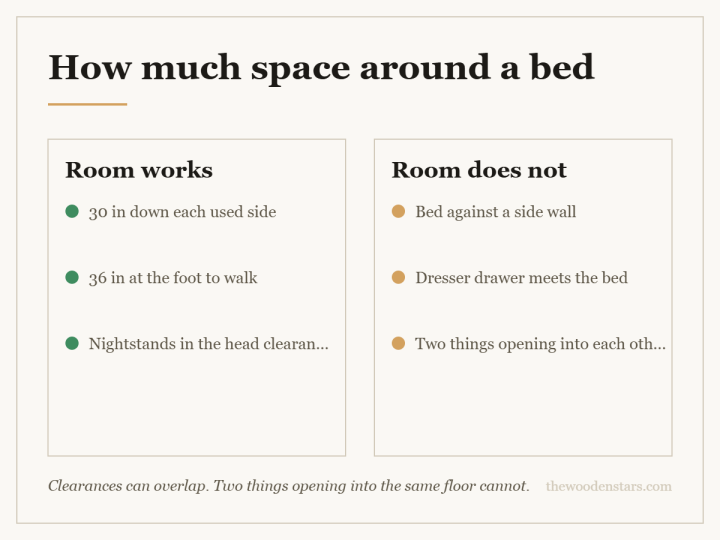
Eighty inches. That is the mattress length, and it is not negotiable. Measure from the wall out into the room and see what is standing there. A coffee table that has to be moved every night gets moved for a week and then the bed stops being used.
Ceiling height
A vertical Murphy bed pivots the mattress up on its short edge, so the cabinet plus the swing arc needs headroom. In a room with a standard ceiling this is rarely a problem; in a basement conversion or under a slope it often is. If the ceiling is the constraint, the answer is a side-mount bed, which folds sideways and needs far less height.
| Measurement | What it has to be | Where it comes from |
|---|---|---|
| Mattress | 60 × 80 in | US queen standard |
| Wall width | More than 60 in, cabinet-dependent | Stated on the listing |
| Clear floor when open | 80 in | Mattress length |
| Mattress thickness | Under the cabinet’s stated maximum | Stated on the listing |
| Fixing | Into studs, not drywall alone | Manufacturer instructions |
The mattress limit is the trap
This is the number that catches people, and it catches them after the cabinet has been installed.
A Murphy bed folds the mattress into the cabinet with the bedding still on it. The cabinet has a fixed internal depth, so there is a maximum mattress thickness it will close on — and a modern hybrid or pillow-top can easily exceed it. Buy the mattress after you have the cabinet’s number, not before.
Two related points that follow from the same geometry:
- A retention strap is not optional. The mattress has to be held to the platform or it slides when the bed swings up. Cabinets ship with one; use it.
- Foam and hybrid are easier than a thick innerspring. Not because innersprings are worse to sleep on, but because they are usually taller for the same feel.
What the cabinet is made of, and why it matters here
On most furniture the carcass material is a question about longevity. On a Murphy bed it is a question about fixings under repeated load.
Every time the bed swings, the mechanism puts force into the points where it is bolted to the case, and the case puts force into the wall anchors. Solid timber and good plywood hold a screw and keep holding it. Particleboard does not: the fixing works loose, the hole enlarges, and there is no good repair. A cabinet that is board inside with a veneer face will look identical on day one.
Be realistic about the market, though. Most Murphy bed cabinets at ordinary prices are engineered panel of some kind, and that is not automatically disqualifying — a well-made plywood or thick MDF case with metal reinforcement at the load points can be entirely sound. What you are looking for is where the board is, not whether any board exists. How to read the vocabulary on a listing is in our guide to what engineered wood actually is.
Vertical or side-mount
A vertical queen swings up on the 60-inch edge and stands 80 inches tall against the wall. A side-mount swings on the 80-inch edge, so it stands about 60 inches tall and sticks out 80 inches along the wall.
The trade is height for width. Vertical eats ceiling; side-mount eats wall. Most rooms have more ceiling than spare wall, which is why vertical is the default — but if you are working under a sloped ceiling or in a basement, the horizontal queen is the version to price up.
What it costs, and where the money goes
Prices here come from Amazon’s feed and go stale — treat them as a band and check the current figure. Queen cabinets span a wide range, and the spread is mostly mechanism and case, not looks.
The lift mechanism is the part that decides whether the bed is pleasant in year five. A gas piston system stays smooth and can usually be adjusted for mattress weight; a spring system is cheaper and gets stiffer or floppier as the springs age. Which one you are buying is covered in piston against spring.
If the budget is the binding constraint, read where the money comes out of a cheap Murphy bed first — some of the savings are fine and some of them are the mechanism.
Before you order
- Stud finder The cabinet must land on studs; drywall anchors alone are not enough
- Tape measure Wall width, 80 in of clear floor, and the ceiling
- Spirit level A cabinet out of plumb makes the bed fold badly for its whole life
- Mattress retention strap Ships with most cabinets; replace it rather than skip it
Who a queen Murphy bed is actually for
- A studio where you sleep every night. The mattress is a real one, so the daily comfort is the same as a bedroom.
- A guest room that is normally an office. The bed disappears completely rather than dominating the room.
- Not for renters, in most cases — the wall fixing is the problem. A freestanding cabinet bed solves that at the cost of a permanent box in the room.
What to buy


If you are still weighing this against the other way of turning one room into two, the comparison is set out in Murphy bed against sofa bed. And if a different size fits your wall better, the four sizes are compared side by side in Murphy bed sizes.
Questions we get asked
How much wall do I need for a queen Murphy bed?
More than the 60-inch mattress width — the cabinet sides add to it, and the exact figure is on the listing. Measure the usable wall between obstructions rather than the wall itself, because a light switch or a door swing at the edge removes the width just as effectively as a wall does.
Can a queen Murphy bed go on a drywall-only wall?
Not safely. The mechanism turns a heavy mattress into a lever, and the load goes into the fixings every time the bed moves. Find the studs. If there are none where you need them, that is a reason to change the plan, not a reason to improvise.
What mattress thickness fits a queen Murphy bed?
Whatever the cabinet says, and no more. The limit exists because the mattress folds into the case with the bedding on it. Buy the cabinet first, read its stated maximum, then buy the mattress.
Do you need a special mattress for a Murphy bed?
Not a special type — a standard queen works. The constraints are thickness and, to a lesser degree, weight, because the lift mechanism is balanced for a range. Foam and hybrid mattresses usually sit inside both limits more easily than a tall innerspring.
How much floor space does a queen Murphy bed need when open?
Eighty inches out from the wall, the full mattress length, plus whatever room you want to walk around it. That floor has to be clear every night, which is the constraint people underestimate.
Is a queen Murphy bed comfortable?
As comfortable as the mattress in it. The platform is flat with slats and the mechanism sits behind the mattress, not under you. Comfort is a mattress decision, not a Murphy bed decision.