Queen bed frames — 60 × 80 inches, and everything that follows
The Wooden Stars is a participant in the Amazon Services LLC Associates Program. We may earn a commission when you buy through links on our site, at no extra cost to you.

A queen is 60 inches wide and 80 inches long, and it is the size most American bedrooms are laid out around. That makes it the easiest size to shop for and the easiest size to get wrong, because the frame is only half the measurement — the other half is the floor you need around it.
Get the room right first, then the frame. A frame that fits the mattress but leaves no walkway is a frame you will resent every night.
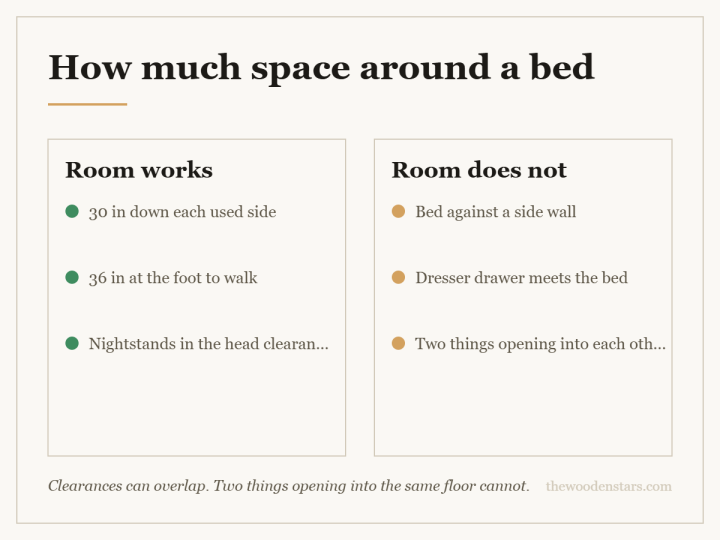
A queen mattress is 60 × 80 inches; a queen frame is typically 63 to 66 inches wide and 84 to 86 inches long once the rails and headboard are counted. Allow 24 to 30 inches of walkway on each side you use and at the foot. That means a queen wants a room about 10 × 12 feet to work comfortably. On the frame itself, check the slat gap (under 3 inches for most mattress warranties), the centre rail with two legs to the floor, and bolts into metal inserts rather than screws into end grain.
The numbers, mattress and room
| Measurement | Figure |
|---|---|
| Mattress | 60 × 80 in |
| Typical frame footprint | 63 to 66 in wide, 84 to 86 in long |
| Walkway each side | 24 to 30 in |
| Walkway at the foot | 24 to 36 in |
| Comfortable room size | About 10 × 12 ft |
| Absolute minimum room | About 9 × 10 ft, one side against a wall |
The frame is always bigger than the mattress. Rails add an inch or two per side; a headboard adds two to four inches of length; a footboard adds the same again. Listings state the overall dimensions separately from the mattress size, and the overall figure is the one your room has to satisfy.
If the room only gives you a walkway on one side, that is a workable layout — plenty of bedrooms do it — but decide which side before you buy, because it determines which side the door, the window and the sockets end up on.
What to check on the frame itself
Slats
Count them, check their thickness, and check the gap. Most foam and hybrid mattress warranties specify a maximum slat gap — commonly 3 inches — and a claim can be declined if the base did not meet it. A queen usually wants 13 to 16 slats.
Also check whether the slats are captive in a routed groove or just resting on a ledge. Loose slats walk sideways over months and eventually drop through.
The centre rail
A queen spans 60 inches, which is too far for slats to carry a mattress and two adults unaided. It needs a centre rail running head to foot with at least two legs down to the floor.
This is the most common omission on cheap queen frames, and its absence is why a frame flexes, then squeaks, then works its joints loose. A weight rating quoted without a centre leg is a number the frame cannot hold.
The joints
A bed frame is designed to come apart. The good version bolts into a threaded metal insert set in the timber; the bad version drives a wood screw into end grain, which strips by the second or third assembly. If you ever expect to move house, this is the detail that decides whether the frame survives it.
The material where it matters
Solid timber and plywood hold a screw and keep holding it. Particleboard enlarges its hole under repeated load and cannot be cleanly repaired — which matters most where the rails meet the posts. Panel elsewhere in the frame is fine. The listing vocabulary is decoded in what engineered wood actually is.
Height: the number nobody calculates
Add the deck height — floor to the top of the slats — to your mattress thickness. That total is the height you sit on to put your shoes on, and somewhere around 22 to 26 inches suits most adults.
A 12-inch platform frame under a 12-inch mattress gives 24 inches, which is comfortable. The same frame under a 6-inch mattress gives 18, which is low. A tall frame plus a thick mattress can pass 30 inches, which is a climb. Do the arithmetic before ordering; it is the single easiest thing to get wrong.
Platform or box spring
Most queen frames sold now are platform frames: the mattress sits directly on slats, which is correct for foam and hybrid mattresses. Some frames still assume a box spring and have only a perimeter rail.
The two look identical in photographs. Putting a foam mattress on a box-spring frame without the box spring leaves nothing under its middle, and the mattress will sag there permanently. If the listing mentions a required box spring or foundation, believe it.
Queen, or something else
Two adults on a queen get 30 inches each, which is the normal American expectation of a double bed. If that feels tight, the step up is a king at 38 inches each — but a king needs 16 more inches of wall and usually a bigger room.
Going the other way, a full is 54 × 75 and gives each of two sleepers 27 inches, which is narrower than a single bed. It is a generous single rather than a comfortable double, and the case for it is set out in full against queen.
Getting it up the stairs
Queen rails are about 84 inches long and they do not bend. Measure the tightest turn on the route — a stairwell half-landing, a narrow hallway, a door at an angle — against the longest single component in the listing.
Headboards are the other problem. A one-piece queen headboard is about five feet wide and rigid. Some ship in two halves that bolt together; those are much easier to get in, and the listing will say.
For assembly and after
- Hex key set Better than the folded key in the box; saves rounding the bolt heads
- Threadlocker A drop on each rail bolt is what keeps the squeak from coming back
- Felt pads Under the legs, so the frame does not walk on a hard floor
- Tape measure Overall frame footprint plus 24 to 30 in of walkway per used side
What to buy


For the different looks at this size, see four styles of queen wood frame; for the hardwood question, hardwood against softwood; and for a straight pre-order checklist, what to check before you order. The category overview is in wood bed frames.
Questions we get asked
What are the dimensions of a queen bed frame?
The mattress is 60 × 80 inches; the frame is usually 63 to 66 inches wide and 84 to 86 inches long once rails and headboard are counted.
What size room do you need for a queen bed?
About 10 × 12 feet to walk around comfortably. A 9 × 10 foot room works with one side of the bed against a wall.
Does a queen bed frame need a centre support?
Yes — a centre rail with at least two legs to the floor. Sixty inches is too far for slats to span unaided.
How many slats does a queen bed need?
Typically 13 to 16, with gaps under 3 inches. Check your mattress warranty, because the maximum gap is usually written into it.
Do I need a box spring for a queen platform bed?
No. A platform frame supports the mattress on slats. Only buy a box spring if the frame was designed to need one.
How tall should a queen bed frame be?
Aim for 22 to 26 inches from the floor to the top of the mattress. Add the frame’s deck height to your mattress thickness before ordering.