Full size loft beds — What fits underneath
The Wooden Stars is a participant in the Amazon Services LLC Associates Program. We may earn a commission when you buy through links on our site, at no extra cost to you.
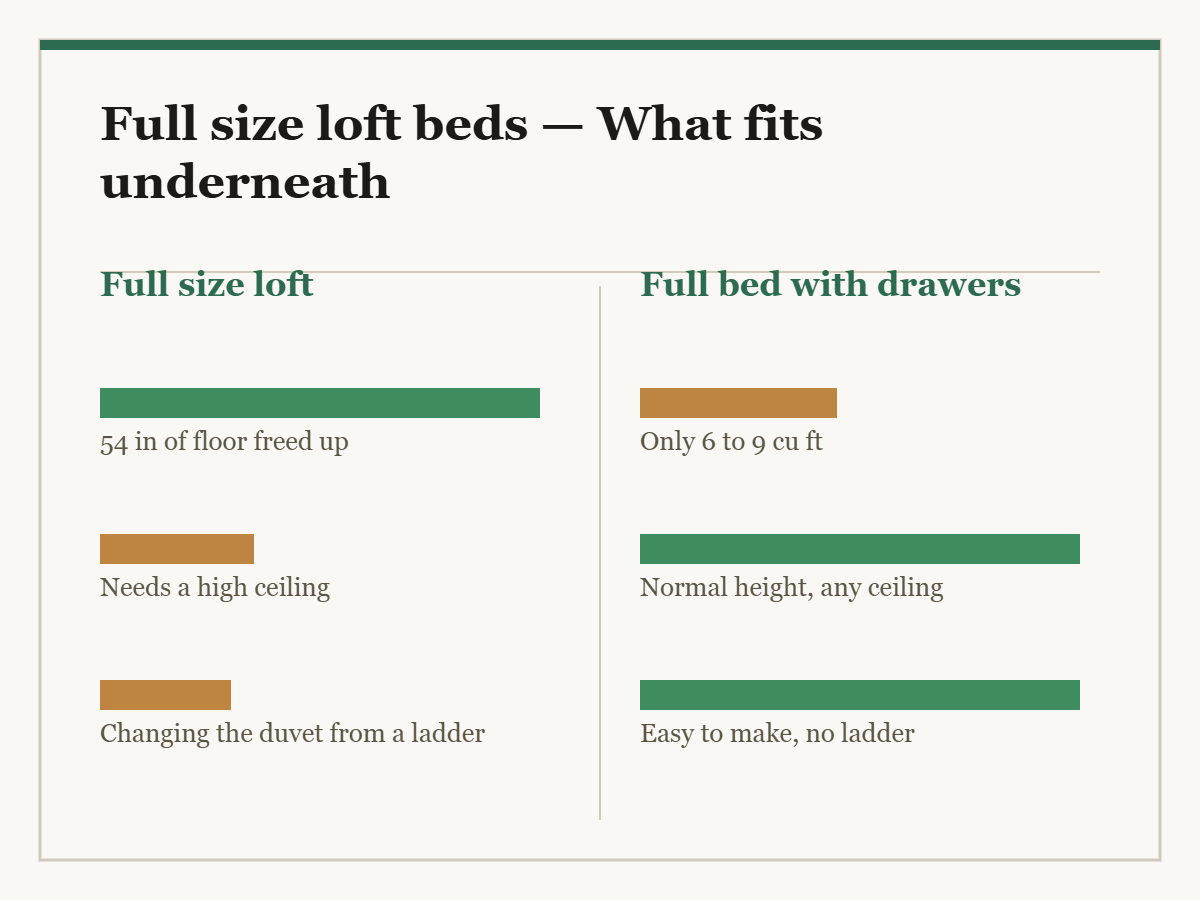
A full size loft bed is the point where a loft stops being children’s furniture. A 54-inch mattress takes an adult comfortably, which means the frame has to carry adult weight, and it means the bay underneath is 54 inches wide — wide enough to be a room rather than a nook.
Those two things pull in opposite directions, and the specification sheet tells you which one the manufacturer prioritised.
A full loft is 58 to 62 inches wide by about 80 long, and 60 to 76 inches tall. The three things to check: the weight rating, where 400 lb is the minimum for an adult sleeper and 600 is better; the clear bay height, where 30 to 34 inches suits a desk, 36 to 44 a mattress or sofa and 50 plus lets you move about; and centre support under a 54-inch slat span, which lofts often omit because a leg would land in the bay. Top mattress thickness is capped by the guard rail, usually at 6 inches, and you want 30 inches of air above it.
Who this is for
A full loft solves one of three problems, and knowing which one you have decides the height.
A teenager’s room. The bay becomes a desk and a wardrobe. Clear height of 34 to 40 inches is plenty, which keeps the top deck at a height they can make the bed at.
A studio or a small flat. The bay is the living area. You want 50 inches or more, which puts the deck at 60-plus and needs a high ceiling.
A guest room that also does something else. A full mattress underneath as well as on top — see twin over full loft beds, which is the same idea with a twin above.
The mistake is buying the tallest frame that fits the ceiling. A deck at 60 inches means changing a full duvet from a ladder, every week, forever.
Weight rating at full size
A full mattress is 54 × 75 inches and weighs 60 to 100 lb. One adult is 150 to 250. Bedding is 15.
That is 225 to 365 lb static for a single adult, and a full bed is wide enough that two people will end up on it at some point.
- Under 300 lb: a child’s frame at full size. Common, and not what the width implies.
- 400 lb: a single adult, sensibly.
- 600 lb and up: two adults, or a frame that will last twenty years.
The rating lives with the post section and the joint type: 2.5 inches square in solid hardwood, with rail-to-post bolts into barrel nuts rather than screws. Those three specifications travel together, and if a listing quotes a high rating on 1.5-inch posts, treat it sceptically.
| Measure | Range | Note |
|---|---|---|
| Mattress | 54 × 75 in | Standard full, not full XL |
| Overall width | 58 to 62 in | — |
| Overall height | 60 to 76 in | Allow 30 in above the top mattress |
| Clear bay | 30 to 54 in | Decides what goes underneath |
| Weight rating | 300 to 800 lb | 400 minimum for an adult |
| Post section | 1.5 to 3 in | 2.5 in hardwood for adult loads |
| Top mattress max | 6 in | Set by the guard rail |
Centre support across 54 inches
Fifty-four inches of slat span is not as bad as a queen’s 60, and it still sags without something down the middle.
On a loft there is nowhere to put a leg — that is the bay. So look for one of:
- A deep centre rail running head to foot, carrying the slat midpoints on its own section.
- A steel deck instead of timber slats.
- Slats thick enough not to need it — in practice this means 1-inch-plus solid timber at close spacing, which is rare and heavy.
Look at the assembly diagram rather than the photograph; the centre rail is the part the styling shot hides. The general case is in bed frame centre support legs, spacing in bed slat replacement and spacing.
Bracing, because the bay is open
A bunk bed gets stiffness free: its lower frame ties the four posts together near the floor. A loft has nothing down there by definition.
So the rigidity has to come from somewhere else:
Panelled or closely slatted end frames at the head and foot. This is the most common and the most effective.
Diagonal braces across the ends or the back.
Full-height corner posts at all four corners — not two posts and a cantilever from the wall side.
A full loft with open ends and no diagonals will sway. Anchoring it to a stud is worth doing regardless; a tall frame with an open base gets climbed.
Access at full size
A full loft is climbed by a teenager or an adult, which changes what is acceptable.
Angled ladder with flat treads is the sensible default. It projects 12 to 20 inches and can be climbed barefoot without pain.
Stairs project 24 to 36 inches and are the safest, and on a loft they block part of the bay you bought — see bunk beds with storage stairs for the drawer versions.
A vertical ladder with round rungs at adult weight is the arrangement people change.
Check the ladder bolts on, and that the guard rail carries through to the opening so there is something to hold at the top.
What it is made of
An adult sleeping five feet up on a frame with no lower bracing is the load case, and it is cyclic.
Solid hardwood — rubberwood, birch, acacia, oak — holds a bolt in end grain, which is what every joint on this frame relies on. See the hardwood hardness scale, rubberwood and the best wood for furniture.
Pine wants a bigger section and annual tightening.
Particleboard does not hold a screw under cyclic load, and on a loft the consequence is not cosmetic — what engineered wood actually is.
Creaks, when they come, are joints first and slats second: why a wooden bed frame squeaks and bed frame brackets.
With the frame
- T-handle hex key Adult-load joints need real torque and the supplied key is too short
- Anti-tip wall strap Tall frame, open base, gets climbed
- Centre support rail The part full and queen lofts most often omit
- Felt slat tape Removes the rub that becomes a nightly creak
What to buy

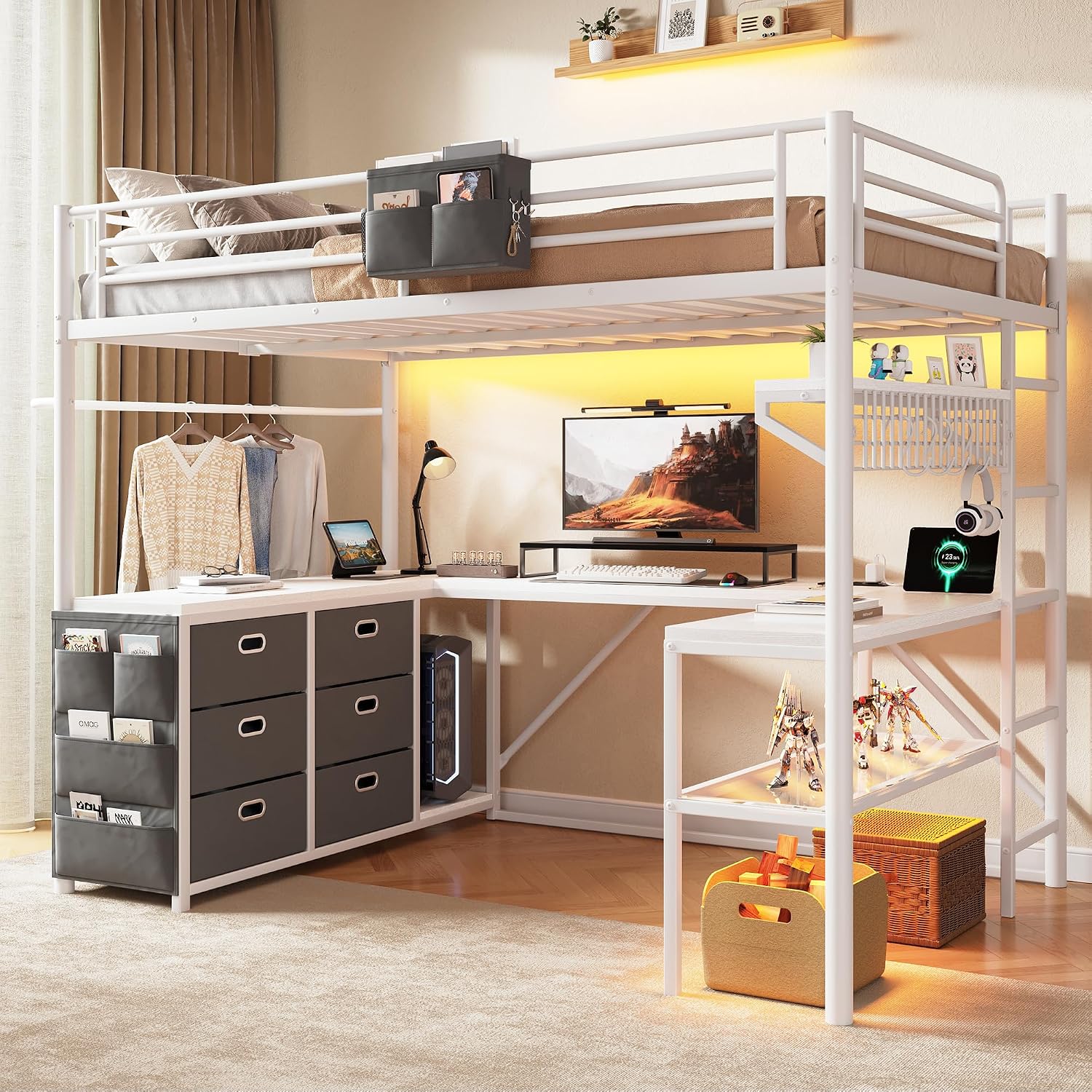


For two levels of bed, see twin over full loft beds and full size bunk beds. For a bigger mattress up top, queen loft beds. Under a low ceiling, low loft beds. With a desk in the bay, loft beds with a desk. Sizing against a queen is in full against queen bed frames.
Questions we get asked
Can an adult sleep on a full size loft bed?
Yes, on a frame rated 400 lb or more with 2.5-inch hardwood posts and bolted joints. Plenty of full lofts are rated under 300, which is a child’s frame at adult width.
How much clear height under it?
Thirty to 34 inches for a desk, 36 to 44 for a mattress or sofa, 50 plus to move about. Every inch pushes the sleeping deck higher.
Does it need centre support?
Yes, across 54 inches of slat span — and it has to be a deep centre rail or a steel deck, because a leg would land in the bay.
How thick can the mattress be?
Usually 6 inches, set by the guard rail needing to stand 5 inches above the sleeping surface.
Is it less rigid than a bunk bed?
Structurally, yes — the lower frame that stiffens a bunk is not there. Look for panelled ends or diagonals and four full-height posts.
Will I be able to make the bed?
At a 40-inch bay, comfortably. At 54, you are changing a full duvet from a ladder every week — worth picturing before ordering.