Thuma bed frame alternatives — What you are actually paying for
The Wooden Stars is a participant in the Amazon Services LLC Associates Program. We may earn a commission when you buy through links on our site, at no extra cost to you.

The Thuma bed frame became the reference point for a particular look: pale solid wood, softly rounded edges, visible joinery, no visible hardware, and a rounded headboard panel. It is well made and it is not cheap, so a large number of people search for something that gets close for less.
This page is about what the design actually consists of, so you can judge a cheaper frame on the same terms rather than on a photograph.
Four features define the look: solid hardwood in a pale natural finish, softened or chamfered edges on every component, Japanese-inspired joinery that slots together with few or no tools, and a rounded, upholstered or slatted headboard. What you are paying for beyond the look is tool-free assembly, thick solid sections, and a felt-lined slat system that is silent. Cheaper frames match the appearance readily; the things they most often skip are the edge softening, the slat felting and the section thickness. Judge those three, not the photograph.
What the design is made of
Four elements, all checkable in a listing.
1. Solid hardwood, pale and unstained
The look depends on seeing real grain in a light natural tone. Rubberwood, ash, birch and pale-finished acacia all get there. What does not get there is a foil or print finish, which reads flat under any light.
So the first check is whether the listing says “solid” attached to a named component — the vocabulary is decoded in what engineered wood actually is.
2. Softened edges
Every exposed edge is eased or chamfered rather than left square. This is the detail that does most of the visual work and the one most often skipped, because it is a machining step that costs money.
It is visible in close-up photographs: look at where two faces meet and see whether there is a crisp line or a soft one.
3. Slot-together joinery
The frame assembles with interlocking joints and few or no fasteners. Genuinely convenient, and it looks clean because there is no visible hardware.
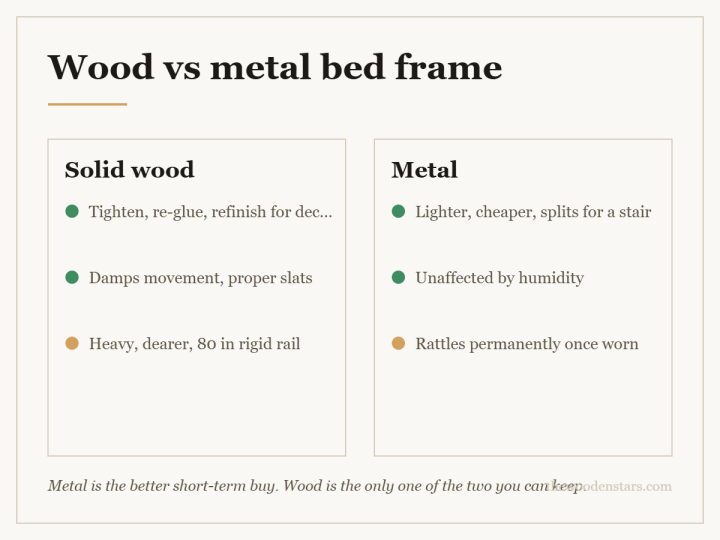
The trade-off is worth knowing: a slot joint relies on precise machining rather than a bolt you can tighten. When it loosens with age, there is nothing to re-torque. A frame with bolts into threaded metal inserts is less elegant and more maintainable over twenty years — the case for that is in wood bed frames.
4. Rounded headboard
A soft-cornered panel, often upholstered or slatted, sitting low rather than tall. Easy to match; the thing to check is how it attaches, because that decides whether it rattles — the two systems are in how queen headboards attach.
What a cheaper frame usually gives up
| Feature | Premium version | Common on cheaper frames |
|---|---|---|
| Edge treatment | Every edge eased or chamfered | Square edges, sharp arrises |
| Slat system | Felt-lined, silent, captive | Bare timber, can shift and creak |
| Section thickness | Generous, feels solid | Thinner rails, more flex |
| Assembly | Tool-free slot joints | Bolts, which is fine and less elegant |
| Finish | Water-based, low sheen | Heavier lacquer, more plastic-looking |
| Centre support | Included, with legs | Sometimes omitted entirely |
The last row is the one that matters structurally rather than cosmetically. A queen needs a centre rail with two legs to the floor, whatever the frame costs. Its absence is the commonest omission at the budget end and the reason frames start creaking within a year.
The three checks worth making
- Felt or rubber on the slats. Bare timber slats sitting in bare timber pockets are where bed noise comes from. Felt strips are cheap to add yourself if a frame lacks them, and it is the single best upgrade to a budget frame.
- Rail section depth. Stiffness rises with the cube of depth, so a rail 4 inches deep is dramatically stiffer than one 3 inches deep. Listings state it; the difference is what “feels solid” actually means.
- Centre support with legs to the floor. Not a style question. Look for the words and the leg count.
Where to accept a difference
Assembly method. Bolts into metal inserts are arguably better than slot joints over decades, because they can be re-tightened. If a cheaper frame bolts together, that is not a downgrade.
Timber species. Rubberwood gets to the same pale look as ash at a third of the price, and on a bed frame — where nothing abrades the timber — the hardness difference barely matters. The comparison is in rubberwood against oak.
Headboard upholstery. A slatted timber headboard is easier to keep clean than a fabric one and sits within the same design language.
The noise question, which is what people actually notice
Ask anyone who replaced a cheap bed frame what was wrong with the old one and the answer is usually not “it broke”. It is that it creaked.
Bed noise comes from three places, and all three are cheap to prevent and irritating to cure after the fact.
- Slats moving in their pockets. Bare timber sliding on bare timber, once per movement, all night. Felt or rubber strips at the slat ends end it completely. This is the single biggest source and the easiest fix.
- Loose rail bolts. Every joint works slightly as the bed is used, and a bolt that has backed off a quarter turn clicks. Threadlocker at assembly prevents it; re-tightening annually cures it.
- The frame rocking on an uneven floor. Three legs touching and one hovering means the whole frame flexes with every movement. Felt pads of different thicknesses, or adjustable feet, fix it in five minutes.
A premium frame arrives with the first two already handled. A budget frame usually does not — but a roll of felt tape and a bottle of threadlocker cost very little and close most of the gap. It is the best value upgrade in this whole comparison.
What not to compromise on
Particleboard at the load points. The rail-to-post joint and the centre support take every movement in the bed. Particleboard enlarges its fixing holes and cannot be cleanly repaired. Panel elsewhere — a headboard face, a slat backing — is fine.
Slat gaps over 3 inches. Most foam and hybrid mattress warranties specify a maximum, and a mattress sagging between wide slats is not a claim you will win.
A missing centre rail on anything above a twin. Discussed above, and it is the difference between a frame that stays silent and one that does not.
Upgrading a budget frame
- Felt strip tape On slat ends and pockets; the cheapest cure for bed noise
- Adjustable centre support bar Adds the leg a budget frame left out
- Threadlocker On rail bolts at assembly, before the creak starts
- Extra bed slats Closes gaps over 3 in without replacing the frame
What to buy


For the structural checks in full, see wood bed frames and what to check before you order. For the other modular-frame design, Floyd bed frame alternatives, and for the midcentury look, midcentury modern bed frames.
Questions we get asked
What makes the Thuma design distinctive?
Pale solid hardwood, softened edges on every component, slot-together joinery with no visible hardware, and a rounded low headboard.
What do cheaper frames usually skip?
Edge softening, felt-lined slats, and rail section thickness. Sometimes the centre support, which matters structurally.
Are slot-together joints better than bolts?
They are neater and faster to assemble. Bolts into metal inserts can be re-tightened for decades, which slot joints cannot.
Does the timber species matter on a bed frame?
Very little. Nothing abrades a bed frame, so section size and joinery matter far more than hardness.
How do I stop a wooden bed frame creaking?
Felt strips where slats meet the rails, and threadlocker on every bolt. Those two fix most bed noise.
Does every queen frame need a centre support?
Yes — a centre rail with two legs to the floor. Sixty inches is beyond an unsupported slat span.