Murphy bed vs loft bed — Both free the floor, differently
The Wooden Stars is a participant in the Amazon Services LLC Associates Program. We may earn a commission when you buy through links on our site, at no extra cost to you.
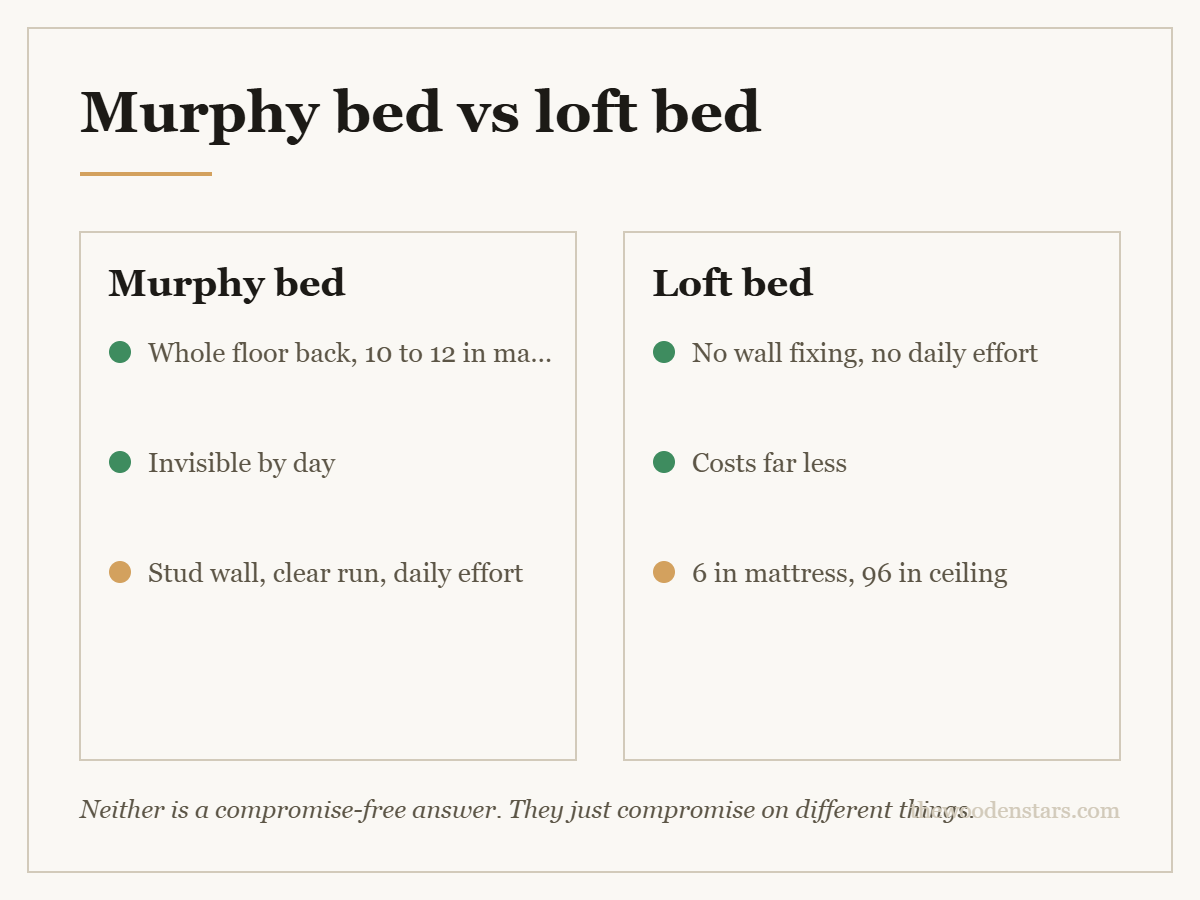
Murphy bed vs loft bed is a choice between a bed that disappears and a bed that moves out of the way upwards. Both free the floor; only one frees it during the day.
The trade is straightforward once you see it: the Murphy bed gives back the whole footprint but only when it is closed, while the loft bed gives back the footprint permanently but keeps a bed overhead forever.
A Murphy bed folds vertically into a cabinet against the wall, returning the full 28 to 35 square feet of floor during the day. It needs a stud wall to bolt into, projects 16 to 22 inches when closed, and has to be made up and cleared every day. A loft bed lifts the mattress to 60 to 72 inches and leaves the space underneath usable permanently — but that space has a ceiling of about 44 inches, so it suits a desk or storage, not standing. Murphy for adult rooms used fully by day; loft for a desk you want always available.
Murphy bed vs loft bed: what each actually returns
The Murphy bed returns everything, part-time
Closed, a queen Murphy bed is a cabinet 16 to 22 inches deep against one wall. The 35 square feet the bed occupied are simply gone — free for a dining table, a yoga mat, a workshop bench.
But it is a daily transaction. The bed comes down at night and goes up in the morning, and whatever occupies that floor has to move.
The loft bed returns a low-ceilinged room, full-time
A loft deck at 60 to 72 inches leaves 44 to 56 inches clear underneath. That is a desk, a dresser, a reading chair or storage — permanently set up, never moved.
What it will not be is a room you stand up in. And the bed is visible all day, which matters in an adult living space more than in a child’s room. See loft beds with a desk.
| Measure | Murphy bed | Loft bed |
|---|---|---|
| Floor returned | All of it, when closed | The footprint, permanently |
| Clear height under | Full room height | 44 to 56 in |
| Closed depth | 16 to 22 in | Not applicable |
| Ceiling needed | Room height plus mattress | About 96 in |
| Wall fixing | Bolted into studs, required | Anti-tip strap, advised |
| Daily effort | Up and down every day | None |
| Sizes | Twin to queen | Twin, twin XL, occasionally full |
| Suits | Adult rooms used fully by day | A desk you want always ready |
The wall, which is the Murphy’s hard constraint
A Murphy bed is not furniture standing on the floor. It is a cabinet bolted into the structure, because the mechanism applies a real tipping load as the bed swings down.
That means studs, located and bolted into — not drywall anchors, and not a plasterboard partition without timber behind it. On masonry it means proper expansion fixings.
It also means the wall has to be available. A Murphy needs an uninterrupted run of 60 to 85 inches with no window, no radiator, no door swing and no skirting standing proud. That single requirement rules it out of more rooms than the price does. The detail is in murphy bed sizes.
Mattress rules, which both have
A Murphy bed caps mattress thickness — usually 10 to 12 inches — because the mattress has to fit inside the cabinet when folded. It also usually requires a mattress that tolerates being stored on edge, and it needs a strap to hold the mattress in place during the fold. Full list in murphy bed mattress requirements.
A loft bed caps thickness at 6 inches, sometimes 8, because the guard rail must stand 5 inches above the sleeping surface. That is a tighter cap than the Murphy’s, and it is the loft’s main comfort compromise — see how thick a bunk bed mattress can be.
Cost, which is not close
A loft bed is a bed frame with long posts. A Murphy bed is a cabinet plus a spring or piston mechanism rated for repeated cycles, and it is priced accordingly — commonly three to six times a comparable loft.
Where the Murphy earns it is in an adult room where the floor is genuinely needed daily: a studio, a home office that is also the guest room, a small apartment. Where it does not is in a child’s room, which is the loft bed’s home ground.
Which to pick
- Is the room used for something else every day, by an adult? Murphy, if the wall allows it.
- Is it a child’s or teenager’s room with a desk? Loft, almost always — loft beds with a desk.
- Is the ceiling under 90 inches? Murphy, or a low loft bed.
- Is there no stud wall free? Loft, by elimination.
- Do you want a full-thickness mattress? Murphy — the loft’s 6-inch cap is the harder one.
If the need is two sleepers rather than free floor, neither is the answer — see loft bed against bunk bed and trundle bed against bunk bed.
For either route
- Stud finder Non-negotiable for a Murphy, useful for a loft’s anti-tip strap
- Mattress retention strap Holds the mattress during the fold on a Murphy
- Six-inch loft mattress Built for the rail limit rather than trimmed to fit it
- Clip-on bed light Neither frame gives you a bedside table
What to buy
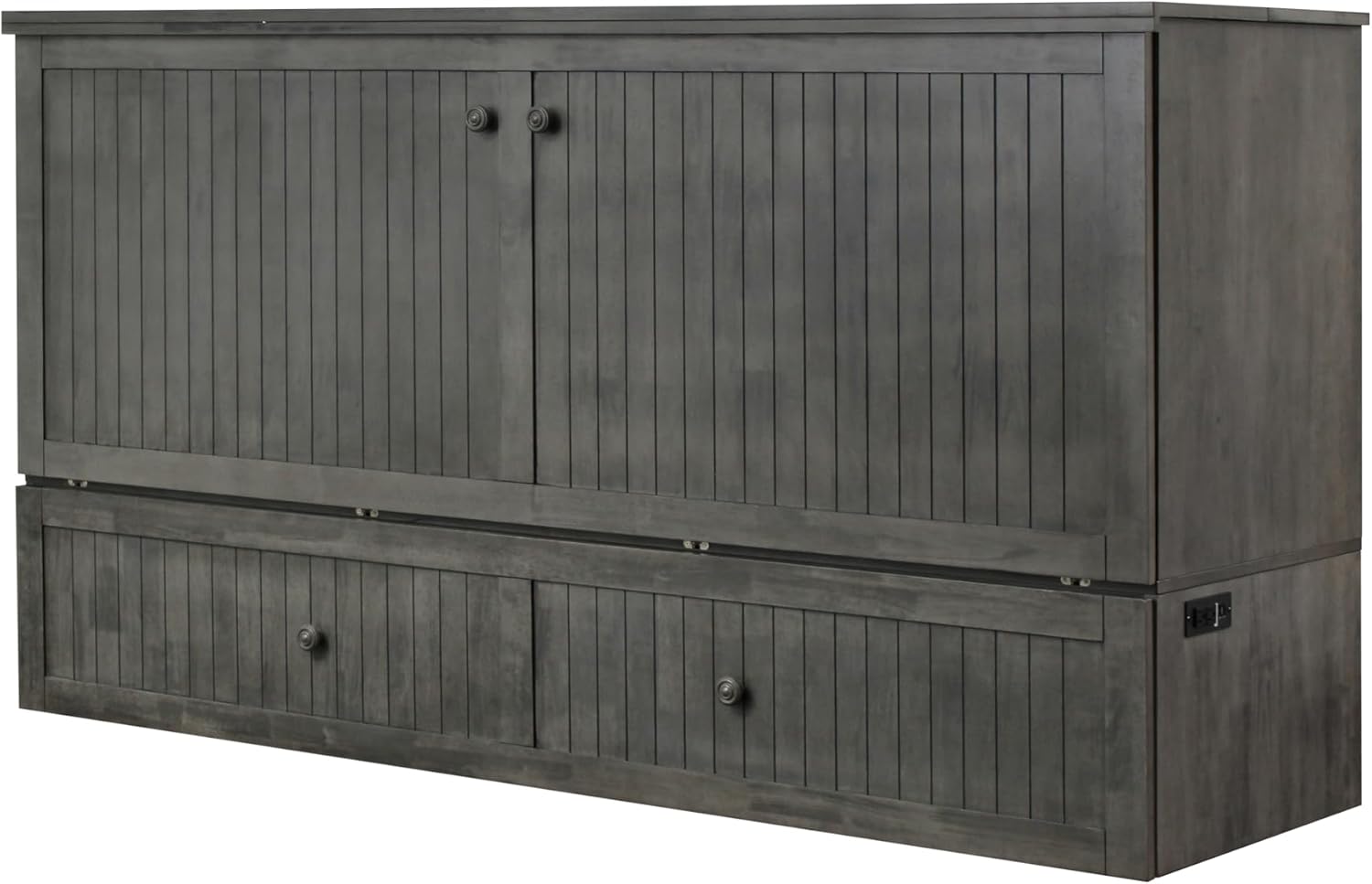


For the Murphy route, see murphy beds, murphy beds with shelves and mattress requirements. For the loft route, loft beds with a desk, low loft beds and how high a loft bed should be.
Questions we get asked
Which saves more space, a Murphy bed or a loft bed?
The Murphy, while it is closed — it returns the entire footprint. The loft returns the footprint permanently but with only 44 to 56 inches of headroom under it.
Does a Murphy bed have to be fixed to the wall?
Yes, bolted into studs. The mechanism applies a real tipping load as the bed swings down, and drywall anchors are not adequate.
Can an adult use a loft bed?
Yes, if the frame is rated for it and the ceiling allows. The 6-inch mattress cap is the usual sticking point rather than the height.
Which is cheaper?
The loft bed, by a wide margin — commonly a third to a sixth of a comparable Murphy, because a Murphy is a cabinet plus a rated mechanism.
How thick a mattress can each take?
Murphy beds take 10 to 12 inches. Loft beds cap at 6, sometimes 8, because of the guard rail.
Which is better in a room with a low ceiling?
The Murphy. A loft wants about 96 inches of ceiling; under 90 you are looking at a low loft instead.