Full or queen bed frame — Six inches of width, five of length
The Wooden Stars is a participant in the Amazon Services LLC Associates Program. We may earn a commission when you buy through links on our site, at no extra cost to you.
Full against queen is six inches of width and five inches of length. Written down like that it sounds trivial. In a real bedroom it is usually the whole decision, because the six inches change how two people sleep and the five inches change whether the bed fits at all.
Here is how to work out which one your room and your household actually want, using numbers rather than instinct.
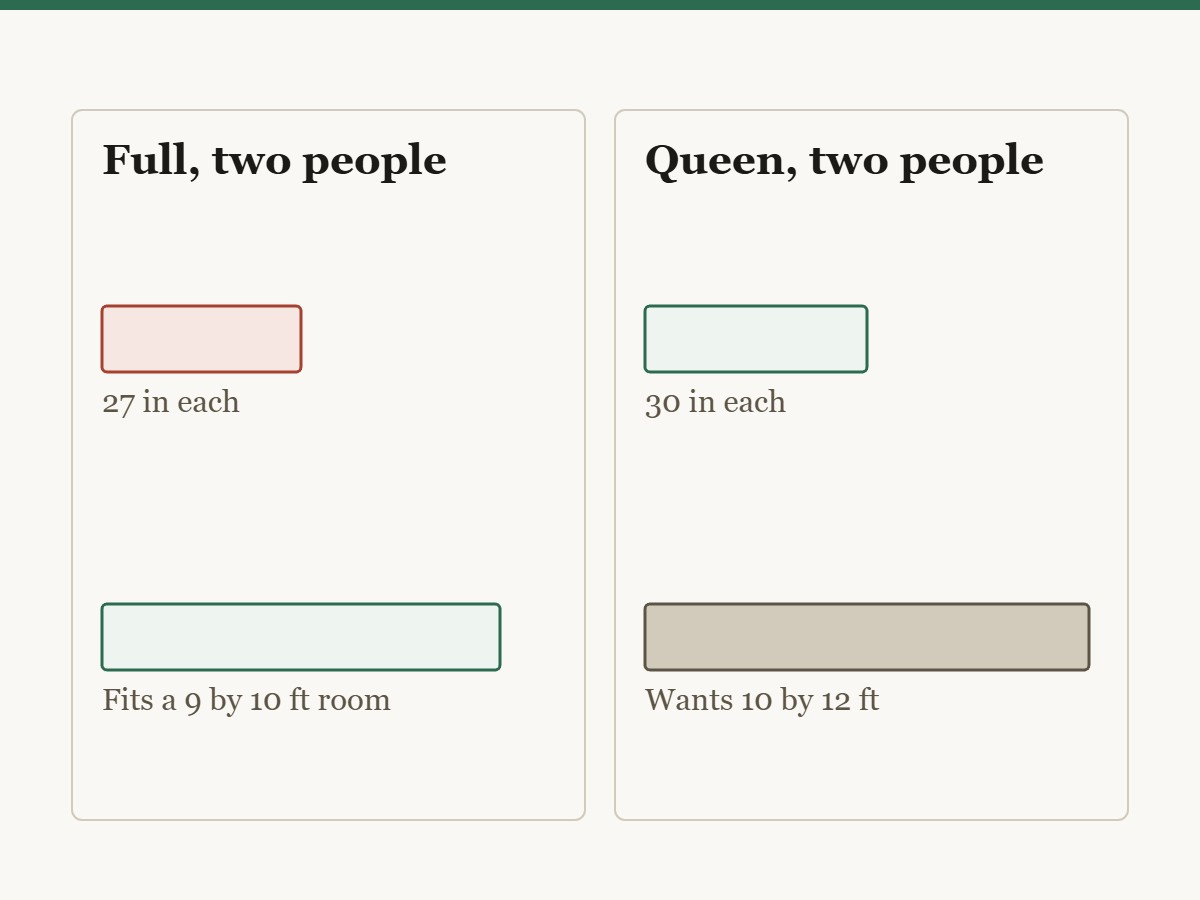
A full is 54 × 75 inches; a queen is 60 × 80. For two sleepers that is 27 inches each against 30 — the queen is the smallest size most couples find comfortable long term. But the queen also needs five more inches of floor length, and in a room with a wardrobe, radiator or doorway about 80 inches out from the wall, the full is the largest bed that fits. Rule of thumb: two adults every night, buy queen. One adult, a teenager, or a length-limited room, buy full.
The numbers side by side
| Measurement | Full | Queen |
|---|---|---|
| Mattress | 54 × 75 in | 60 × 80 in |
| Frame footprint | About 57 × 79 in | About 64 × 85 in |
| Width per sleeper, two people | 27 in | 30 in |
| Clear floor length needed | About 79 in | About 85 in |
| Comfortable room | About 9 × 10 ft | About 10 × 12 ft |
| Centre support | One centre leg | Centre rail, two legs |
| Bedding availability | Good | Widest of any size |
Two rows do most of the work. The width-per-sleeper row decides comfort. The clear-floor-length row decides whether the queen is even an option.
The width question: 27 inches or 30
Twenty-seven inches is narrower than a standard single bed. That is the honest way to describe a full shared by two adults, and it is why a full is often described as a generous single rather than a comfortable double.
Thirty inches each is the normal American expectation of a double bed, and it is enough that one person turning over does not automatically wake the other. It is not luxurious — that is a king at 38 inches each — but it is the point where sharing stops being a compromise.
The practical test: if two adults sleep in this bed more than a couple of nights a week, the three inches each are worth more than anything else you could spend the money on. If the bed is for one person, or for guests a few times a year, they are worth very little.
The length question: five inches that decide rooms
A full and a twin are both 75 inches long. A queen and a king are both 80. The length changes exactly once across the whole range, and it changes here.
So the decision often has nothing to do with comfort. Measure from the wall the headboard will sit against to the first obstruction — a wardrobe, a radiator, a chimney breast, a doorway, the swing of the room door. If that number is under about 85 inches, a queen frame does not fit and a full does.
This is also the reason to measure before shopping rather than after. People compare 54 against 60, decide the full is the lesser bed, and only discover the length constraint when the queen frame will not go in.
Height and support differ too
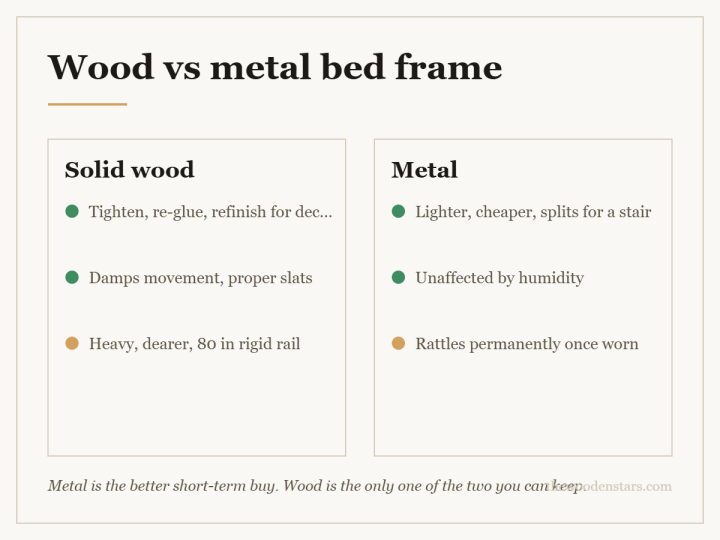
A full needs a centre rail with one leg to the floor. A queen needs a centre rail with two. Both figures are minimums, and a frame at either size that has no centre support will flex, squeak and work its joints loose.
Slat counts differ accordingly — roughly 12 to 14 for a full, 13 to 16 for a queen — and in both cases the gap should be under 3 inches for a foam or hybrid mattress, because that limit is usually written into the mattress warranty.
Cost, which is smaller than people expect
A queen frame is not dramatically more expensive than a full. The material difference is six inches of rail and a bit more panel; the mechanism — there is none — does not change.
The mattress is where the money moves, and even there the gap is modest. Bedding is the one place the queen can actually be cheaper per item, because queen is the highest-volume size in the US and the choice is enormous. Full bedding is widely available but the range is narrower.
In short: do not choose a full to save money. Choose it because of the room or because of who sleeps in it.
What the frame should have, either way
- Bolts into threaded metal inserts at the rail-to-post joint, not wood screws into end grain.
- Captive slats in a routed groove, not resting loose on a ledge.
- Solid timber or plywood where the load goes — the rails, the posts and the centre support. Particleboard enlarges its hole under repeated load and cannot be cleanly repaired. The words on the listing are decoded in what engineered wood actually is.
- A deck height that suits you: add it to the mattress thickness and aim for 22 to 26 inches total.
Before you decide
- Tape measure Wall to first obstruction — under 85 in and the queen is out
- Painter’s tape Mark both footprints on the floor and walk around them
- Hex key set Whichever size you pick, better than the folded key in the box
- Threadlocker On the rail bolts at assembly, not after the squeak starts
What to buy


Once you have chosen, go to full bed frames or queen bed frames for the size-specific detail. If neither fits the room, the smaller step down is the twin, and the four checks that apply at any size are in wood bed frames.
Questions we get asked
What is the difference between a full and a queen bed?
A queen is six inches wider and five inches longer: 60 × 80 against 54 × 75. That is 30 inches per sleeper against 27.
Is a full bed big enough for a couple?
For occasional use, yes. For sharing every night, 27 inches each is narrower than a single bed and most couples find a queen the practical minimum.
Should I get a full or queen for a small bedroom?
Measure from the headboard wall to the first obstruction. Under about 85 inches, the full is the only one that fits; over that, the queen is worth the extra width.
Is a queen frame much more expensive than a full?
Usually only modestly. The frame is six inches wider and that is most of the difference — the cost gap is not a reason to choose a full.
Can I use full bedding on a queen bed?
No, it will not cover it. Bedding is sized to the mattress, and queen is the more widely stocked of the two in the US.
Do full and queen frames need the same support?
Both need a centre rail, but a full needs one leg to the floor and a queen needs two. Neither works without any.