Queen bunk beds — Adult weight on an adult frame
The Wooden Stars is a participant in the Amazon Services LLC Associates Program. We may earn a commission when you buy through links on our site, at no extra cost to you.
A queen bunk bed sleeps four adults in the footprint of one queen bed. That is the entire proposition, and it is a good one for a holiday house, a bunk room or a shared flat.
It is also the most heavily loaded piece of furniture most people will ever own. Two adults on the top deck, six feet in the air, on four posts — and almost every failure in this category traces back to a frame that was specified for children and sold at queen size.
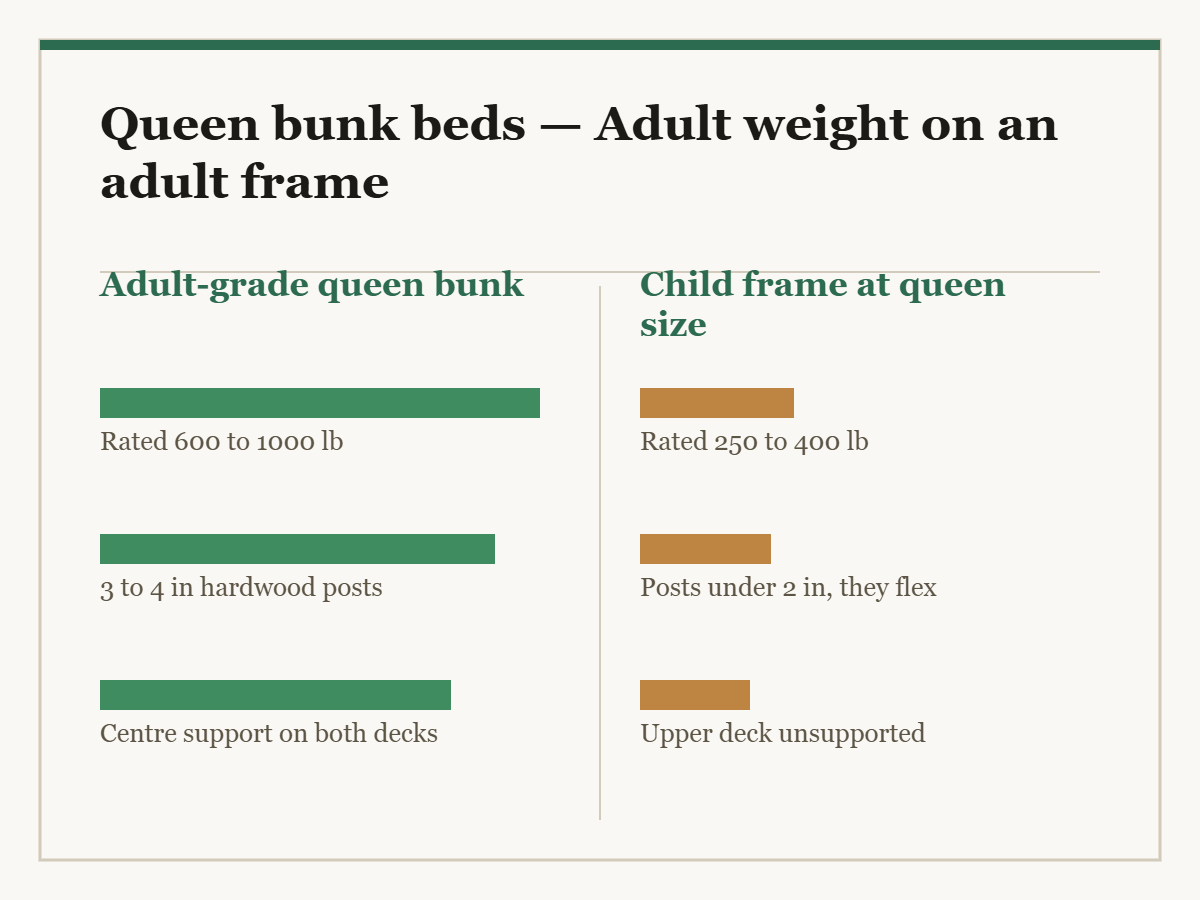
The specification that decides everything is the top bunk weight rating: 600 to 1,000 lb is what an adult queen bunk needs, and a frame quoting 250 or 400 is a child’s design scaled up. Then post section — 3 to 4 inches square in solid hardwood — and centre support under both decks, because 60 inches of slat span sags without it. Overall height runs 66 to 78 inches; you want 36 inches of clear height over the lower mattress so an adult can sit up, and 30 inches above the top mattress. Footprint is about 66 × 86 inches.
The load, written out
It is worth doing the arithmetic rather than trusting a number on a page.
- Queen mattress: 70 to 130 lb.
- Two adults: 300 to 400 lb.
- Bedding: 15 to 25 lb.
- Total, static: 385 to 555 lb on the top deck alone.
Now add that the load is not static. Two adults getting into bed apply peak forces well above their weight, and they do it every night for years. A rating of 600 lb is the floor; 800 to 1,000 is what the heavy-duty hardwood frames quote and what you want if the bed is in a rental or a holiday house.
Beds rated 250 to 400 lb at queen size exist in quantity. They are not lying — that is genuinely the rating — they are simply the wrong bed for two adults.
Height on two adult levels
The reason a queen bunk is 66 to 78 inches tall is that both decks have to work for grown-ups.
From the floor: lower mattress at 12 to 16 inches, then 36 inches of clear air so someone can sit up, then the top deck structure at 5 to 7, then the top mattress. That puts the top sleeping surface at 58 to 68 inches, and you want 30 inches above that.
Total demand on the ceiling: 88 to 98 inches. A standard 96-inch ceiling works if the frame is at the shorter end and there is no fan. A 108-inch ceiling is comfortable. Under 90 inches, one of the two levels is going to be cramped and it is usually the bottom.
| Option | Sleeps | Footprint | Ceiling needed |
|---|---|---|---|
| Queen bunk | 4 adults | 66 × 86 in | 96 in or more |
| Twin over full bunk | 1 adult, 1 child | 60 × 80 in | 84 in |
| Two queen beds | 4 adults | 132 × 86 in | Any |
| Queen loft plus sofa bed | 2 plus 2 | 66 × 86 in | 96 in or more |
| Queen bed plus murphy | 4 adults | Varies, murphy folds | Any |
Centre support on both decks
A queen slat span is 60 inches. Unsupported in the middle it dips, and the mattress follows within a year.
On the lower deck this is easy — a centre rail with a leg to the floor, exactly as on a normal queen bed.
On the upper deck there is nowhere for a leg to go, so the centre rail has to carry the span on its own section between the head and foot ends. Look for a deep centre rail, or a steel deck instead of slats. A frame whose upper deck has slats and nothing down the middle is one to skip.
The general case is in bed frame centre support legs; slat spacing — under 3 inches for foam, 4 for sprung — in bed slat replacement and spacing.
Access, at adult scale
Climbing to a 64-inch deck is a different act from climbing to a child’s bunk.
Stairs are the right answer wherever the floor plan allows. They project 24 to 36 inches, they can be climbed with your hands full, and they usually carry drawers — see bunk beds with storage stairs.
An angled ladder with flat treads is the usual compromise. Round rungs at adult weight are genuinely unpleasant barefoot.
A vertical ladder at this height, used by adults at night, is the arrangement that gets replaced.
Whatever it is, check it bolts to the frame and that the guard rail continues to the ladder opening so there is something to hold at the top.
Guard rails for adults
The 5-inch rule still applies — the rail must stand 5 inches above the mattress surface — but at adult scale there is a second consideration.
An adult rolls further than a child and weighs more when they hit the rail. A full-length rail on both sides is worth more here than on a children’s bunk, and so is the rail being bolted through rather than screwed into the deck edge.
Mattress thickness is capped by the same rule. Frames usually state 6 to 8 inches maximum. A 12-inch adult mattress on a frame designed for 6 leaves a rail level with the sleeping surface.
What it is made of
This is the frame where material is not a preference.
Solid hardwood at 3 inches or more, with rail-to-post bolts into barrel nuts, is what carries 600 lb-plus ratings and stays tight. Species are compared in the hardwood hardness scale, and rubberwood is the common one in this category.
Heavy steel works when the tube section and wall thickness are real. Check the rating, not the material.
Pine at adult loads wants a bigger section and annual tightening.
Particleboard is not a queen bunk material at any price — what engineered wood actually is explains why it will not hold a screw under a cyclic load.
Noise is inevitable on a frame with this many joints; the order of diagnosis is in why a wooden bed frame squeaks, and the joints themselves in bed frame brackets.
Before you order
- Measure the ceiling to the lowest fixture at the bed’s position.
- Check the rails fit up the stairs. An 86-inch rigid rail and a stair turn is where these stop.
- Weigh the delivery. An adult-grade queen bunk is 200 to 350 lb of timber in several boxes.
- Find the studs. This frame should be anchored, and you want to know before assembly day.
With the frame
- T-handle hex key Adult-load joints need real torque, annually
- Anti-tip wall strap Tall, heavy, and climbed by adults at night
- Felt slat tape A bunk with two adult decks has a lot of places to rub
- Levelling feet Diagonal rock on a tall frame is the floor, not the joints
What to buy


For a smaller adult bunk, see full size bunk beds and twin over full bunk beds. For construction and joints generally, wooden bunk beds. If only one level needs a bed, queen loft beds. For a guest bed that disappears, queen murphy beds.
Questions we get asked
What weight rating does a queen bunk need?
Six hundred pounds minimum on the top deck, 800 to 1,000 for a rental or holiday house. Two adults plus a queen mattress is 385 to 555 lb static.
What ceiling height do I need?
Ninety-six inches at least, and only if the frame is at the shorter end with no ceiling fan. Both levels need adult sitting height.
How much clear height above the lower mattress?
Thirty-six inches, so an adult can sit up. Less and the bottom bunk becomes a child’s bed.
Does the top deck need centre support?
Yes. Sixty inches of slat span sags without it, and there is nowhere to put a leg — so look for a deep centre rail or a steel deck.
How thick a mattress can go on top?
Whatever the frame states, usually 6 to 8 inches. The rail has to stand 5 inches above the sleeping surface.
Are stairs worth it over a ladder?
At adult scale, yes. They can be climbed with your hands full and they usually carry drawers. They cost you 24 to 36 inches of floor.