Bed frame with or without footboard? Height and feet
The Wooden Stars is a participant in the Amazon Services LLC Associates Program. We may earn a commission when you buy through links on our site, at no extra cost to you.
Bed frame with or without footboard is usually settled by two measurements: how tall you are, and how much floor the room has at the end of the bed.
The footboard is not structural on most modern frames. It is a boundary — and whether you want one depends on what it is bounding.
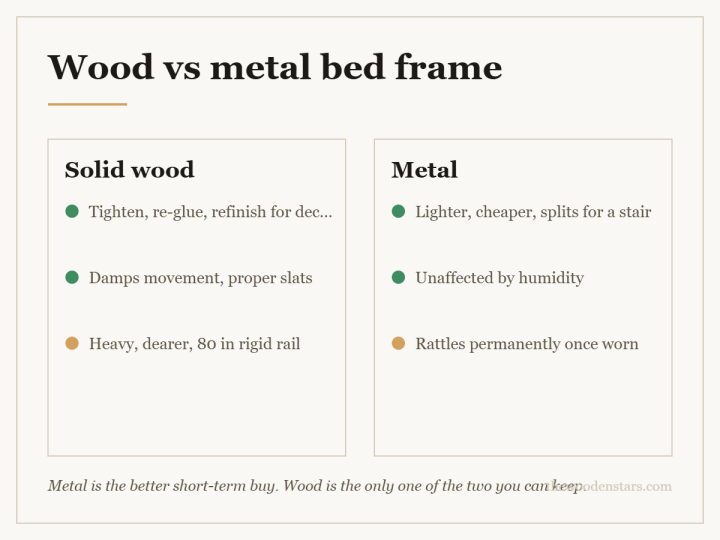
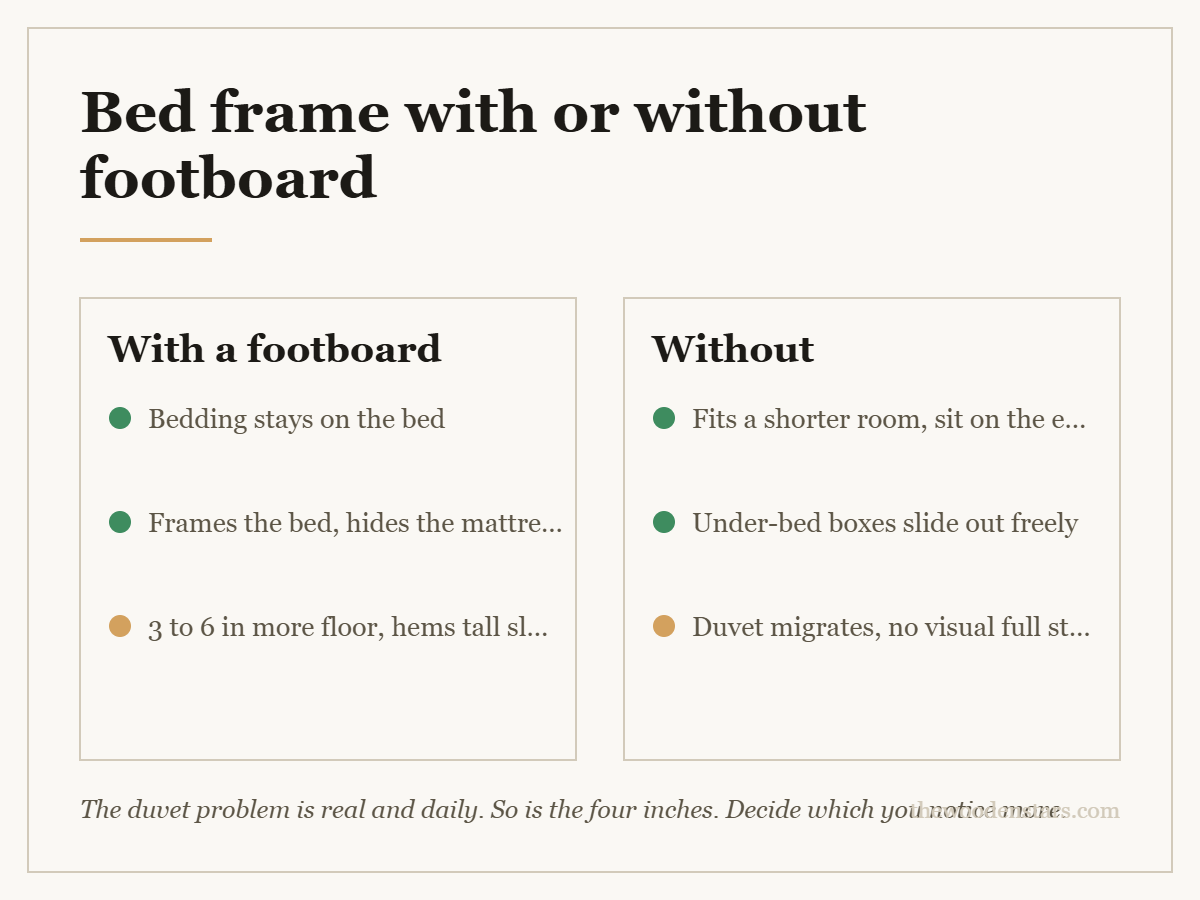
A footboard adds 3 to 6 inches to the bed’s length, stands 14 to 30 inches above the floor, and stops bedding sliding off the end. It also stops anyone over about 6 feet stretching out, because a standard mattress is only 80 inches and a footboard makes that a hard edge. Without one, the bed reads lighter, fits a shorter room, and you can sit on the end — but the duvet migrates and the room has no visual full stop. Structurally it rarely matters: on most frames the side rails and centre support do the work.
Bed frame with or without footboard: the height test
A queen or king mattress is 80 inches long. A person 6 feet tall is 72, so there is 8 inches of margin — which sounds ample and is not, because people sleep diagonally, stretch, and put their feet over the end.
Practical guidance:
- Under 5 ft 10: a footboard is a free choice.
- 5 ft 10 to 6 ft 1: a low footboard (14 to 18 inches) is fine; a tall one starts to be felt.
- Over 6 ft 1: go without, or choose a California king at 84 inches — California king bed frames.
The complaint is specific and consistent: it is not that your feet hit the board, it is that you stop stretching in your sleep because something is there.
| Measure | With footboard | Without |
|---|---|---|
| Floor length | Mattress plus 5 to 7 in | Mattress plus 1 to 3 in |
| Footboard height | 14 to 30 in | — |
| Suits sleepers up to | About 6 ft 1 | Any height |
| Keeps bedding on | Yes | No |
| Sit on the end | No | Yes |
| Under-bed access | Restricted at the foot | Open |
| Visual weight | Heavier, frames the bed | Lighter |
The floor at the end of the bed
A footboard adds 3 to 6 inches of length, which is not much — until you are working to a 36-inch walkway.
Measure from the wall behind the headboard to whatever is opposite:
- Bed with footboard: 85 inches of frame.
- Plus 36 inches to walk: 121 inches, or just over 10 feet.
- Add a dresser opposite at 18 inches deep: 139 inches, nearly 11 ft 8.
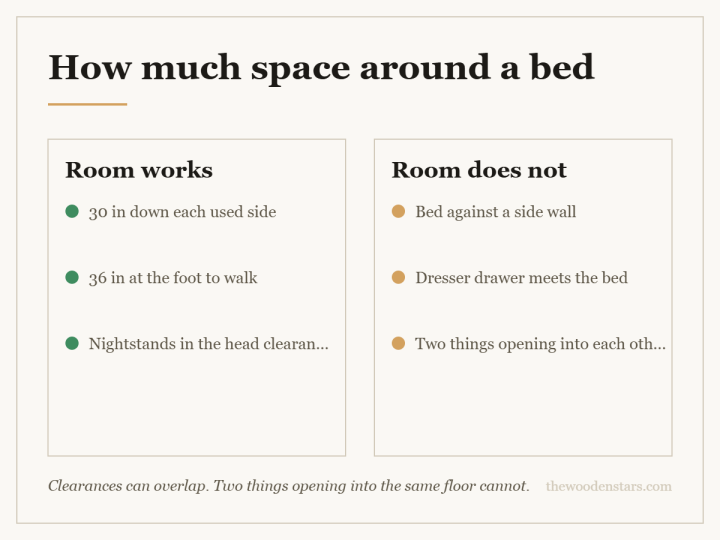
In a room a foot shorter than that, dropping the footboard is the cheapest four inches you will find. The full clearance method is in how much space around a bed.
What the footboard actually does for you
It keeps the bedding on. This is the real, daily benefit and it is underrated. Without a footboard a duvet creeps off the end over a few nights, particularly on a slippery mattress protector.
It gives the bed a full stop. In a large room, a bed without a footboard can look like a mattress on a platform. The footboard frames it.
It stops things sliding under. Relevant if the bed is on a hard floor.
It hides the mattress end. A bare mattress edge at the foot is the least attractive part of a made bed.
What going without buys you
Somewhere to sit. The end of a bed is where people sit to put shoes on. A footboard removes that, and a bench in front of it is the usual replacement — which costs the floor you were saving.
Access underneath. Under-bed storage boxes come out at the end on most layouts. A footboard with a low rail blocks them; the drawer version of the same idea is in bed frames with drawers underneath.
A lighter room. Two tall boards make a bed read as a large object. One tall board and an open end reads as a headboard with a bed attached.
Making the bed. Tucking sheets at the foot is easier with nothing in the way.
Does the footboard hold the frame together?
On most modern frames, no. The side rails bolt to the headboard and footboard posts, and the centre support carries the middle. Remove a footboard from a frame designed with one and you lose a structural member — but frames designed without one are engineered accordingly, with a rail-to-rail brace at the foot.
What this means practically: do not remove a footboard from an existing frame hoping to gain floor. The rails will splay. Buy a frame built the way you want it.
Either way the things that decide whether the bed lasts are the same: bolts into barrel nuts rather than cam locks, slat spacing under 3 inches for foam, and a centre leg at queen and above. See bed frame brackets, slat spacing and centre support legs.
The middle options
A low footboard, 14 to 18 inches — level with or just above the mattress. Keeps the bedding on, does not hem in a tall sleeper, and still reads as a frame. This is the version most people should look at first.
A footboard bench. No board, but a storage bench across the end doing the same job of stopping the duvet and giving somewhere to sit — at the cost of the floor.
A panel bed with a tall headboard only. The presence comes from one end, which is where you look anyway: queen headboard height.
Either way
- Duvet clips or a bed band The fix for a migrating duvet on an open-ended bed
- Furniture bolts and barrel nuts What lets a footboard joint be pulled up for decades
- Centre support leg Does the structural job people credit to the footboard
- Under-bed storage bins The reason to keep the end of the bed clear
What to buy
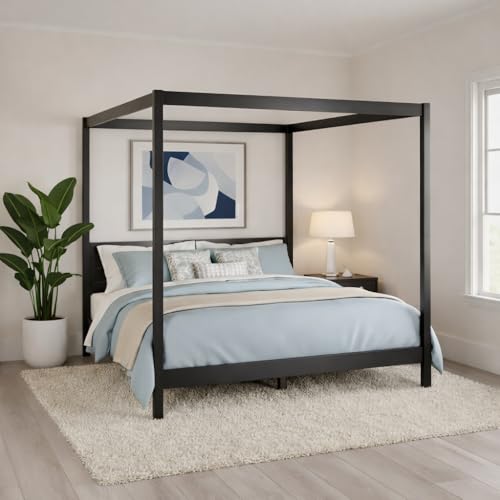


For frames, see wood bed frames, queen bed frames and king size bed frames. For length, California king bed frames. For the head end, queen headboard height. For storage, bed frames with drawers underneath.
Questions we get asked
Should a bed frame have a footboard or not?
With one if you want the bedding to stay on and the room has the floor; without if the room is short or anyone sleeping there is over about 6 ft 1.
How much floor does a footboard add?
Three to 6 inches of length, so about 85 inches of frame instead of 81 on a queen or king.
Is a footboard structural?
Not on most modern frames — the side rails and centre support do the work. But do not remove one from a frame built with it.
Do footboards bother tall people?
Over about 6 ft 1, yes. The issue is that you stop stretching in your sleep, not that your feet touch it.
What keeps the duvet on without a footboard?
Duvet clips or a bed band, or a bench across the end. The migration is real, particularly on a slippery mattress protector.
Is there a compromise?
A low footboard at 14 to 18 inches — level with the mattress. It holds the bedding without hemming anyone in.