Coffee tables and side tables are bought on looks and lived with on proportion. A table that is two inches too tall or a foot too short for its sofa reads as wrong long before anyone works out why — and unlike a dining table, the failure is not that it does not fit the room, but that it does not fit the seat next to it.
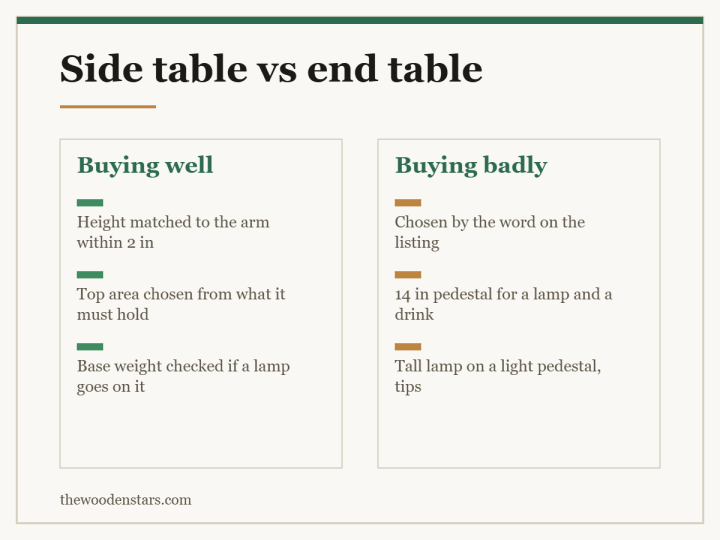
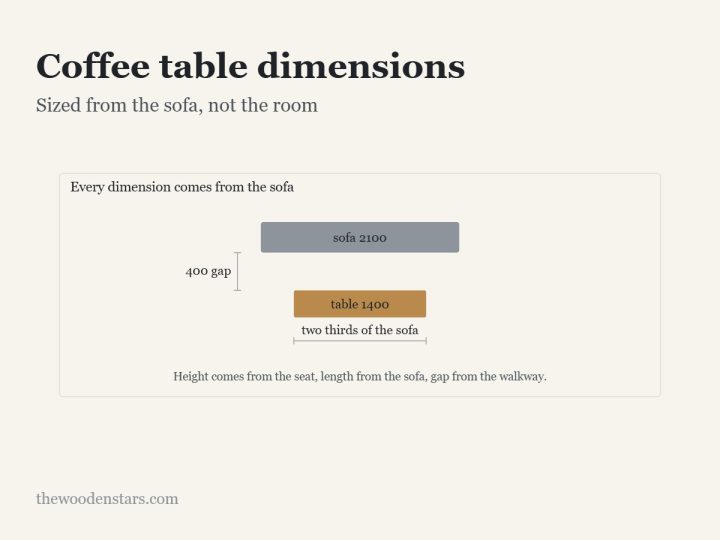
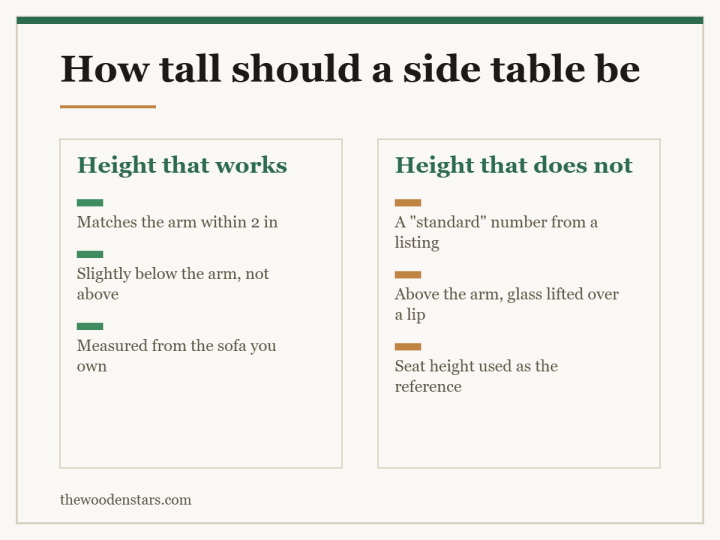
Match the table to the seat, not the room. A coffee table should be within an inch or two of the sofa’s seat height and about two-thirds of its length, sitting 14 to 18 inches away. A side table should be within a couple of inches of the sofa’s arm height. Get those two relationships right and almost any style works.
Anatomy of a low table
- Top — solid boards, a veneered panel, or a slab. On a coffee table this is the surface most likely to meet a wet glass.
- Apron or frame — the rails under the top, if any. Plenty of low tables have none, which puts all the load on the leg fixing.
- Legs — four legs, hairpins, a sled base, or a pedestal. Hairpin legs are the most commonly retrofitted part in the whole house.
- Mounting plates — the steel plates that legs bolt through. Standard patterns, easy to replace, easy to strip.
- Lower shelf or stretcher — on two-tier tables, both storage and the thing that stops the base racking.
The proportions that decide whether it looks right
| Relationship | Target | Why |
|---|---|---|
| Coffee table height | Within 1–2 in of sofa seat height | Reaching down or up both feel wrong |
| Coffee table height (typical) | 16–18 in | Follows from modern sofa seat heights |
| Coffee table length | About 2/3 of the sofa length | Shorter looks lost, longer crowds the room |
| Distance from sofa | 14–18 in | Enough to walk past, close enough to reach |
| Side table height | Within 2 in of sofa arm height | You set a glass down without looking |
| Side table height (typical) | 22–26 in | Follows from typical arm heights |
| Walkway around | 30 in minimum | 18 in only if nobody walks that side |
The one number people get wrong is the gap to the sofa. Under 14 inches and you cannot get past without turning sideways; over 18 and you lean forward to reach your cup, which is exactly the posture a coffee table exists to prevent.
Which species belong on a low table
A coffee table gets the specific abuse of standing liquid — glasses without coasters, condensation, wet bottles — for years. That makes finish, more than species, the deciding factor. But species sets how well the finish holds up and how visible the damage is.
- Oak — open grain hides rings and scratches better than any of the pale close-grained woods.
- Walnut — dark, and shows white heat marks vividly. Beautiful, and a coaster discipline.
- Acacia and mango — the mid-price staples for slab-style tops. Wide colour variation between boards, which reads as character or as mismatch depending on your taste. See wood types.
- Maple — pale, fine, and every mark shows.
- Reclaimed pine — already dented, which means new dents disappear. Genuinely practical for a family room.
Solid, engineered or veneer
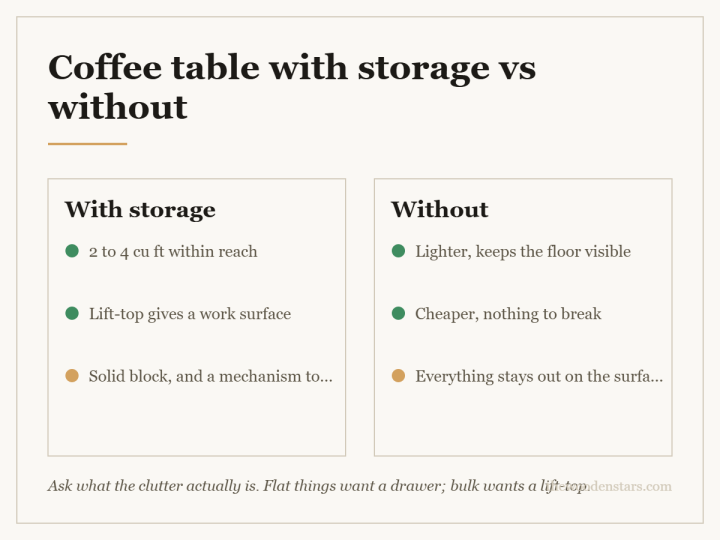
On a low table the veneer question has an extra edge: coffee-table tops meet standing water more than any surface except a kitchen counter, and water at a veneer edge lifts it.
- Solid top — can be sanded and refinished when the rings win. Needs fasteners that let it move, exactly as on a dining table.
- Veneer over plywood — stable and fine, provided the edges are properly sealed.
- Veneer over MDF — the common construction, and the one where a glass left overnight can raise a permanent bump at the edge.
What goes wrong, and why
- White rings. The signature coffee-table injury: moisture trapped in the finish, not in the wood. Usually reversible, often in minutes — see wood care.
- A wobbling side table. Small tables have short legs and no apron, so all the leverage lands on the mounting plate screws. They loosen. Tighten them, and if the holes have stripped, plug and re-drill.
- Splayed or bent hairpin legs. Hairpins are springy by design; dragging a table sideways bends them permanently. Lift, do not slide.
- A lifted veneer edge. Water reached the edge and swelled the core. Fixable early with glue and a clamp; not fixable once the MDF has crumbled.
- A cupped slab top. The underside was left unfinished. Same cause as on a desk, same fix — finish both faces.
Parts you can actually replace
- Hairpin legs — sold by height, typically 16 inches for a coffee table and around 28 for a desk or dining table. The single most effective cosmetic change available on a low table.
- Mounting plates — standard patterns, and the part that actually fails when a leg loosens.
- Felt pads — on the feet, and under anything heavy that sits on the top.
- Top fasteners — Z-clips and figure-8s, if a solid top has been screwed down rigidly.
- Levelling glides — for a table that rocks on an old floor.
Before you buy
- Measure your sofa seat height and arm height before looking at a single table. Those are the two numbers that matter.
- Measure the sofa length and take two-thirds of it as your target table length.
- Check what the top is made of, and whether the edges are sealed.
- For a slab top, ask whether the underside is finished. If the answer is no, plan to do it.
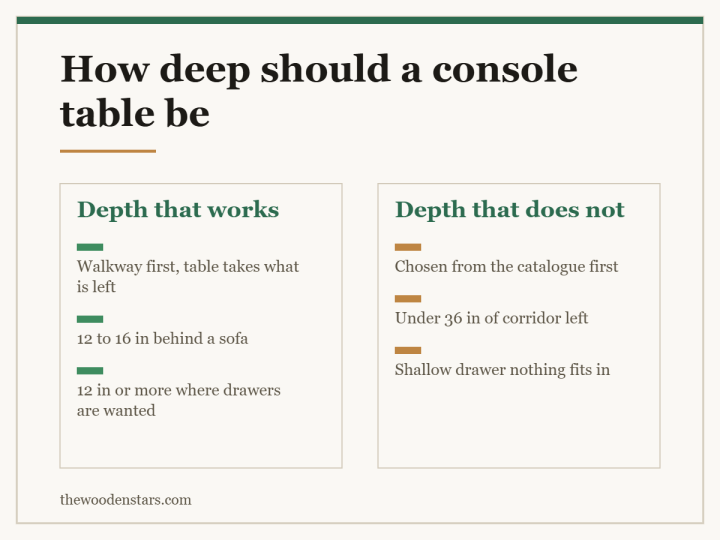
- Think about the walkway. A coffee table that fits the sofa but blocks the route to a doorway will be moved out of place within a week and never moved back.
Questions we get asked
How far should a coffee table be from the sofa?
Fourteen to eighteen inches. Closer and it blocks the route past; further and you have to stand up to reach it.
Should a coffee table be lower than the sofa seat?
Level with it, or an inch or two below. Noticeably lower makes people stoop; higher makes the room feel cramped and looks accidental.
Can I use a bench or a trunk as a coffee table?
Yes, and benches often land in exactly the right height band. A trunk usually sits too high — check it against the sofa seat before buying.
Do side tables have to match the coffee table?
No, and matching sets tend to make a room look showroom-flat. What has to match is the height relationship to the seating; the wood and style do not.
How do I stop glasses marking the top?
Coasters, and — if the top is solid wood — a finish that resists water rather than one that only looks good. A hard wax oil or a film finish behaves very differently from a wax polish here. The three are compared on the wood care hub.