Wooden bunk beds — Joints, slats and the ladder
The Wooden Stars is a participant in the Amazon Services LLC Associates Program. We may earn a commission when you buy through links on our site, at no extra cost to you.
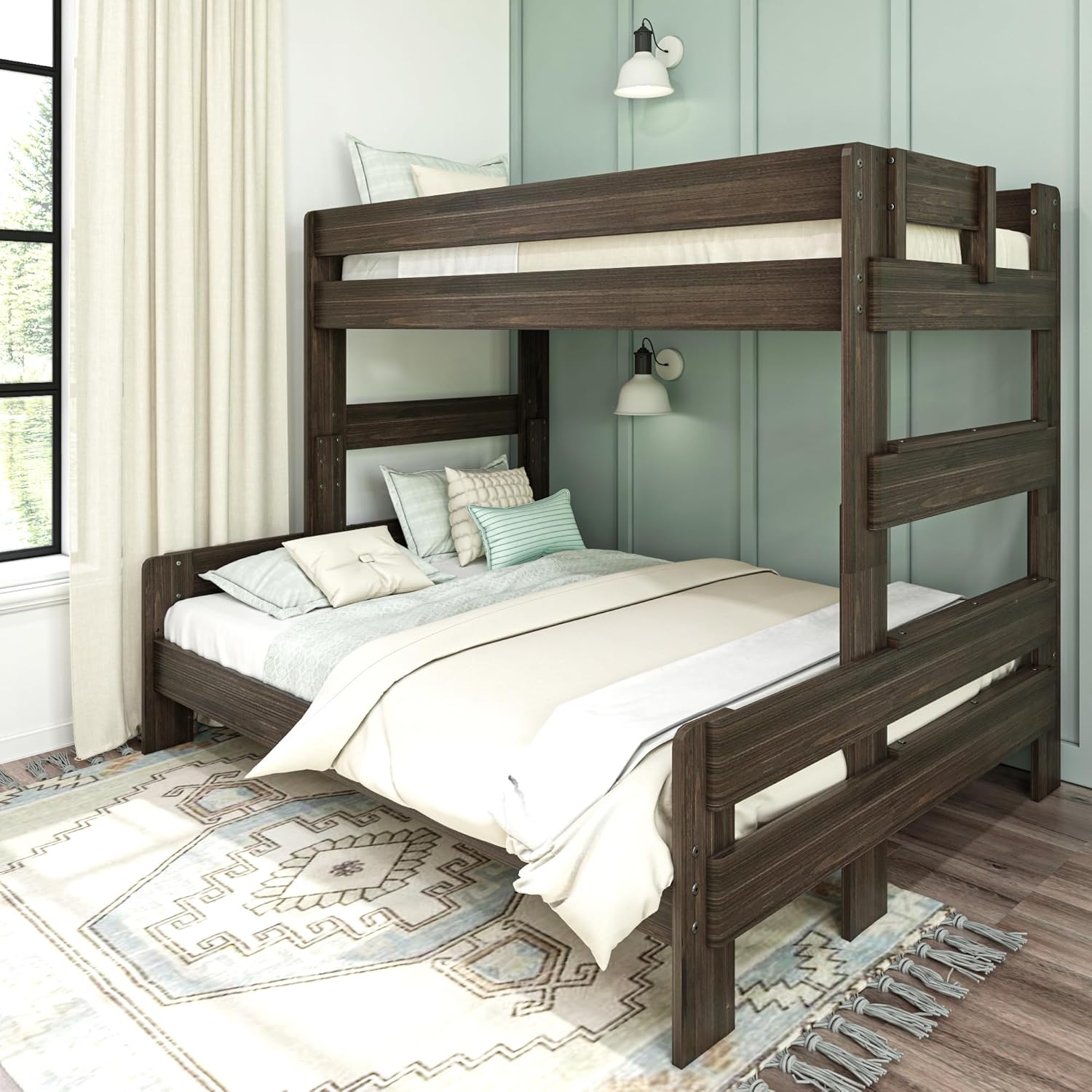
Buying a wooden bunk bed rather than a metal one is usually an aesthetic decision, and it should not be. The material changes how the frame carries load, how it fails, whether it can be repaired, and whether it still feels solid in year eight.
Four things decide a wooden bunk: the species, the section, the joint, and the slats. Everything else is styling.
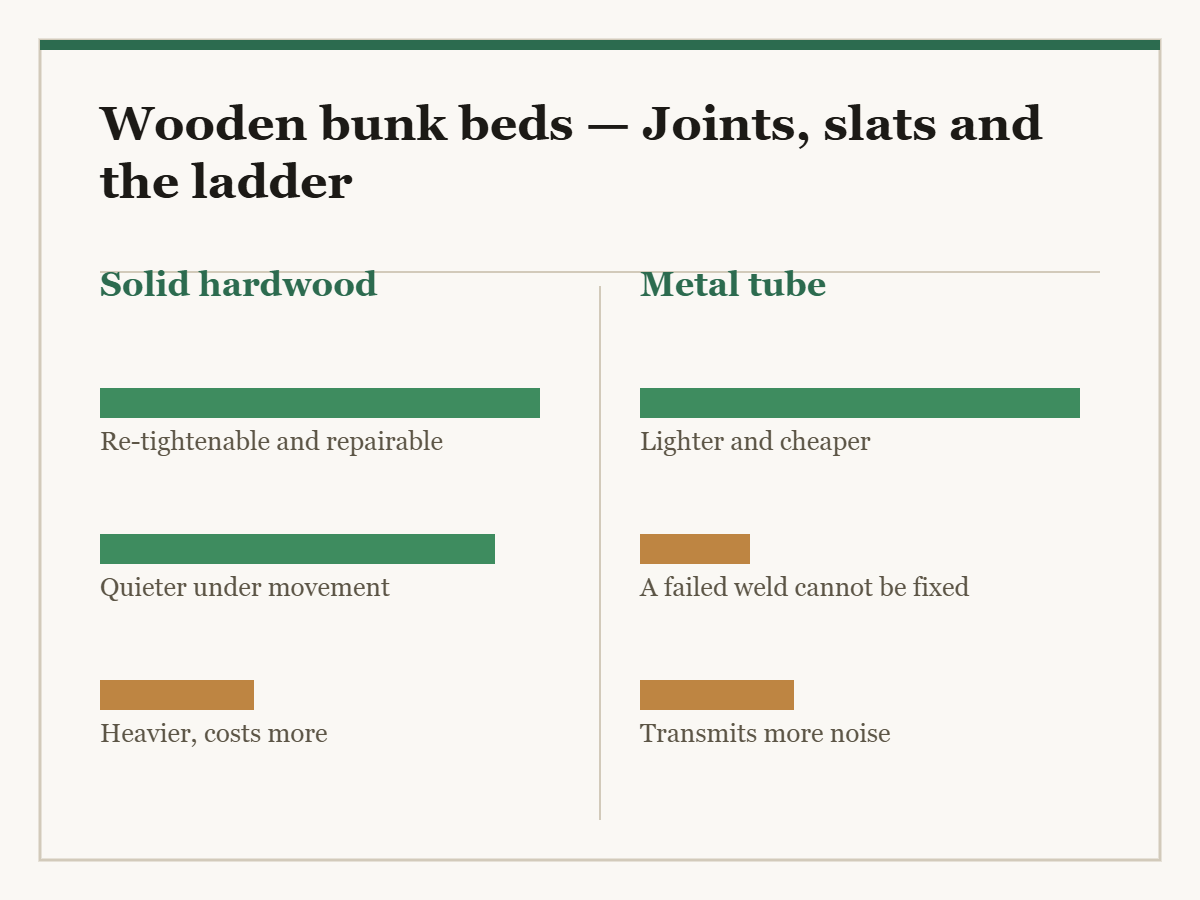
Look for solid hardwood — rubberwood, birch, acacia, oak or maple — in posts of 2.5 inches square or more, with rail-to-post joints that are bolts into barrel nuts rather than screws or cam locks. Those three together are what produce a weight rating of 400 lb and up, and what lets you re-tighten the frame every year for twenty years. Slats should be solid timber, under 3 inches apart for a foam mattress, and fixed rather than loose. Pine works and is softer, so its joints want checking twice as often. Particleboard does not belong in a bunk at any price.
Species, and what each one is actually like
Rubberwood
The most common hardwood in this category and a genuinely good one — dense, stable, straight-grained, and cheap because it is a by-product of latex plantations. It holds a bolt well and takes a finish evenly. The full picture is in rubberwood and rubberwood against oak.
Pine
Everywhere, and softer than the hardwoods by a wide margin. That has two consequences on a bunk: the posts want a bigger section for the same stiffness, and a bolt in end grain crushes the fibres slightly every time it is tightened, so the joints need checking twice a year rather than once.
Pine is not a bad choice. It is a choice that needs maintenance.
Birch, maple, oak, acacia
All dense enough that section can be moderate and joints stay tight. Oak and maple are the heaviest and the most expensive; acacia sits in between. Hardness figures are in the hardwood hardness scale, and general selection in the best wood for furniture.
Engineered panels
Plywood is fine as a deck or an end panel — it is stable and strong in shear. Particleboard and MDF are not fine as structure. They carry weight adequately and they do not hold a screw under a cyclic load, which is exactly what a bunk applies. The distinctions are in what engineered wood actually is and solid wood against engineered wood against veneer.
Section, and why it is not cosmetic
A bunk post is a column six feet tall carrying a deck at its top. Stiffness in a square section rises with the fourth power of the side length, so small changes matter enormously.
- 1.5 inches square: flexes visibly when someone climbs. Common on cheap frames.
- 2.5 inches: the sensible minimum for a hardwood bunk carrying children.
- 3 to 4 inches: what adult-rated frames use.
Rails matter too. The side rails carry slats along 75 to 80 inches, so a rail depth of 4 inches or more, or a ledger strip to spread the load, is what stops the rail bowing under a mattress and a sleeper.
| Specification | Poor | Good |
|---|---|---|
| Species | Particleboard, thin pine | Rubberwood, birch, oak, acacia |
| Post section | 1.5 to 2 in | 2.5 to 4 in |
| Rail-to-post joint | Screws, cam locks | Bolts into barrel nuts |
| Slats | Thin, loose, over 4 in apart | Solid, fixed, under 3 in apart |
| Weight rating | 150 to 250 lb | 400 lb and up |
| Centre support | Absent | Deep centre rail or steel deck |
Slats, which are the part people never check
The slats carry the mattress and everyone on it, and they are the cheapest thing to skimp on.
Spacing. Under 3 inches for a foam or hybrid mattress; up to about 4 for a sprung one. Wider and the mattress sags between them, and most mattress warranties specify a maximum.
Thickness and material. Solid timber slats of a real section. Thin sprung ply slats are fine on an adult bed at floor level and are the first thing to break on a bunk that gets jumped on.
Fixing. Slats that simply rest in a groove rub, and that rub is most of the noise a bunk makes. A screw or a clip at each end stops it.
Replacement and spacing are covered in bed slat replacement and spacing. Note that a slatted deck is also what lets a mattress dry downward — a solid deck traps moisture.
Noise, and why wooden bunks get a reputation for it
A wooden bunk has more timber-on-timber contacts than a metal one, and timber moves with humidity. So a frame that was silent in November squeaks in March.
The causes in order:
- Rail-to-post bolts. Check every joint after a month and annually after. This is a ten-minute job on a bolted frame and impossible on a cam-locked one.
- Slats rubbing. Felt tape or a fixing at each end.
- The frame rocking on an uneven floor. Level it before blaming anything else — levelling feet and glides.
- The ladder against the rail. A hooked ladder taps; a bolted one does not.
The full diagnosis order is in why a wooden bed frame squeaks. A joint that has already loosened and worn may need reglueing — how to reglue a loose joint covers the method.
Safety details that apply whatever the material
- Guard rails on both sides of the top bunk, standing 5 inches above the mattress surface. The wall side too — beds move.
- No gap over 3.5 inches in the rail, at the ladder opening, or between rail and deck.
- Maximum mattress thickness as stated, usually 6 inches. A thicker mattress defeats the rail.
- Anchor the frame to a stud. A bunk is tall, and it gets climbed on from the side.
- Age six is the usual guidance for sleeping on a full-height top bunk. Under that, see low loft beds.
Finish, and what you can do later
A wooden bunk in a child’s room will get drawn on, scuffed at the ladder, and dented.
An oil or hardwax finish can be spot-repaired: sand the mark, re-oil the patch, done in ten minutes. This is a real advantage over the life of the bed.
A lacquer or painted finish looks harder-wearing and cannot be spot-repaired — a repair shows as a patch.
Scratches and dents are covered in how to fix scratches on wood furniture, and finish choice in the best finish for a solid wood table top, which applies to any solid timber surface.
Worth owning with a wooden bunk
- T-handle hex key The supplied key is too short to torque a bunk joint properly
- Felt slat tape Kills the rub that is most bunk-bed noise
- Anti-tip wall strap Tall, and climbed on from the side rather than the ladder
- Hardwax oil Spot-repairs a scuff on an oiled frame in ten minutes
What to buy



For sizes, see twin over twin bunk beds, twin over full, full over full and queen bunk beds. For storage stairs, bunk beds with storage stairs. For an open bay instead of a lower bunk, twin over twin loft beds. For a small room, bunk beds for small spaces.
Questions we get asked
What wood is best for a bunk bed?
A solid hardwood — rubberwood, birch, acacia, oak or maple. They hold a bolt in end grain under repeated load, which is what a bunk needs.
Is pine good enough?
Yes, with a bigger post section and joints checked twice a year rather than once. It is softer, so bolts bed in over time.
What joint should the rails use?
Bolts into barrel nuts. Those can be pulled up annually. Cam locks work loose and screws into end grain split the fibres.
How thick should the posts be?
Two and a half inches square minimum in hardwood, 3 to 4 for adult ratings. At 1.5 inches a six-foot post flexes when someone climbs.
Why does my wooden bunk squeak?
Rail bolts first, then slats rubbing, then an uneven floor, then the ladder tapping the rail. All four are quick fixes on a bolted frame.
Can a bunk bed be made of particleboard?
It is sold that way, and it should not be. Particleboard does not hold a screw under cyclic load, which is exactly the load a bunk applies.