King bed frames — 76 × 80 inches and the room it really needs
The Wooden Stars is a participant in the Amazon Services LLC Associates Program. We may earn a commission when you buy through links on our site, at no extra cost to you.

A king mattress is 76 inches wide and 80 inches long. That is 16 inches wider than a queen, and those 16 inches are the whole story: they change the room you need, the support the frame needs, and whether the thing will get up your stairs.
The mattress is the easy part. The frame under it, and the floor around it, are where a king either works or quietly makes the bedroom unusable.
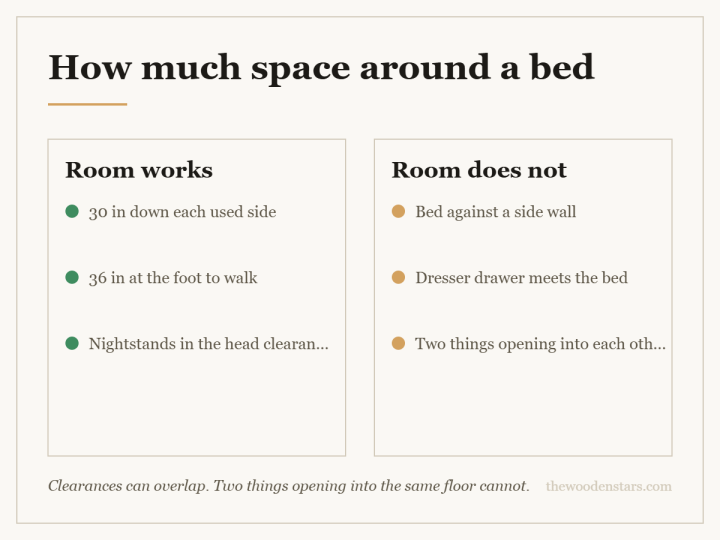
A king mattress is 76 × 80 inches; the frame is typically 79 to 82 inches wide and 84 to 86 inches long. Add 24 to 30 inches of walkway per side and you want a room about 12 × 13 feet. The frame must have a centre rail with two or three legs to the floor — at 76 inches the span is beyond what slats carry alone. Check that the listing means standard king, not California king, which is 72 × 84 and takes different bedding. Two adults get 38 inches each, the same as a twin bed apiece.
The numbers, and the room they demand
| Measurement | Figure |
|---|---|
| Mattress | 76 × 80 in |
| Typical frame footprint | 79 to 82 in wide, 84 to 86 in long |
| Width per sleeper, two people | 38 in each |
| Walkway each side | 24 to 30 in |
| Comfortable room size | About 12 × 13 ft |
| Absolute minimum | About 11 × 11 ft, and it will feel full |
A king in a 10 × 12 room technically fits and practically does not: you lose the walkway on one side, the chest of drawers has nowhere to stand, and the door may not open fully. Measure the room and mark the frame footprint on the floor with tape before ordering. It takes ten minutes and it is the only reliable test.
The compensation is real, though. Thirty-eight inches each is the same width a single sleeper gets in a twin bed, and for two adults who both move in their sleep that is the difference between sleeping well and not.
Why the support matters more at this width
A slat spanning 76 inches carries more load and bends further than the same slat spanning 60. Everything about a king frame follows from that.
The centre rail is not optional
A king needs a centre rail running head to foot, with two or three legs going down to the floor. Some good frames use two centre rails. Without any, the slats flex under every movement, the flex works the joints loose, and within a year the frame announces itself every time someone turns over.
A weight rating quoted for a frame with no centre leg is a number it cannot hold. Look for the leg count, not the pounds.
Slats, and their gaps
A king usually wants 15 to 18 slats. The gap between them should be under 3 inches for most foam and hybrid mattresses — that limit is normally written into the mattress warranty, and a sagging mattress over a wide gap is not a claim you will win.
Slat thickness matters more here than at smaller sizes. Thin slats that are fine across a twin will bow across a king, and a bowed slat does not spring back.
Joints and fixings
Bolts into threaded metal inserts, not wood screws into end grain. A king frame is heavy, it is assembled under more load, and the rail-to-post joint is where the movement concentrates. Screws into end grain hold the first time and strip by the third.
Material where the load goes
Solid timber and plywood hold a fixing indefinitely. Particleboard enlarges its hole under cyclic load and cannot be cleanly repaired. Panel elsewhere in the frame is not a problem — what matters is the rails, the posts and the centre support. The words on the listing are decoded in what engineered wood actually is.
King or California king
These are different mattresses and they are not interchangeable. A standard king is 76 × 80; a California king is 72 × 84 — four inches narrower and four inches longer.
Cal king suits tall sleepers and narrow rooms; standard king suits couples who want width. Bedding is not shared between them, and a frame is built for one or the other. The comparison is set out in Cal king against king.
Getting a king into the bedroom
This is a bigger problem than at any other size, and it is worth solving before the delivery arrives.
- The rails are about 84 inches and rigid. Measure the tightest turn on the route — a stairwell half-landing is usually the worst point.
- The headboard may ship as one piece nearly seven feet wide. Some split into two halves that bolt together, which is dramatically easier. The listing will say, and it is worth choosing on.
- The mattress is a separate problem: a king mattress does not fold, and in a tight stairwell it may simply not go. Foam mattresses ship compressed in a box, which sidesteps this entirely.
Matching the mattress to the frame
Frames are built to the standard mattress dimension, but mattresses vary by an inch or so between makers, and a frame with a rigid perimeter can be a tight fit. A little play is normal and harmless.
What matters more is that the mattress is fully supported: no overhang at the foot, nothing unsupported in the middle. The detail is covered in matching a king mattress to the frame.
For assembly and after
- Hex key set A king takes a lot of bolts; the folded key in the box will punish your hand
- Threadlocker On every rail and centre-support bolt — this is the squeak prevention
- Felt pads Under all legs, centre legs included, so nothing marks the floor
- Tape measure Frame footprint plus 24 to 30 in per side, marked on the floor first
What to buy


For the timber-specific version of this size, see wood bed frames at king size. If the room is not quite big enough, price a queen before compromising the walkway, and the category as a whole is in wood bed frames.
Questions we get asked
What are the dimensions of a king bed frame?
The mattress is 76 × 80 inches; the frame is usually 79 to 82 inches wide and 84 to 86 inches long once rails and headboard are counted.
What size room do you need for a king bed?
About 12 × 13 feet for a comfortable walkway on both sides and at the foot. Smaller works, but something else in the room has to give.
Does a king bed frame need a centre support?
Yes — a centre rail with two or three legs to the floor, and some frames use two rails. Seventy-six inches is well beyond an unsupported slat span.
How many slats does a king bed need?
Usually 15 to 18, with gaps under 3 inches. Slat thickness matters more at this width because the span is longer.
Is a king bed the same as a California king?
No. King is 76 × 80, California king is 72 × 84. Different bedding, different frames, and not interchangeable.
Will a king bed frame fit up my stairs?
Measure the tightest turn against the longest single component — usually an 84-inch rail or a one-piece headboard. A split headboard makes the job far easier.