Cabinet beds, queen — The Murphy bed that needs no wall
The Wooden Stars is a participant in the Amazon Services LLC Associates Program. We may earn a commission when you buy through links on our site, at no extra cost to you.

A cabinet bed is the Murphy bed that does not touch your wall. It is a freestanding chest — roughly the footprint of a large sideboard — and the mattress folds out of it onto legs that drop to the floor. Nothing is bolted to anything.
That single difference is why the category exists, and it is worth understanding properly, because a cabinet bed is not a wall bed with the fixings left off. It is a different machine that solves a different problem, and it charges you for the privilege in one specific place.
A queen cabinet bed is a freestanding box that unfolds into a bed, with no wall fixing at all. That makes it the answer for renters, for masonry or metal-stud walls, and for anyone who wants to take the bed with them. The cost is the mattress: it has to fold in two or three sections to fit inside the chest, so it is a tri-fold or bi-fold mattress rather than one you chose. The box also stays in the room permanently — it does not disappear against a wall the way a closed wall bed does. Expect to need 80 inches of clear floor when it is open, the same as any queen.
What you are actually buying
Picture a chest about the size of a wide sideboard, usually on castors or short feet. The front panel folds down and out; the mattress, stored folded inside, unfolds across the opening; support legs drop to the floor at the far end. Closed, it is furniture. Open, it is a bed with a chest at the head end.
Most models sold as queen cabinet beds also have a drawer in the base, because the mattress does not fill the whole box. That drawer is genuinely useful and is one of the honest advantages over a wall bed, which has no storage of its own unless you buy the side cabinets.
The mattress is the trade
This is the part to be clear-eyed about, because it is where a cabinet bed differs most from the wall-mounted queen.
A wall bed takes an ordinary mattress. The platform is flat, the mattress lies on it whole, and you buy whatever you would buy for a normal bed within the cabinet’s thickness limit. A cabinet bed cannot do that, because the mattress has to fold to fit inside the chest. So it ships with — and generally requires — a sectioned mattress, usually three hinged panels of foam.
Two consequences follow:
- You can feel the hinges. How much depends on the mattress quality and on the topper you add, but the seams exist and a light sleeper will find them. A mattress topper is not an optional upgrade here; treat it as part of the purchase price.
- You cannot simply swap in a better mattress. The replacement also has to fold, which narrows the market to specialist tri-fold mattresses rather than the whole mattress industry.
If the bed will be slept in most nights, this matters a great deal. If it is for guests a dozen times a year, it matters much less, and the freedom from wall fixings may be worth far more.
Floor space: the thing people assume wrong
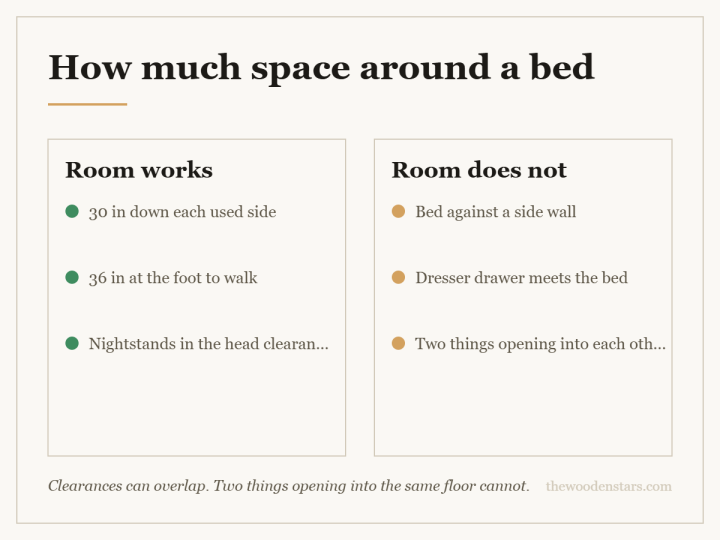
A cabinet bed does not save floor when open. A US queen mattress is 60 inches wide and 80 inches long, and those dimensions are fixed regardless of how the bed is stored. Open, a queen cabinet bed occupies the same footprint as a queen wall bed.
What differs is the closed state. A closed wall bed is a shallow cabinet flat against a wall, and in a well-planned room it reads as joinery. A closed cabinet bed is a substantial freestanding chest that sits in the room whether or not you want it there — it cannot be pushed flat, because the fold-out mechanism needs its depth.
| Question | Cabinet bed | Wall bed |
|---|---|---|
| Wall fixing | None | Into studs, mandatory |
| Works in a rental | Yes | Rarely |
| Mattress | Folding, tri-fold or bi-fold | Any standard queen within the thickness limit |
| Storage included | Usually a drawer in the base | Only if you buy side cabinets |
| Closed footprint | A freestanding chest, permanently | A shallow cabinet flat to the wall |
| Clear floor when open | 80 in | 80 in |
| Can you move house with it | Yes, it is furniture | Only by unbolting and making good |
Who should buy one
- Renters. The single strongest case. No holes, no making good, no conversation with a landlord.
- Solid masonry or metal-stud walls. Where a correct wall-bed fixing is either difficult or beyond what you want to take on.
- Anyone who expects to move. A cabinet bed goes on the van. A wall bed is a small demolition job.
- Rooms with no suitable wall. Windows, radiators, doors and switches can eat every run of wall in a small room. A freestanding box only needs floor.
Who should not
Anyone sleeping on it regularly. The folding mattress is a real compromise and it compounds night after night. If the room is your bedroom rather than an occasional guest room, a wall bed with a mattress you chose is the better machine — or, if the wall genuinely will not take one, an ordinary bed frame is cheaper than either.
Also, anyone hoping the box will vanish. It will not. Plan where it lives as a piece of furniture, not as a temporary measure.
What to look at on a listing
The mattress specification
How thick, how many folds, what foam. A thicker sectioned mattress usually sleeps better and is the main quality difference between models at different prices.
The support legs
They carry the far end of the bed and the person on it. Metal legs that drop and lock are what you want; check that the mechanism is positive rather than friction-held.
Castors
If the box has to move for cleaning or for opening, castors matter. Locking castors matter more, because a bed that creeps across the floor as you get into it is unpleasant.
Carcass material
Unlike a wall bed, a cabinet bed puts no load into a wall — but it does put the whole weight of the bed and sleeper into its own frame and legs. That makes the carcass a structural question rather than a cosmetic one. Solid timber and good plywood hold a screw indefinitely; particleboard loosens at the fixings and cannot be repaired well. Most models in this category are engineered panel somewhere, which is fine if the load points are reinforced — the vocabulary on the listing is decoded in what engineered wood actually is.
Worth having
- Tape measure 80 in of clear floor when open, plus the closed footprint you are giving up permanently
- Mattress topper Treat it as part of the purchase, not an upgrade — it hides the fold seams
- Furniture sliders A loaded cabinet bed is heavy and the floor underneath still needs cleaning
- Felt pads For models on feet rather than castors
What to buy


If your wall would actually take a fixing, price the wall-mounted queen against these before deciding — the mattress difference is the whole argument. For the wider category and the four types sold under one name, start at how Murphy beds work.
Questions we get asked
What is the difference between a cabinet bed and a Murphy bed?
A Murphy bed in the strict sense is anchored to the wall and swings up into a cabinet. A cabinet bed is freestanding and folds out of a chest. Both are sold under the Murphy name; only one needs studs.
Do cabinet beds need to be attached to the wall?
No. That is the entire point of them, and it is why they suit rented flats.
Are cabinet beds comfortable?
Less so than a wall bed, because the mattress folds. A good tri-fold mattress plus a topper is perfectly fine for guests. For nightly sleeping it is a compromise you will notice.
Can you use a regular mattress in a cabinet bed?
Generally no — it has to fold to fit inside the chest. Replacements exist, but you are shopping the tri-fold market rather than the whole mattress market.
How much floor space does a queen cabinet bed need?
Eighty inches out from the chest when open, the same as any queen. Plus the closed footprint of the chest itself, permanently.
Are cabinet beds worth it?
They are worth it when the wall is the obstacle — a rental, a masonry wall, a room with no clear run. They are not worth it as a cheaper wall bed, because the saving comes out of the mattress rather than out of the price.