What age is a bunk bed safe for? Six, and why that number
The Wooden Stars is a participant in the Amazon Services LLC Associates Program. We may earn a commission when you buy through links on our site, at no extra cost to you.
What age is a bunk bed safe for? Six years old for the top bunk, and that figure is not a marketing convention — it comes from published safety guidance and it is printed on the frames themselves.
The lower bunk has no age limit at all, which is the part most buying guides forget to mention.
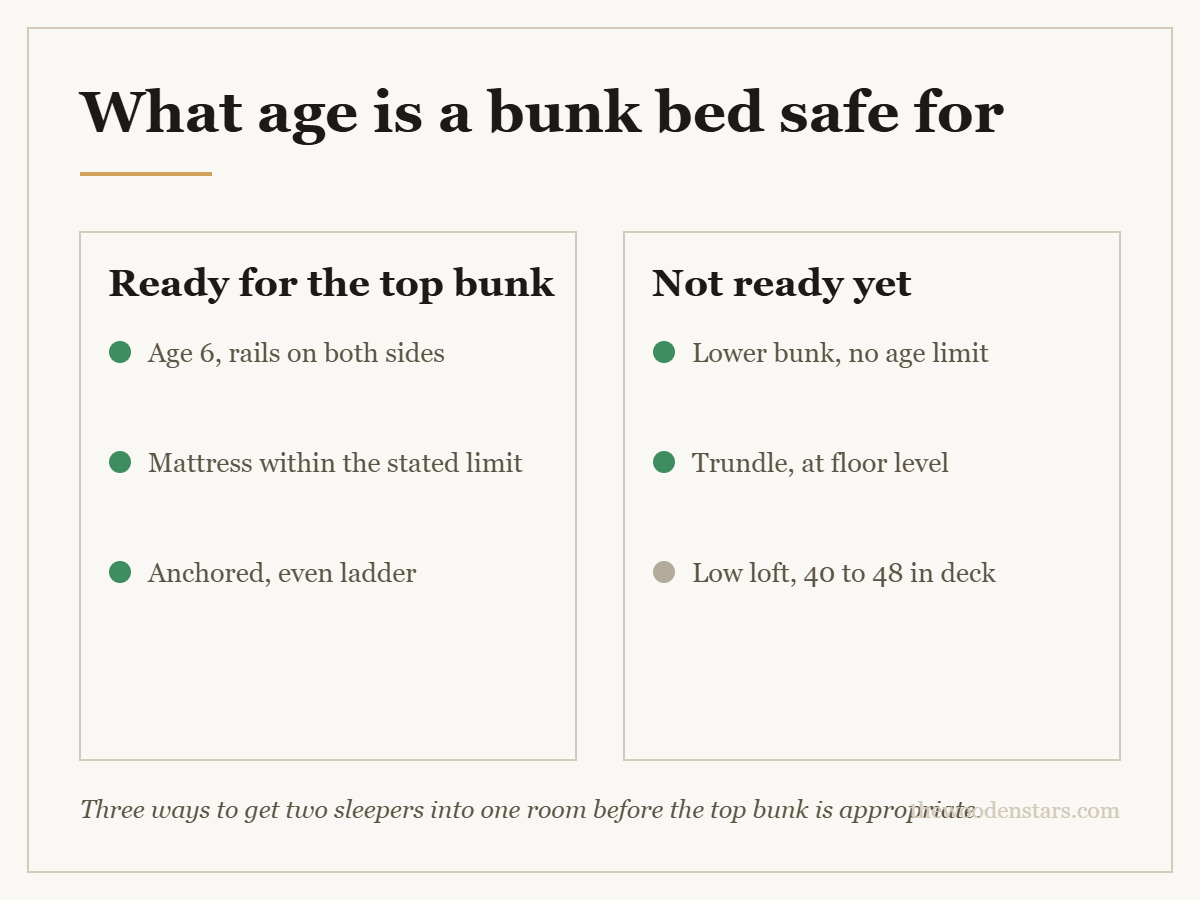
The standard answer is age 6 for the top bunk. It is on the warning label of every compliant frame sold in the US, and it is about judgement and coordination on a ladder rather than weight. There is no minimum age for the lower bunk — a three-year-old can use it the day the bed arrives. What makes the top bunk safe once the child is old enough: guard rails on both sides standing 5 inches above the mattress, no gap wider than 3.5 inches anywhere in the structure, a mattress no thicker than stated, and the frame anchored to a stud.
What age is a bunk bed safe for, and why six
Age six is the figure in US consumer safety guidance for the upper bunk, and manufacturers print it because compliant frames must carry the warning.
It is not about weight. A well-built frame holds several hundred pounds and a five-year-old is nowhere near that. The number is about three things a child develops around that age:
- Ladder coordination, including coming down half asleep in the dark.
- Judgement — understanding that the top bunk is not a platform to jump from.
- Waking properly rather than rolling and moving while still mostly asleep.
Children vary, and the number is a floor rather than a promise. A cautious seven-year-old and a boisterous seven-year-old are not the same case.
| Item | Figure | Applies to |
|---|---|---|
| Minimum age | 6 years | Top bunk only |
| Guard rail height | 5 in above the mattress | Both sides of the top bunk |
| Maximum gap | 3.5 in | Anywhere in the structure |
| Mattress thickness | As stated, usually 6 in | Top bunk only |
| Ladder rung spacing | Even, about 10 to 12 in | The climb |
| Wall anchor | Into a stud, not drywall | The whole frame |
The 3.5-inch rule, which catches people out
No gap in the structure should exceed 3.5 inches. The reasoning is entrapment: a gap that passes a child’s body but not their head is the dangerous size, and 3.5 inches is below it.
Places it gets breached in practice:
- Between the guard rail and the mattress, when a thin mattress leaves a gap under the rail.
- At the end of a guard rail, where a short rail leaves an opening before the post.
- Between slats, if the frame ships with wide spacing.
- Between the frame and the wall, if the bed is not pushed tight.
The mattress-thickness rule interacts with the first two in both directions: too thin and a gap opens under the rail, too thick and the rail stops working. That is worked through in how thick a bunk bed mattress can be.
Under six: what to buy instead
If the child is four and the room still needs two beds, three routes work.
The lower bunk now, the top later. Buy the bunk, put the younger child underneath, and move them up at six. No age rule applies to the bottom.
A trundle. The second mattress is at floor level, so there is nothing to fall from and no age limit — trundle bed against bunk bed and daybeds with a trundle.
A low loft. A deck at 40 to 48 inches rather than 60-plus, with a short ladder. Still a raised bed and still rail-governed, but the fall distance is roughly half — low loft beds.
The ladder, which is where most incidents happen
Falls from a bunk mostly happen on the climb, not from the mattress. What to look for:
- An angled ladder rather than vertical where the room allows it. Easier to descend half asleep, and it costs about 14 inches of floor.
- Flat rungs, not round dowels. Round rungs hurt bare feet and get avoided.
- Bolted, not hooked. A hook-on ladder can be knocked off its rail.
- Even spacing, about 10 to 12 inches. An uneven last step is where a foot gets misplaced.
- Something to hold at the top — a rail extension or the post continuing above the deck.
Construction detail is in wooden bunk beds.
Keeping it safe after the first year
A bunk that was safe on assembly day is not automatically safe two years later. Joints work loose, and a loose bunk racks.
Tighten every joint after the first month, then annually. Ten minutes with a T-handle key — the supplied L-key cannot apply proper torque. Check the rails are still tight at the same time, and check the anchor strap, which is the one fixing that fails silently.
Frames with bolts into barrel nuts can be pulled up indefinitely. Cam locks cannot be re-tightened meaningfully, which is the real argument against them on a bunk — see how much weight a bunk bed can hold.
Making a bunk safe and keeping it so
- Anti-tip wall strap The fixing that fails silently, and the one that matters most
- T-handle hex key The supplied L-key cannot torque a bunk joint properly
- Bunk bed safety rail For an open side on a frame that shipped with one rail
- Stud finder The strap has to reach a stud, not drywall
What to buy


For frames, see wooden bunk beds, twin over twin bunk beds and twin over full bunk beds. For the younger-child routes, low loft beds and daybeds with a trundle. For adults, can adults sleep on a bunk bed.
Questions we get asked
What age is a bunk bed safe for?
Six years old for the top bunk. The figure comes from US safety guidance and is printed on the warning label of compliant frames.
Is there an age limit for the bottom bunk?
No. A toddler can use the lower bunk from the day the bed arrives — the age rule applies only to the upper deck.
Why six and not a weight?
Because it is about ladder coordination, judgement and waking properly rather than load. A well-built frame is nowhere near its limit with a five-year-old on it.
How tall should the guard rail be?
Five inches above the mattress surface, on both sides of the top bunk. That is what sets the maximum mattress thickness.
What is the 3.5-inch rule?
No gap anywhere in the structure should exceed 3.5 inches, because a gap that passes a body but not a head is the entrapment risk.
Does a bunk bed need to be anchored to the wall?
Yes, into a stud rather than drywall. It is the fixing that fails silently and the one worth checking annually.