Furniture labels use the word “wood” to mean at least four different things, and the difference between them is most of the price. This hub exists to make those four things legible before you spend money, and to give the numbers a source rather than an adjective.
Four categories, in descending order of what they will survive: solid wood (one piece of timber, refinishable for decades), veneer over plywood (a real wood face on a stable core, one careful refinish), veneer over MDF or particleboard (a real wood face on a core that swells permanently if it gets wet), and laminate or “wood-look” (a printed photograph of wood). All four are legally sold as “wood furniture”.
The single most useful thing on this page: “acacia” is not a species
Acacia is a genus containing hundreds of species, and furniture sold as “acacia” can be any of several of them. Their hardness, colour and stability differ enormously. The same is true, to a lesser degree, of “mango”, “sheesham” and “rosewood” — all trade names covering a range rather than a single timber.
This matters commercially. A retailer can charge a premium for the word “acacia” without telling you which acacia, and two tables with the same label can behave completely differently. When a listing names only the genus, treat the hardness figures below as a range, not a specification — and treat the price as a claim about marketing rather than about material.
Hardness, and what it does and does not tell you
The Janka hardness test measures the force needed to embed a steel ball halfway into a piece of wood. It predicts one thing well — resistance to denting — and nothing else. It says nothing about stability, nothing about how the wood takes a finish, and nothing about whether a joint cut in it will hold.
| Timber | Janka (lbf) | Dents easily? | Common use |
|---|---|---|---|
| Paulownia | ~300 | Very easily | Lightweight panels, drawer boxes |
| Poplar | ~540 | Easily | Painted frames, hidden parts |
| Eastern white pine | ~380 | Very easily | Budget frames, rustic tops |
| Southern yellow pine | ~690 | Moderately | Frames, tops, shelving |
| Mahogany (Honduran) | ~800 | Moderately | Fine furniture, veneer |
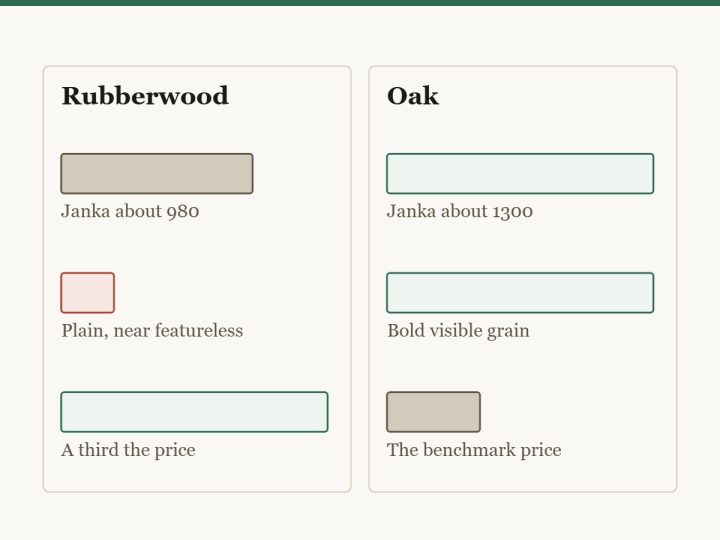
| Rubberwood | ~980 | Moderately | Affordable “solid wood” furniture |
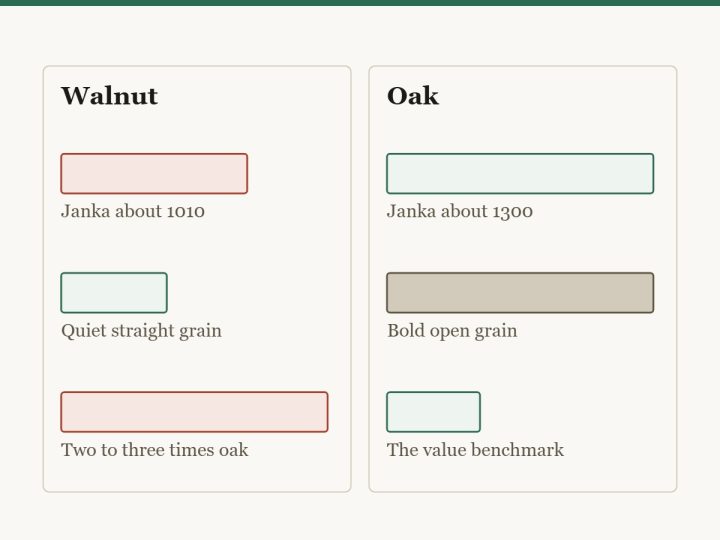
| Black walnut | ~1010 | Moderately | Premium tops, accents |
| Mango | ~1070 | Moderately | Mid-price tables and sideboards |
| Teak | ~1155 | Well | Outdoor furniture, boat trim |
| Birch | ~1260 | Well | Plywood, drawer boxes, painted work |
| Red oak | ~1290 | Well | Everything, for a century |
| Ash | ~1320 | Well | Chairs, frames, bentwood |
| Beech | ~1300 | Well | Chairs, worktops |
| White oak | ~1350 | Well | Tops, flooring, exterior joinery |
| Hard maple | ~1450 | Very well | Butcher block, worktops |
| Sheesham (Indian rosewood) | ~1660 | Very well | Indian-made case goods |
| Acacia (varies by species) | ~1100–2300 | Varies | Tables, slabs, worktops |
Read that table for relative position, not for precision. The gap between pine and oak is real and enormous. The gap between red oak and white oak is not something you will ever feel.
Stability is the property nobody advertises
Wood moves across the grain as the air changes. How much it moves, and how evenly, is dimensional stability — and on a wide panel it matters more than hardness. It is what decides whether a tabletop opens a seam in January, whether a drawer sticks in August, and whether a desk slab cups.
The practical consequences:
- A stable timber (white oak, teak, mahogany) can be used in wide solid panels with fewer precautions.
- A less stable timber can still make an excellent table, but the top must be fastened so it is free to move. See the dining tables hub for how that is done.
- Plywood barely moves at all across its width, which is why a plywood drawer bottom or case back is an upgrade rather than a compromise.
No amount of finish stops movement. Finish slows the rate at which wood exchanges moisture with the air; it does not seal it. The real control is the humidity of the room — see wood care for the band to aim at.
How to tell solid wood from veneer, in a shop or a photograph
- Look at the edge. On solid wood, the grain on the top face continues over the edge and down the side. On veneer, the edge is either a separate strip with different grain, or a hard line where the face stops.
- Look at the end grain. A solid panel shows growth rings on its ends. A veneered panel shows a thin dark line — the glue — under the face.
- Find a repeat. Veneer is sliced in sequence and often book-matched, so the same pattern appears mirrored or repeated. Solid boards never repeat.
- Check the underside. Manufacturers finish what you see. An unfinished, uniform, speckled underside is particleboard; a stripey layered edge is plywood.
- Weigh it, roughly. Particleboard is heavier than solid softwood and lighter than solid hardwood, which makes weight a hint rather than a proof — but a suspiciously light “solid oak” chest is not solid oak.
The one thing that never works is reading the listing. “Engineered wood”, “wood composite”, “solid wood construction” and “acacia finish” are all phrases that can legally describe a printed panel.
Is engineered wood always worse?
No — and pretending otherwise is how people waste money. Engineered panels are better than solid wood at exactly one thing: staying flat and dimensionally stable across a wide span. That makes them the right choice for:
- Case backs and drawer bottoms, where movement would be a problem and strength is not needed.
- Large flat headboard panels, which in solid wood would need a frame to survive.
- Wide shelves, where plywood outperforms solid boards of the same thickness.
They are the wrong choice where a fastener has to hold under load — a bed rail, a leg joint, a drawer corner — and they are the wrong choice anywhere water can reach an exposed edge.
Where our numbers come from
Hardness and density figures on this site are taken from The Wood Database and, where available, the USDA Forest Products Laboratory’s Wood Handbook. Every figure on a species page names its source. We do not estimate hardness, and we do not publish a number we cannot point at — an uncited figure is worse than no figure, because it looks like knowledge. Our full position on this is in the editorial policy.
Questions we get asked
Is acacia good furniture wood?
Usually yes — but the answer depends on which acacia, and the label rarely says. As a group it tends to be hard and attractively figured, with more colour variation between boards than oak. Judge the piece, not the word.
Is rubberwood real wood?
Yes. It is the timber of the rubber tree, harvested after its latex-producing years, which makes it one of the more sustainable hardwoods on the market. It is genuinely solid and genuinely soft — a fair material at a fair price, oversold when it is priced like oak.
Is mango wood durable?
Durable enough for case goods and sideboards, marginal for a surface that will take knife and cutlery abuse. It sits below oak on hardness and shows dents accordingly.
What is the difference between MDF and particleboard?
Both are wood fibre and glue. MDF is finer, denser, machines cleanly and holds a painted edge; particleboard is coarser, lighter and cheaper. Neither holds a screw well under repeated load, and both swell irreversibly when wet.
Should I pay more for solid wood?
Pay more for solid wood where the piece takes load or where you want to refinish it in twenty years — tops, rails, drawer boxes, legs. Do not pay a solid-wood premium for a large flat panel that would be more stable in plywood anyway.