How thick can a bunk bed mattress be? The five-inch rule
The Wooden Stars is a participant in the Amazon Services LLC Associates Program. We may earn a commission when you buy through links on our site, at no extra cost to you.
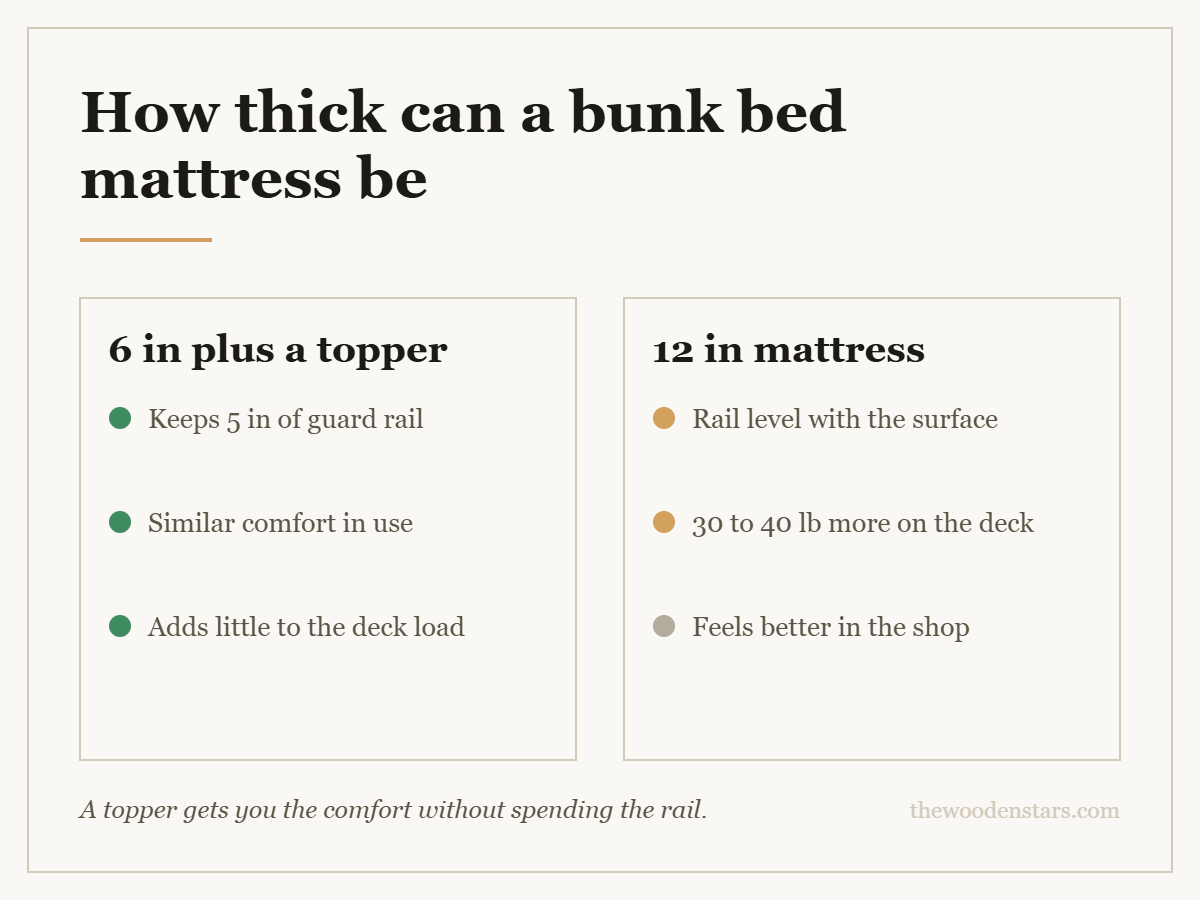
How thick can a bunk bed mattress be? Almost always 6 inches, sometimes 8, and the number is set by the guard rail rather than by the frame’s strength.
It is the most-ignored specification in the category, because a thicker mattress feels like an upgrade and the consequence is invisible until somebody rolls.
The rule behind every maker’s figure: the guard rail must stand 5 inches above the mattress surface. Frames are built with a rail height that assumes a mattress of a stated maximum — usually 6 inches, sometimes 8 on adult frames. Fit a 10 or 12-inch mattress and the rail ends up level with or below the sleeping surface, which is the same as having no rail. The lower bunk has no such cap — it can take any thickness the frame clears. If you want more comfort up top, use a 2-inch topper on a 6-inch mattress rather than a thicker mattress.
How thick can a bunk bed mattress be, and why 5 inches is the number
Guard-rail guidance across the industry works from a single figure: 5 inches of rail standing proud of the sleeping surface. That is roughly the height that stops a sleeping body rolling over the edge.
Manufacturers build the rail at a fixed height above the deck, then state the mattress thickness that leaves 5 inches showing. So:
- Rail 11 inches above the deck ⇒ maximum mattress 6 inches.
- Rail 13 inches ⇒ maximum 8.
- Rail 11 inches with a 10-inch mattress ⇒ 1 inch of rail. Decorative.
You can measure this yourself on a frame you already own: deck to top of rail, minus mattress thickness. If the answer is under 5, the mattress is too thick.
| Position | Maximum | Set by |
|---|---|---|
| Top bunk | 6 in, sometimes 8 | Guard rail height |
| Lower bunk | No cap | Clearance to the deck above |
| Loft bed | 6 in, sometimes 8 | Guard rail height |
| Trundle | 6 to 8 in | Clearance under the main deck |
| Daybed | Any | Nothing, but it sets the seat height |
What to do if 6 inches is not comfortable enough
A 6-inch mattress is thinner than most adults are used to, and for a child it is generally fine. Where it is not, there are two honest fixes and one bad one.
Good: a topper. A 2-inch topper on a 6-inch mattress gives 8 inches of comfort while the mattress itself still measures 6. Rail geometry is judged on the mattress, and a compressible topper does not lift the sleeping surface the way 4 inches of extra foam core does. This is what most people should do.
Good: buy a frame with a taller rail. Adult-grade frames state 8 inches, and a few state 10. If you know you want a thick mattress, that is a frame specification to shop for rather than a rule to break.
Bad: adding a rail extension. Aftermarket rails clamp to the frame and are not part of its tested geometry. They are better than nothing on an open side, and they are not a licence to fit a 12-inch mattress.
Weight, which the thickness also changes
Mattress thickness is not only a rail question. A twin mattress at 6 inches is 40 to 50 lb; at 12 inches of memory foam it can be 70 to 90.
That difference comes straight off the deck’s weight allowance, which already includes the mattress. On a frame rated 200 lb it is a meaningful share — the arithmetic is in how much weight a bunk bed can hold.
The lower bunk has no cap, which people forget
There is no guard rail on a lower bunk, so nothing limits the mattress except headroom. Whatever thickness you add comes out of the clear height under the top deck.
- Clear height 36 inches with a 6-inch mattress ⇒ 30 inches of sitting room. Fine for an adult.
- Same frame, 12-inch mattress ⇒ 24 inches. A child sits up; an adult does not.
So on a twin-over-full where an adult uses the bottom, the thick mattress is the right call only if the clear height allows it — see twin over full bunk beds.
Buying the mattress: two other numbers
Size. A twin is 38 × 75 inches; twin XL is 38 × 80. Bunk frames are usually built for one or the other and the difference is five inches of length — check before ordering, because a twin XL in a twin frame overhangs and a twin in a twin XL frame leaves a gap at the foot.
Firmness on slats. A mattress on slats is supported at intervals rather than continuously. Slat spacing under 3 inches keeps a foam mattress flat; wider and it dips between them, which most warranties exclude. See bed slat replacement and spacing.
The same thickness logic applies to a trundle, where the cap comes from the clearance under the main deck rather than a rail — daybeds with a trundle.
Getting the top bunk right
- Two-inch mattress topper The way to add comfort without spending the guard rail
- Six-inch bunk mattress Built for the height limit rather than trimmed to fit it
- Bunk bed safety rail For an open side, not as a licence for a thicker mattress
- Felt slat tape Thin mattresses transmit slat rub more than thick ones
What to buy



For the frames themselves, see wooden bunk beds, twin over twin bunk beds and full size bunk beds. For the load side, how much weight a bunk bed can hold. For the same rule applied to a folding bed, murphy bed mattress requirements.
Questions we get asked
How thick can a bunk bed mattress be?
Usually 6 inches, sometimes 8 on adult frames. The maker states it, and the figure comes from the guard rail needing to stand 5 inches above the sleeping surface.
What happens if the mattress is too thick?
The rail ends up level with or below the sleeping surface, which is functionally the same as having no rail.
Can I use a topper instead?
Yes, and it is the right answer. A 2-inch topper on a 6-inch mattress gives the comfort without lifting the sleeping surface the way a thicker core does.
Does the lower bunk have a thickness limit?
No rail limit. But every extra inch comes out of the clear height under the top deck, so an adult sitting up loses it.
How do I check my own frame?
Measure from the deck to the top of the guard rail, then subtract the mattress thickness. Under 5 inches means the mattress is too thick.
Does mattress thickness affect the weight rating?
Yes. A 6-inch twin is 40 to 50 lb; a 12-inch memory foam twin can be 70 to 90, and the rating includes the mattress.