Do loft beds need special mattresses? Thickness, not type
The Wooden Stars is a participant in the Amazon Services LLC Associates Program. We may earn a commission when you buy through links on our site, at no extra cost to you.
Do loft beds need special mattresses? Not special, but restricted — the mattress has to be 6 inches thick or less on most frames, and that single number rules out the majority of mattresses sold.
There is no such thing as a “loft bed mattress” as a distinct product. There is a standard twin mattress that happens to be thin enough.
A loft bed does not need a special type of mattress, but it does need a thin one. The guard rail must stand 5 inches above the sleeping surface, and frames are built assuming a mattress of a stated maximum — usually 6 inches, sometimes 8. Anything thicker leaves the rail level with the mattress, which is the same as having no rail. Beyond thickness, the sensible choices are a foam or hybrid that is light enough to wrestle up there, slat-friendly (spacing under 3 inches), and the right size — a twin is 38 × 75, a twin XL 38 × 80.
Do loft beds need special mattresses, or just thin ones?
Thin ones. The requirement comes entirely from the guard rail.
Rails are built at a fixed height above the deck. The maker then states the mattress thickness that leaves 5 inches of rail showing above the sleeping surface:
- Rail 11 inches above the deck ⇒ 6-inch maximum mattress.
- Rail 13 inches ⇒ 8-inch maximum.
- Rail 11 inches, 10-inch mattress ⇒ 1 inch of rail. Decorative.
You can check any frame yourself: deck to top of rail, minus mattress thickness. Under 5 and the mattress is too thick. The same rule governs bunks — how thick a bunk bed mattress can be.
| Property | Target | Why |
|---|---|---|
| Thickness | 6 in, or the stated maximum | Guard rail must show 5 in |
| Size | 38 × 75 twin, 38 × 80 twin XL | Frames are built for one or the other |
| Type | Foam or hybrid | Light enough to get up there |
| Weight | Under about 50 lb | You will lift it alone |
| Slat tolerance | Fine at under 3 in spacing | Foam dips over wide slats |
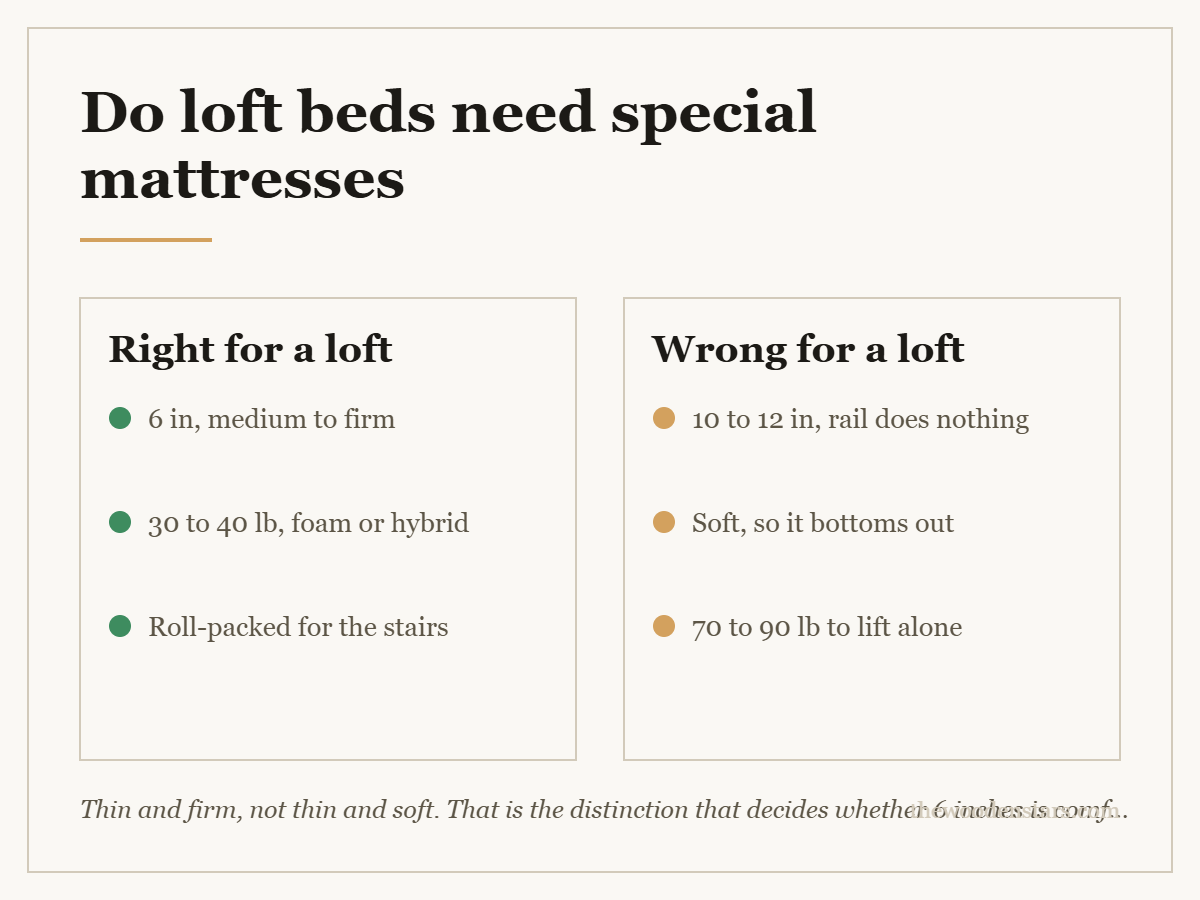
| Firmness | Medium to firm | Thin plus soft bottoms out |
Comfort on 6 inches, honestly
Six inches is thinner than most adults are used to. For a child it is genuinely fine — lighter bodies do not compress a mattress the way a heavier one does, and a good 6-inch foam mattress supports a 60-pound sleeper properly.
For a teenager or adult, two things make it work:
Firmness. A thin soft mattress bottoms out — you feel the deck. A thin firm one does not. Medium-firm to firm is the right end of the range here, which is the opposite of the usual advice for a thick mattress.
A topper. Two inches over a 6-inch mattress gives 8 inches of comfort while the mattress still measures 6. This is the correct fix, and it is worth stating plainly: a compressible topper does not raise the sleeping surface the way four extra inches of foam core does, so the rail geometry survives.
Weight, which people discover on assembly day
A mattress for a loft has to be lifted 60 to 72 inches, usually by one person, usually alone.
- 6-inch foam twin: 30 to 40 lb. Manageable.
- 8-inch hybrid twin: 45 to 60 lb. Awkward.
- 12-inch memory foam twin: 70 to 90 lb. Two people, and it should not be up there anyway.
A roll-packed mattress solves the delivery half of this — it arrives compressed in a box that goes up the stairs, and expands in place. For a loft that is worth choosing deliberately.
The weight also counts against the deck rating, which includes the mattress — see how much weight a bunk bed can hold.
Slats, which quietly ruin thin mattresses
A thin mattress transmits everything the deck does. Wide slat spacing that a 12-inch hybrid bridges easily will show through 6 inches of foam within months.
- Spacing under 3 inches for foam. Most mattress warranties specify this and void over it.
- Add a bunkie board or a sheet of ply if the frame’s spacing is wider. Cheap, and it fixes the problem permanently.
- Fix the slats at both ends. A loose slat rubs, and a thin mattress transmits that noise straight to the sleeper.
Detail in bed slat replacement and spacing, and if the frame talks rather than sleeps, why a wooden bed frame squeaks.
Size: check twin against twin XL before ordering
A twin is 38 × 75 inches, a twin XL is 38 × 80. Loft frames are built for one or the other and the listing does not always shout about it.
A twin XL in a twin frame overhangs the foot. A twin in a twin XL frame leaves a 5-inch gap — which is worse than it sounds, because it is a gap at the foot of a raised bed.
Frame sizing generally is in loft beds with a desk and how high a loft bed should be.
Getting the loft mattress right
- Six-inch twin mattress Built for the rail limit rather than trimmed to fit it
- Two-inch mattress topper Adds comfort without spending the guard rail
- Bunkie board Fixes wide slat spacing under a thin mattress permanently
- Fitted sheet for a thin mattress Standard deep sheets billow on a 6-inch mattress
What to buy


For frames, see loft beds with a desk, low loft beds and wooden bunk beds. For the height question, how high a loft bed should be. For the same rule on a bunk, how thick a bunk bed mattress can be.
Questions we get asked
Do loft beds need special mattresses?
Not a special type — a standard twin mattress that is thin enough. Most frames cap it at 6 inches, some at 8.
Why does the mattress have to be thin?
Because the guard rail must stand 5 inches above the sleeping surface. A thicker mattress raises the surface until the rail does nothing.
Is a 6-inch mattress comfortable enough?
For a child, yes. For an adult, choose medium-firm rather than soft and add a 2-inch topper — a thin soft mattress bottoms out.
Can I use a memory foam mattress on a loft bed?
Yes, if it is within the thickness limit. Check the weight too — a thick memory foam twin can be 90 lb, which is a two-person lift.
Does slat spacing matter more on a loft?
It matters more with a thin mattress. Keep spacing under 3 inches, or add a bunkie board.
Twin or twin XL?
Whichever the frame is built for — 38 × 75 against 38 × 80. A mismatch either overhangs the foot or leaves a five-inch gap.