Hardwood bed frames, queen — Where the timber actually matters
The Wooden Stars is a participant in the Amazon Services LLC Associates Program. We may earn a commission when you buy through links on our site, at no extra cost to you.

“Hardwood” on a bed frame listing is doing less work than most buyers think. It is a botanical category — trees that lose their leaves — not a hardness rating. Balsa is a hardwood. Yew is a softwood and harder than several hardwoods.
What actually decides whether a queen frame stays quiet and square for a decade is where the timber is, how big the sections are, and how the joints are made. Species matters, but it comes third.
On a bed frame, hardwood buys stiffness per inch of section and screw-holding, not scratch resistance — nothing abrades a bed frame. Oak, maple, birch, beech and acacia are stiff and hold a fixing well; pine and rubberwood are lighter and cheaper and need bigger sections to match, which good pine frames simply use. The comparison that matters is not oak against pine but solid timber against particleboard at the load points — the rails, the posts and the centre support. A well-designed pine frame beats a thin oak one every time.
What hardwood actually changes on a bed
A bed frame is not a worktop, a floor or a chopping board. Nothing rubs it, nothing cuts it, and it never gets wet. So the properties that make hardwood famous are mostly irrelevant here.
Three properties do matter:
- Stiffness. How far a rail or a slat bends under load. Denser timbers bend less for the same section, which is why they can be thinner for the same result.
- Screw-holding. How well a threaded fixing stays put under cyclic load. Dense timber holds better, and end grain holds worse than face grain in every species.
- Weight. An oak queen frame is genuinely heavy. That is good for stability and bad for anyone carrying it upstairs alone.
Species, ranked by what they do here
| Timber | Category | What it gives you |
|---|---|---|
| Oak | Hardwood | Stiff, heavy, holds a fixing indefinitely, expensive |
| Maple and birch | Hardwood | Stiff, pale, very good screw-holding, mid price |
| Beech | Hardwood | Stiff, common in slats, takes a finish well |
| Acacia | Hardwood | Dense and warm-coloured, widely used at mid prices |
| Rubberwood | Hardwood | Dense enough, cheap, usually finger-jointed |
| Walnut | Hardwood | Chosen for colour; priced for it |
| Pine and fir | Softwood | Light and cheap; fine with generous sections |
| Bamboo | Grass, sold as wood | Stiff laminate, light, dimensionally stable |
Rubberwood and bamboo are worth a note. Rubberwood is a genuine hardwood, usually made up from finger-jointed short lengths, and it is perfectly sound in a bed frame — the joints are glued and well distributed. Bamboo is not a tree at all but its laminated form is stiff, light and stable, which suits slats particularly well.
The comparison that actually matters
Not oak against pine. Solid timber against particleboard, at the three places load concentrates.
The rails. They carry the whole mattress and everyone on it, and they take the racking every time someone sits on the edge. Solid.
The posts. Where the rails bolt in. This is the joint that loosens, and the material around the fixing decides whether it can be tightened again. Solid.
The centre support. A queen needs a centre rail with two legs to the floor. It carries the middle of the bed and it is loaded constantly. Solid.
Everywhere else — a headboard face, a footboard panel, a slat roll backing — engineered panel is fine and is used by good makers for sound reasons: it is flat, it is stable, and it does not move seasonally. What each term on a listing means is set out in what engineered wood actually is.
Section size beats species
A pine rail 1.5 inches thick and 4 inches deep is stiffer than an oak rail 0.75 inches thick and 3 inches deep, by a wide margin — stiffness rises with the cube of depth. Good pine frames know this and use generous sections; the extra timber costs less than the hardwood would.
So read the dimensions before the species name. A listing that names its timber but hides its section sizes is telling you which of the two it is proud of.
The same logic applies to slats. A queen wants 13 to 16 slats with gaps under 3 inches, and a thick softwood slat outperforms a thin hardwood one across a 60-inch span.
Seasonal movement, and why frames are less affected
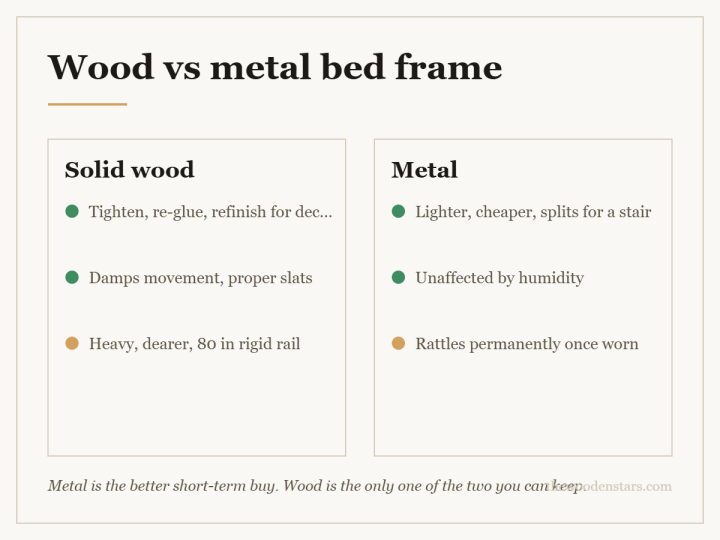
Solid timber shrinks and swells across the grain as humidity changes. On a wide tabletop that causes real problems; on a bed frame it mostly does not, because the components are narrow and the joints are bolted rather than glued rigid.
Where it does show is in a solid-panel headboard. A wide solid panel in a dry winter can open a gap or, if it was fixed too rigidly, split. This is exactly why many good frames use a veneered panel in a solid frame — not a cost saving but the correct construction.
Finish, and what to expect from each
Lacquer and catalysed finishes are hard, resist marks, and are difficult to repair invisibly. Good in a child’s room.
Oil and hardwax oil feel like timber, show marks more readily, and can be spot-repaired with a cloth. Good where the bed will be lived with for decades.
Stained pine pretending to be walnut is common at the bottom of the market. It is not dishonest if the listing says pine; it becomes a problem only when the wear reaches the pale timber underneath.
For assembly and after
- Hex key set Solid hardwood frames use a lot of bolts and torque
- Threadlocker Dense timber holds a thread well; the bolt is what loosens
- Hardwax oil For an oiled frame, a light refresh every few years keeps it even
- Felt pads A solid oak queen is heavy enough to mark a floor when it shifts
What to buy


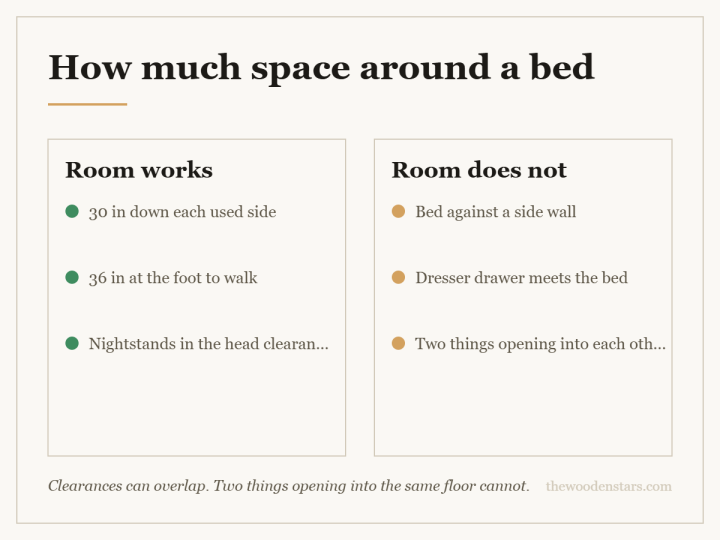
For the room and support numbers at this size, see queen bed frames; for a straight pre-order checklist, what to check before you order; and for the different looks available, four styles of queen wood frame.
Questions we get asked
Is hardwood better than softwood for a bed frame?
For the same section size, yes — it is stiffer and holds a fixing better. But a generously sized softwood frame outperforms a thin hardwood one, so read the dimensions first.
What is the best wood for a queen bed frame?
Oak, maple, birch, beech and acacia are all excellent. Pine and rubberwood are fine when the sections are generous. Species matters less than where solid timber is used.
Is rubberwood good for a bed frame?
Yes. It is a genuine hardwood, dense enough for the job, and the finger-jointing used in it is sound and well distributed.
Is a solid wood bed frame worth the extra?
Where the load goes — rails, posts, centre support — clearly yes, because particleboard cannot be repaired once a fixing hole enlarges. Panel elsewhere in the frame is not a compromise.
Does a hardwood bed frame still squeak?
It can. Squeaks come from loose bolts and slats moving in their seats, not from the species. Threadlocker at assembly is the fix.
Is bamboo a good bed frame material?
Laminated bamboo is stiff, light and dimensionally stable, which makes it good for slats and perfectly sound for frames. It is a grass rather than a timber, but that changes nothing practical here.