Most damage to solid wood furniture is not damage to the wood. It is damage to the finish — a film a few thousandths of an inch thick sitting on top of the timber. That distinction decides everything about the repair, because a finish can usually be persuaded to recover, while wood that has actually been cut or crushed has to be filled.
Before you touch anything, work out whether the mark is in the finish or through it. Run a fingernail across the edge: if you cannot feel a step, it is in the finish and probably reversible with heat or a mild solvent. If your nail catches, the finish is broken and the job becomes fill, colour and re-coat — in that order.
The four things that actually attack wood furniture
- Moisture — under the finish it turns white and cloudy; through the finish it raises the grain and lifts veneer.
- Heat — softens the finish and drives moisture into it. A hot mug leaves a white ring for the same reason a wet glass does, but harder to shift.
- Dry air — the quiet one. Shrinking wood opens seams, splits panels and pops joints, and it does it in winter when the heating is on.
- Abrasion — grit under a lamp base, a chair dragged instead of lifted, a cat.
Notice that only the last one is what most people mean by “damage”. The other three are why furniture that has never been knocked still fails.
Humidity is the setting nobody adjusts
Wood moves across the grain with the moisture in the air, and it does not care how much you paid for it. Keeping indoor relative humidity in a stable band does more for solid wood furniture than any polish on the market.
| Relative humidity | What happens | Typical result |
|---|---|---|
| Below 30% | Rapid shrinkage across the grain | Open seams, split panels, loose joints |
| 35–50% | Slow seasonal movement | Normal — seams open and close and nothing breaks |
| Above 60% | Swelling, slow drying | Sticking drawers, doors that bind, mould on backs |
A cheap hygrometer in the room where the furniture lives will tell you more than any inspection of the furniture itself. Winter heating is the usual culprit, and the fix is a humidifier, not a wax.
The repair ladder
Always work from the least invasive step upward. Every rung you skip is a rung you cannot go back down.
- Clean. A great deal of “damage” is decades of polish and airborne grease. Mild soap, barely damp cloth, dried immediately.
- Reactivate. White rings and hazing are trapped moisture. Gentle heat, or a solvent that softens the existing finish enough to let it flow back together.
- Colour. A scratch through the finish into bare wood usually only needs the colour put back — a touch-up marker or a wax stick in the right shade disappears at arm’s length.
- Fill. Only when material is missing. Filler is the first step you cannot undo, which is why it is fourth.
- Re-coat. One panel, one surface, feathered out.
- Strip and refinish. The nuclear option. Sometimes right, always the last resort — and on veneer, often fatal.
Wax, oil, or polyurethane — they are not alternatives
These three get discussed as though they were competing brands of the same thing. They protect against different things and fail in different ways.
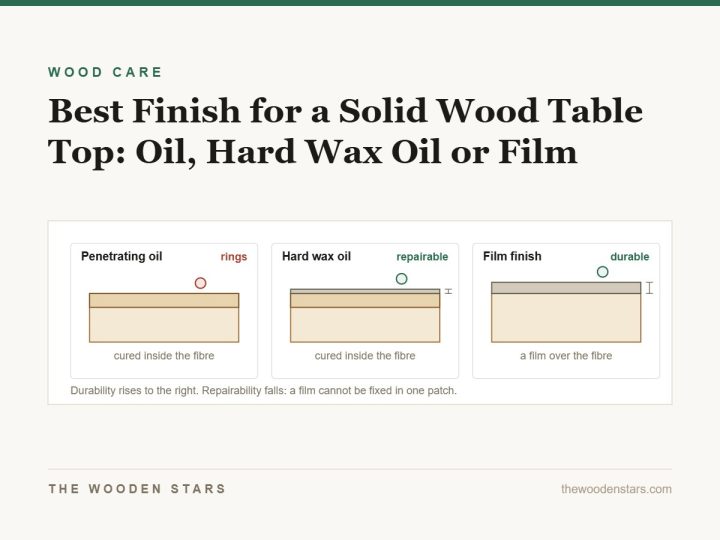
- Wax sits on the surface, adds sheen and a little water resistance for a short while, and buffs off. It protects against nothing serious and is easy to renew. Good on a piece you handle often, useless on a dining top.
- Oil penetrates and hardens in the wood rather than on it. Repairs invisibly — you can spot-treat a patch and it blends. Offers little resistance to standing water and none to heat.
- Polyurethane and other film finishes form a plastic layer over the wood. Genuinely resist heat and water, which is why they are on kitchen tables. But when they fail they fail visibly, and spot repairs show as patches.
The practical rule: oil for pieces you want to keep repairing, film for surfaces you want to stop worrying about. Hard wax oils sit in between and are the usual modern compromise.
What lives in a wood care kit
You do not need much, and most of it is cheap. Guides for each of these are in the Part layer above as they publish.
- Touch-up markers and wax fill sticks in two or three shades — one lighter and one darker than the piece, because you blend towards a match rather than buying one.
- Wood glue. A PVA for interior joints; a waterproof grade where moisture is possible. Glue is the only consumable where the cheap option is genuinely worse.
- Clamps. The tool people skip, and the reason their joint repairs fail. Glue needs pressure, not hope.
- Wood filler versus wood putty — not the same product. One is for pre-finish repairs and takes stain; the other is for post-finish cosmetics and does not.
- Felt pads and a hygrometer. Between them they prevent more damage than every other item combined.
The three mistakes we see most
- Sanding first. Sanding is the last step, not the first. Almost every mark has a less destructive fix, and once you have cut through a finish on veneer you are into the substrate.
- Re-gluing over old glue. Cured glue is not a gluing surface. If the old joint is not cleaned back to wood, the repair will loosen again — usually within a year.
- Treating dry-air cracks as a repair problem. Filling a seam that opened because the room is at 25% humidity means the filler will be crushed out when the season turns. Fix the air first.
Questions we get asked
Will polish fix a scratch?
It will hide a very light one for a few days by filling it with wax and oil. It does nothing for a scratch through the finish, and repeated use builds a soft layer that later has to be cleaned off before any real repair.
Can I use olive oil or mayonnaise on wood?
Kitchen oils do not cure — they stay soft, collect dust, and eventually go rancid, which is a smell you cannot remove. There are cheap products made for the job; use those.
Is a white ring permanent?
Rarely. A white ring is moisture in the finish, and the finish can usually be persuaded to release it. A dark ring is different — that is water that has reached the wood and reacted with it, and it needs bleaching or refinishing.
My drawers stick in summer and run fine in winter. Is something broken?
No, that is wood doing exactly what wood does. Humid air swells the drawer sides. If it only happens in the wettest part of the year, leave it alone; if it happens all year, the problem is the runners, not the weather. See dressers and nightstands.
How often should solid wood furniture be treated?
Far less often than polish manufacturers suggest. A film-finished piece needs cleaning, not feeding. An oiled piece wants topping up when water stops beading — for most furniture that is once a year, not once a month.