Can adults sleep on a bunk bed? Only on the right frame
The Wooden Stars is a participant in the Amazon Services LLC Associates Program. We may earn a commission when you buy through links on our site, at no extra cost to you.
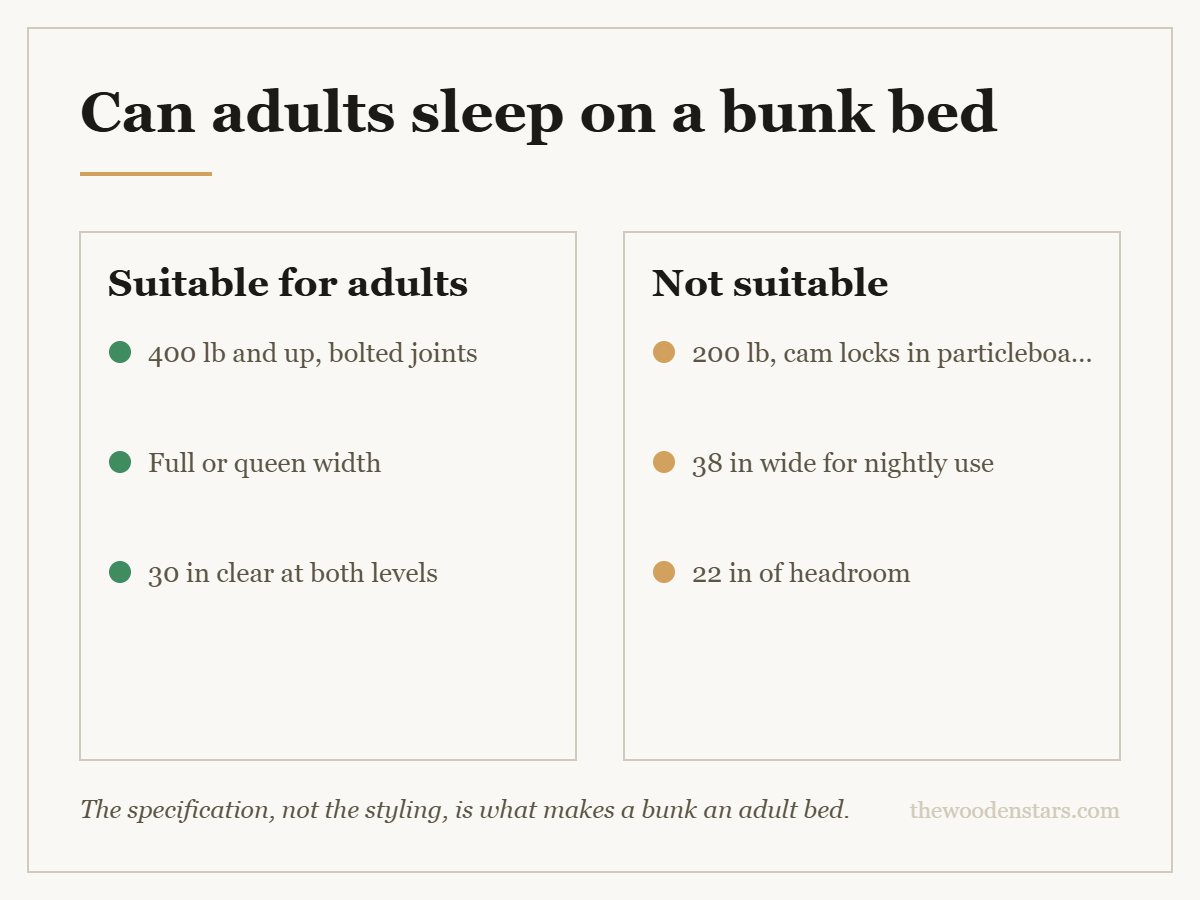
Can adults sleep on a bunk bed? Yes — but only on a frame built for it, and the frames built for it look different from the ones sold for children’s rooms.
Three numbers separate an adult bunk from a child’s bunk, and none of them is the price.
Adults can use a bunk bed on a frame rated 400 lb or more per deck, with posts of 2.5 to 4 inches and bolts into barrel nuts rather than cam locks. Check three clearances: 30 to 36 inches of headroom above the top mattress so an adult can sit up, 30 inches of sitting room under the top deck for the lower sleeper, and a mattress within the 6 to 8-inch cap set by the guard rail. A full or queen bunk is usually the honest choice — a twin is 38 inches wide, which most adults find narrow for regular use.
Can adults sleep on a bunk bed: the rating comes first
Bunk weight ratings run from 150 lb to over 1,000, and the number tells you what the frame is.
- 150 to 250 lb: thin metal tube or particleboard. A child, and only a child.
- 250 to 400 lb: pine or light rubberwood, screwed. A teenager.
- 400 to 600 lb: solid hardwood, bolted joints. One adult with margin.
- 600 to 1,000 lb: heavy hardwood or thick-wall steel. Two adults, rentals, holiday houses.
And the rating includes the mattress — 40 to 70 lb on a twin, 60 to 100 on a full. A 400 lb deck with a 60 lb mattress and bedding leaves about 325 for the person, which is a real margin. A 250 lb deck leaves 175, which is not. The arithmetic is in how much weight a bunk bed can hold.
Aim for roughly double the sleeper’s weight. Published ratings are static, and getting into bed applies two to three times body weight momentarily.
| Item | Adult figure | Child frame typically |
|---|---|---|
| Deck rating | 400 lb and up | 150 to 250 lb |
| Post section | 2.5 to 4 in | 1.5 to 2 in |
| Joints | Bolts into barrel nuts | Cam locks or screws |
| Width | Full or queen preferred | Twin, 38 in |
| Headroom above | 30 to 36 in | 24 in accepted |
| Sitting room below | 30 in after the mattress | Whatever is left |
| Mattress cap | 6 to 8 in on top | 6 in |
Width is the comfort question, not height
A twin is 38 inches wide. That is fine for a child and narrow for an adult sleeping there regularly — most adults want 54 inches or more.
So for adult use, look at:
Full over full. Fifty-four inches on both decks. The usual sensible answer for a guest room or a shared adult room — full size bunk beds.
Twin over full. A full underneath, a twin on top. Works when one sleeper is an adult and one is not — twin over full bunk beds.
Queen over queen. Sixty inches per deck and a serious structure; the frames that offer it are built for it — queen bunk beds.
Wider decks also change the support requirement: at full and queen widths the deck needs a centre rail under the slats, or it dips. See bed frame centre support legs.
The two clearances that decide comfort
Above the top mattress. An average adult’s sitting height is about 34 inches, so allow 33 to 36. A standard 96-inch ceiling with a 68-inch frame and a 6-inch mattress gives 22 — not enough. Adult bunks are often a little lower than children’s for exactly this reason, or they need a taller room. Worked through in how much space above a bunk bed.
Under the top deck. Clear height there is typically 33 to 40 inches. A 12-inch mattress on the lower bunk leaves an adult 21 to 28 inches, which means they cannot sit up in their own bed. Either accept a thinner lower mattress or buy a frame with more clearance — this is a specification worth asking about and it is often missing from listings.
The ladder, which adults find harder than children do
Children go up and down bunk ladders fearlessly. Adults are heavier, less flexible and more likely to be doing it at three in the morning.
For adult use, prefer an angled staircase or wide-tread ladder over a vertical one — it costs 14 inches of floor and it is the difference between a bunk you use and one you resent. Flat rungs, not round dowels. Bolted, not hooked. And something to hold at the top.
Where the top bunk is for occasional guests only, the vertical ladder is tolerable. Where an adult sleeps up there nightly, it is not.
Keeping an adult bunk tight
Heavier loads loosen joints faster. Two habits:
- Tighten every joint after the first month, then annually. Ten minutes with a T-handle key; the supplied L-key cannot apply proper torque. This is only possible on a bolted frame, which is the real argument against cam locks for adult use.
- Anchor it to a stud and check the strap yearly. It is the fixing that fails silently.
If it starts to talk, that is usually slats rather than joints — why a wooden bed frame squeaks and bed slat replacement and spacing.
For adult use
- T-handle hex key Heavier loads loosen joints faster, and the L-key cannot torque them
- Anti-tip wall strap The fixing that fails silently, checked yearly
- Centre support leg Full and queen decks dip without one
- Eight-inch bunk mattress Where the frame allows 8 rather than 6, take it
What to buy
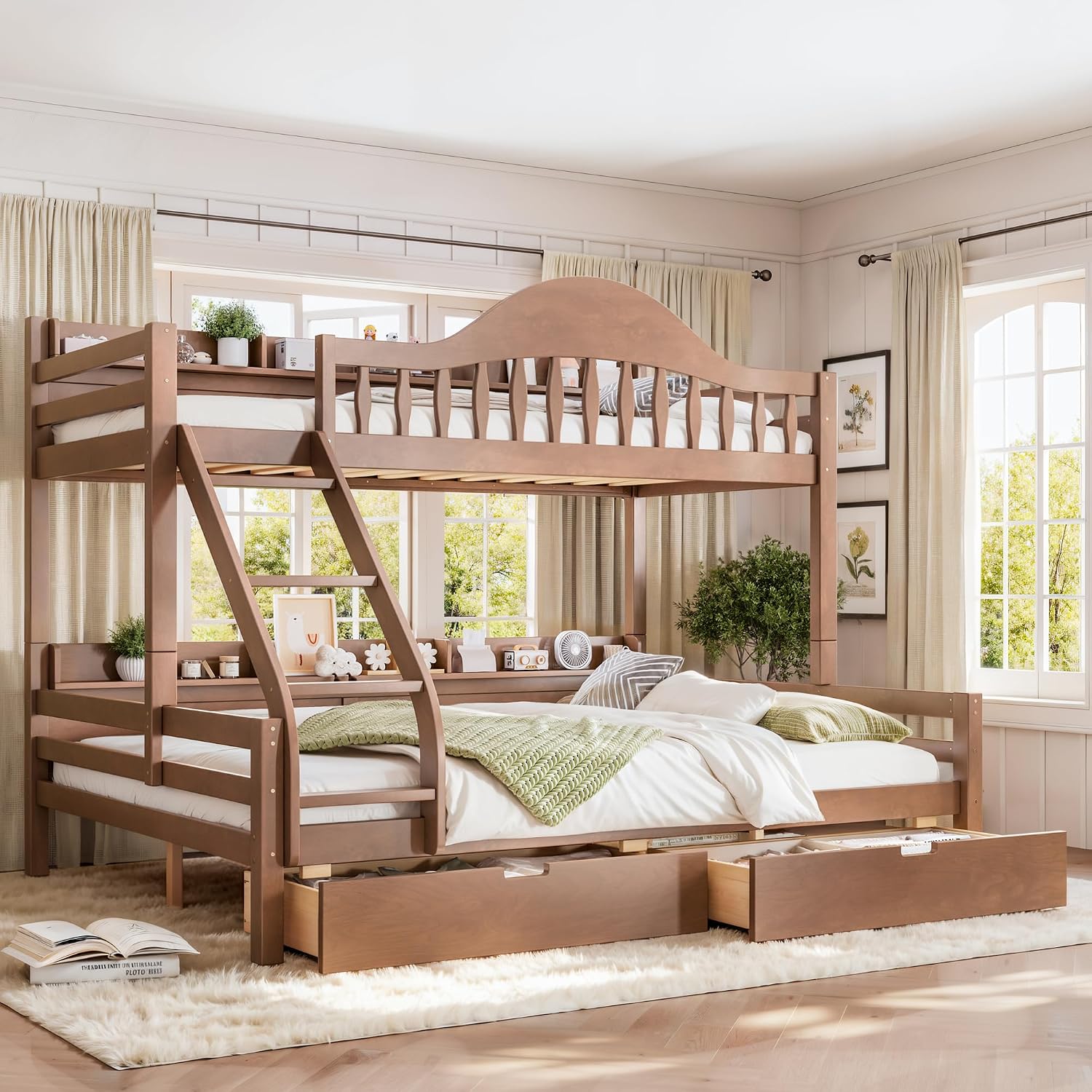

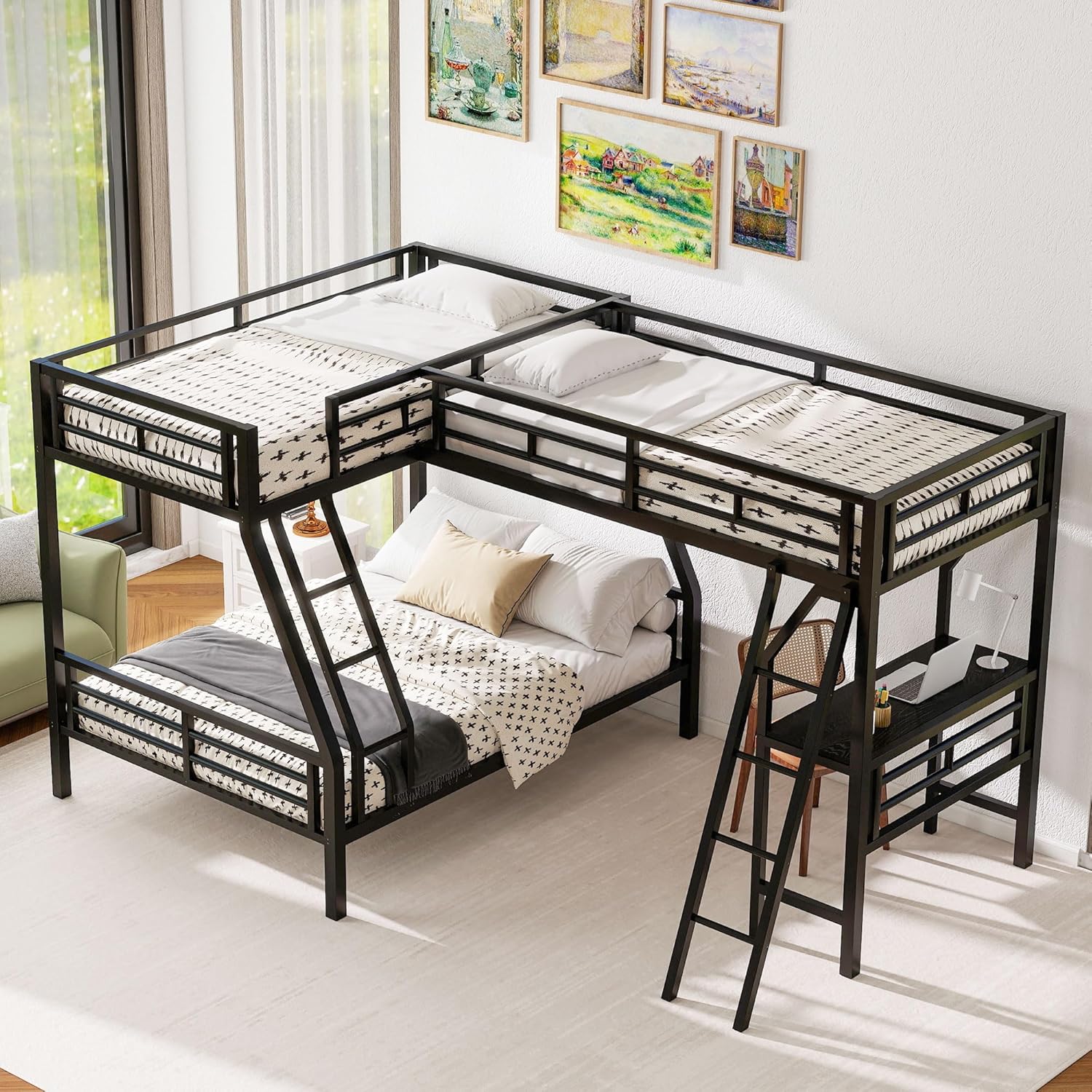

For adult-width frames, see full size bunk beds, queen bunk beds and twin over full bunk beds. For construction, wooden bunk beds. For the alternatives in an adult room, murphy bed against loft bed and bunk bed against two twin beds.
Questions we get asked
Can adults sleep on a bunk bed?
Yes, on a frame rated 400 lb or more per deck with solid hardwood posts and bolted joints. Children’s frames rated 150 to 250 are not suitable.
What weight rating should an adult bunk have?
Roughly double the sleeper’s weight, because published ratings are static and getting into bed applies two to three times body weight momentarily.
Is a twin bunk wide enough for an adult?
Thirty-eight inches is narrow for regular adult use. Full over full at 54 inches is the usual sensible choice.
How much headroom does an adult need on the top bunk?
Thirty-three to 36 inches above the mattress. An average adult’s sitting height is about 34.
Can an adult use the bottom bunk comfortably?
If there is 30 inches of sitting room after the mattress. A thick lower mattress in a 36-inch clearance leaves too little.
Do adult bunk beds need a different ladder?
An angled staircase or wide-tread ladder is worth the 14 inches of floor. Vertical ladders with round rungs are tolerable for guests, not for nightly use.