A bookcase is the only piece of furniture people routinely overload by a factor of three. Books are dense — a shelf of hardbacks is one of the heaviest loads in a house, applied continuously for years — and the shelf either has the span and thickness to carry it or it slowly bows until the sag is permanent.
Sag is a function of span, not quality. A 3/4-inch solid wood or plywood shelf carrying books starts to look tired somewhere past 30 to 36 inches of unsupported span; particleboard gives up considerably earlier. If a shelf is sagging, the fix is to shorten the span — a centre support or a stiffening strip — not to buy a thicker shelf of the same length.
Anatomy of a bookcase
- Sides or gables — the two vertical panels. Drilled with pin holes if the shelves are adjustable.
- Fixed shelves — usually top, bottom and one in the middle. They are structural: they hold the case square.
- Adjustable shelves — sitting on pins, clips or a track.
- Back panel — thin, and the single most important part for rigidity. A bookcase with a loose back racks into a parallelogram.
- Plinth or toe kick — the base. Keeps the bottom shelf off a damp floor and hides an uneven one.
- Anti-tip restraint — as with a dresser, not optional. A tall bookcase full of books is a serious load at head height.
The numbers that decide whether it works
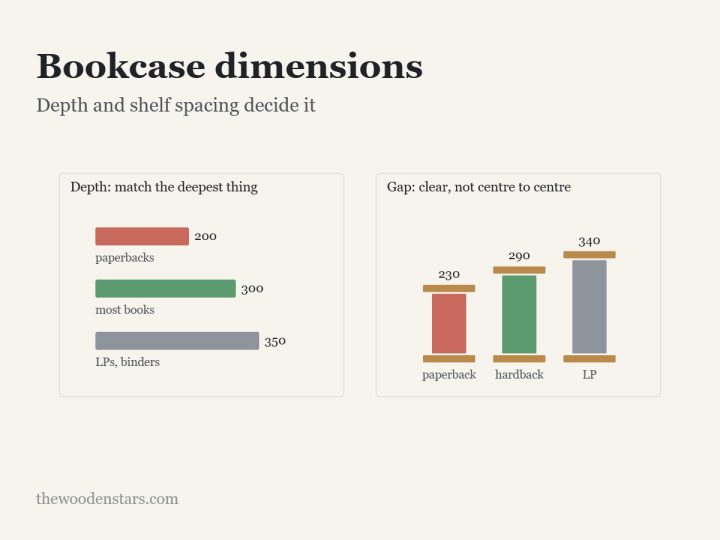
| Contents | Shelf depth | Height between shelves |
|---|---|---|
| Paperbacks | 8–9 in | 9–10 in |
| Standard hardbacks | 10–12 in | 11–13 in |
| Large format / art books | 13–15 in | 14–16 in |
| Vinyl records | 13–14 in | 13–14 in |
| Box files | 13 in | 13–14 in |
Two things follow. Most bookcases sold as “deep” at 11 to 12 inches are sized for hardbacks and will not take art books, which is why one shelf always ends up lying flat. And a case with all shelves evenly spaced at 12 inches wastes a great deal of height — book heights vary, so shelf spacing should too.
Span: the one calculation worth doing
Shelf deflection depends on the material, the thickness, the depth and — overwhelmingly — the span, because deflection rises with the cube of the length. Doubling a shelf’s length makes it sag roughly eight times as much.
| Material | Comfortable span | Notes |
|---|---|---|
| Solid hardwood | 30–36 in | Stiffest of the common options |
| Hardwood plywood | 30–36 in | Comparable to solid, more stable |
| Softwood (pine) | 24–30 in | Visibly deflects sooner |
| MDF | 24–28 in | Sags slowly and permanently |
| Particleboard | 18–24 in | The usual culprit in flat-pack |
These are working figures for a full load of books, not laboratory limits — deflection depends on thickness, depth, edge treatment and how heavy your books actually are. If you want a real number for a specific shelf, the Sagulator is the standard tool for it and takes about a minute.
Three ways to beat a span, in order of effort:
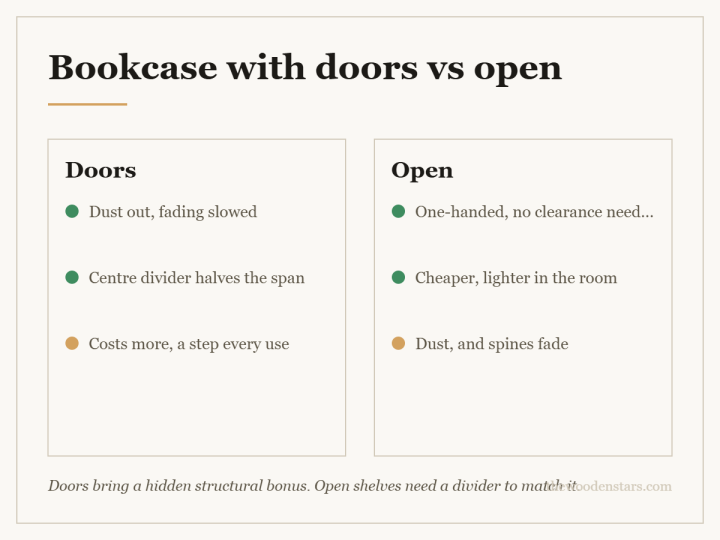
- Add a vertical divider in the middle. Halving the span cuts deflection to about an eighth.
- Glue a stiffening strip along the front edge, standing down an inch. A shelf’s stiffness comes from its depth in the direction of the load, so an inch of edge banding on edge does more than doubling the thickness of the panel.
- Turn the shelf over once a year while it is young. Only works on a shelf that has not yet set, and it is a delaying tactic, not a fix.
Which species and materials belong in shelving
- Hardwood plywood — the quiet best answer for shelves. Stiff, stable, does not cup, and the exposed edge can be banded with solid wood.
- Oak, maple, ash — stiff and handsome. A solid shelf wide enough for books usually has to be glued up from narrower boards, which is fine.
- Pine — the traditional shelving timber, and honest about it. Keep spans short.
- Acacia and mango — common on decorative shelving units where the load is ornaments rather than books. See wood types.
- Particleboard with printed foil — the flat-pack default. Works at short spans and light loads, and nowhere else.
What goes wrong, and why
- A sagging shelf. Span, load, or both. Not a defect — physics. See above for the three fixes.
- The case leaning forward. The back panel has come loose, or was only ever pinned to the outer edge. Re-fixing a back properly is the cheapest structural repair in furniture.
- Shelves that will not sit level. One pin hole drilled slightly off, or a pin missing. Look at all four before blaming the shelf.
- Pins pulling out of the side panel. The hole has worn, usually in MDF. Repairable with a glued hardwood plug and a fresh hole.
- A bowed side panel on a tall unit. The case is carrying more than the sides can take in compression, often because the fixed shelves are too far apart.
Parts you can actually replace
- Shelf pins and supports — 5 mm and 1/4 inch are the two common diameters, and they are not interchangeable. Measure an existing pin, or measure the hole.
- Back panels — a sheet of 1/4-inch plywood or hardboard cut to size, fixed all round rather than at the corners.
- Shelves themselves — cut to the inside width. Replacing a sagging particleboard shelf with plywood of the same thickness is a real upgrade.
- Anti-tip kits — one per case, into a stud or a rated cavity fixing.
- Levelling feet — a bookcase on an uneven floor twists, and a twisted case does not hold its shelves level.
Before you buy
- Measure your tallest and deepest books, not an average. One shelf must fit the biggest thing you own.
- Check the span between verticals against the table above. A handsome 40-inch-wide bookcase with no centre divider will sag.
- Look for a full back panel housed in a groove or fixed all round.
- Confirm the shelf material. “Solid wood bookcase” often means solid frame and particleboard shelves.
- Plan the anti-tip fixing before it arrives, especially in a room a child uses.
Questions we get asked
How much weight can a shelf hold?
The honest answer is that it depends on the span far more than on the material, which is why nobody publishes a single figure. A short particleboard shelf outperforms a long solid one. Work out the span first.
Can I stop a shelf that has already sagged?
You can stop it getting worse, and sometimes recover a little by unloading it and turning it over. A shelf that has held a deflection for years has taken a permanent set and will not come back flat.
Are floating shelves strong enough for books?
Only where the bracket is fixed into studs and the shelf is short. A floating shelf carries its entire load as a cantilever, so the wall fixing, not the shelf, is the limit.
Is plywood really as good as solid wood for shelves?
For stiffness at the same thickness, roughly yes — and for staying flat, better. The only real drawback is the exposed edge, which is why good plywood shelving has a solid banding strip.
Do I need to anchor a short bookcase?
If a child can climb it, yes. Height is not the only factor; a loaded case tips because weight moves forward when a drawer or a shelf is pulled on, and that happens at any height.