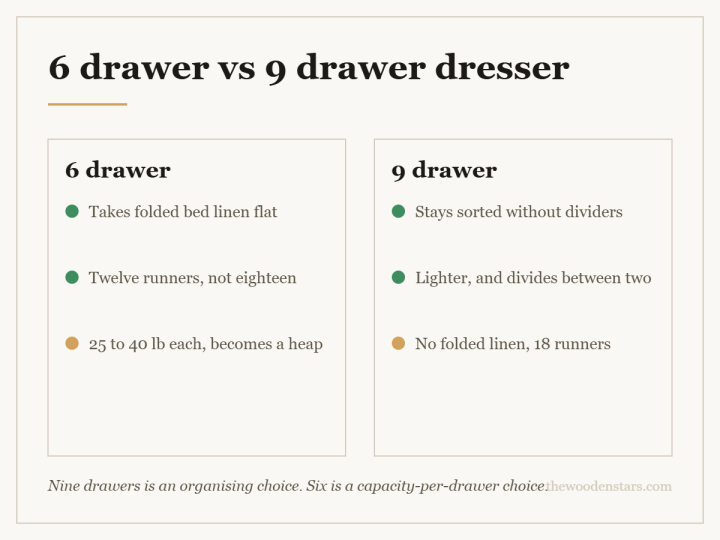
A chest of drawers is the most mechanical piece of furniture in a bedroom. Everything else sits still; a dresser has six to ten moving assemblies that each run thousands of cycles. That is why dressers are where cheap construction shows up first, and also why they are the most rewarding thing in the house to repair.
A drawer that sticks, drops or tips out has one of four causes: the slides are the wrong length or have come off their rail, the case has racked out of square, the drawer box has swollen with humidity, or the runner is simply worn. Pull the drawer right out and look at the runner before touching anything — the answer is almost always visible in ten seconds.
Anatomy of a chest of drawers
- Case — the box. Sides, top, bottom, and critically a back panel, which is what keeps the case square.
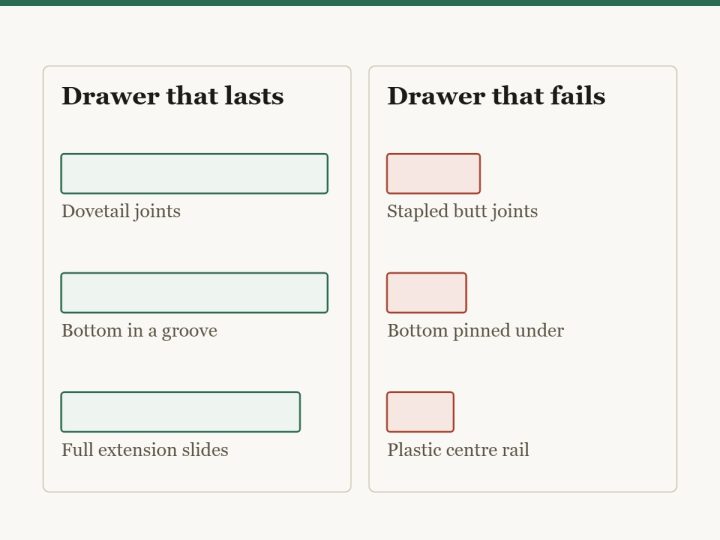
- Drawer box — four sides plus a bottom. How the corners are joined is the single best indicator of quality: dovetails, then dowels, then staples.
- Drawer front — sometimes the same piece as the box front, sometimes a separate applied face.
- Runners or slides — wooden runners, or metal ball-bearing or roller slides. Sold by length in 2-inch increments.
- Dust panels — thin panels between drawers. Present on good casework, absent on most flat-pack.
- Knobs and pulls — held by machine screws at a standard centre-to-centre spacing.
- Anti-tip restraint — the strap or bracket anchoring the case to the wall. Not optional.
Anti-tip: the one paragraph on this page that is about safety
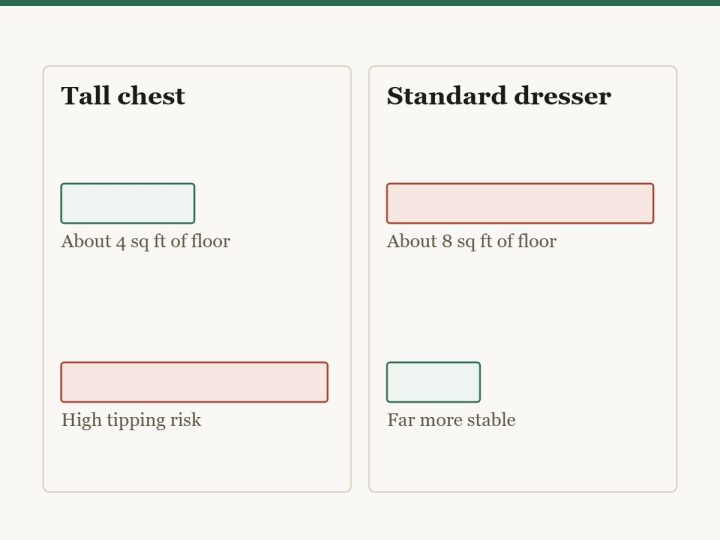
Clothing storage units tip over when a child climbs an open drawer, and the US furniture industry has a voluntary stability standard (ASTM F2057) precisely because of it. Every dresser ships with a restraint kit, and a large share are never fitted. If you do nothing else on this page, fit the strap — and fit it into a stud or a proper cavity anchor, not into plasterboard alone.
The numbers that decide fit
| Piece | Height | Width | Depth |
|---|---|---|---|
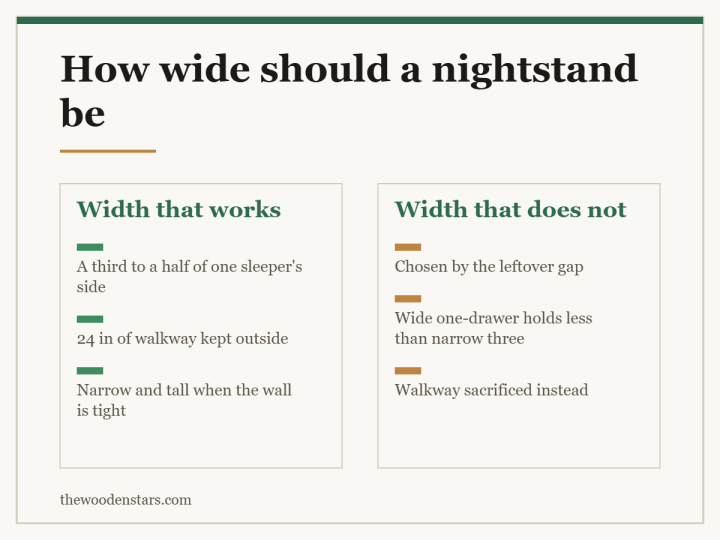
| Nightstand | 24–28 in | 18–24 in | 16–18 in |
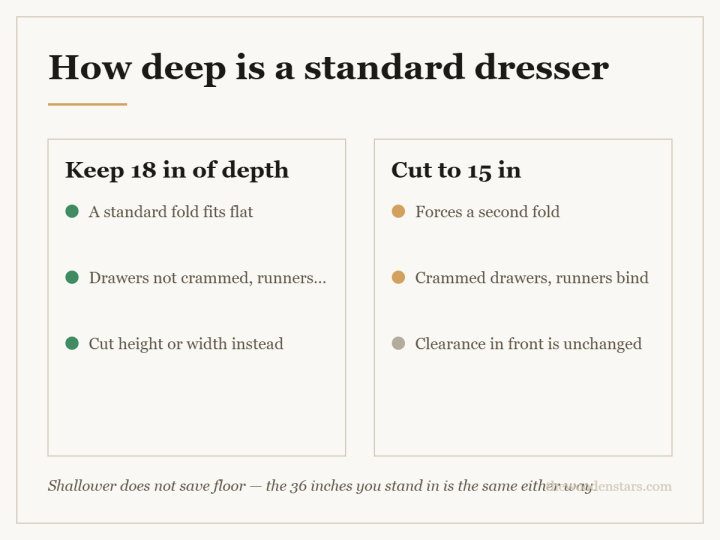
| Standard dresser (wide) | 30–36 in | 52–66 in | 18–20 in |
| Tall chest | 40–50 in | 30–40 in | 18–20 in |
| Dresser with mirror | 30–34 in | 56–66 in | 18–20 in |
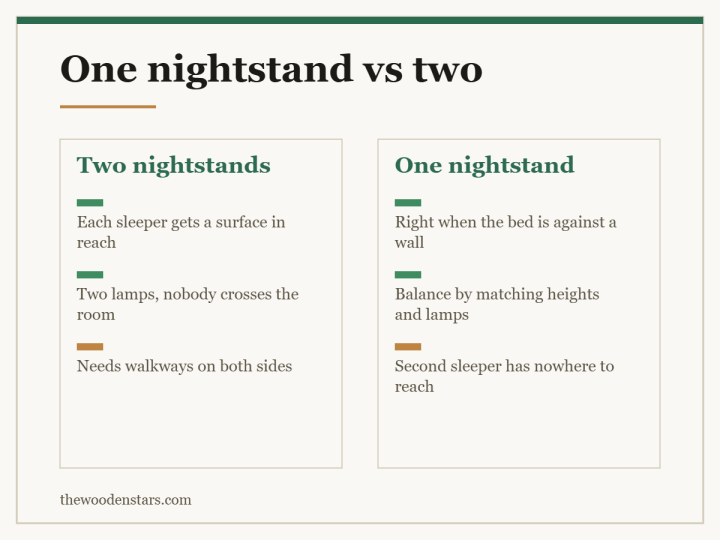
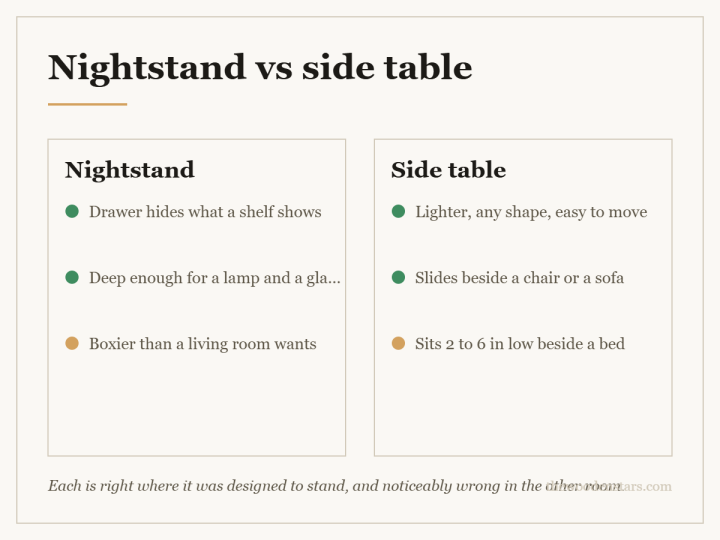
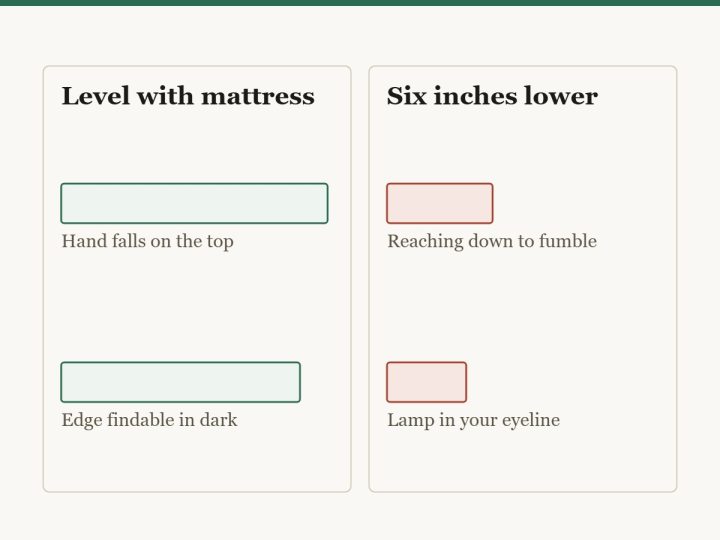
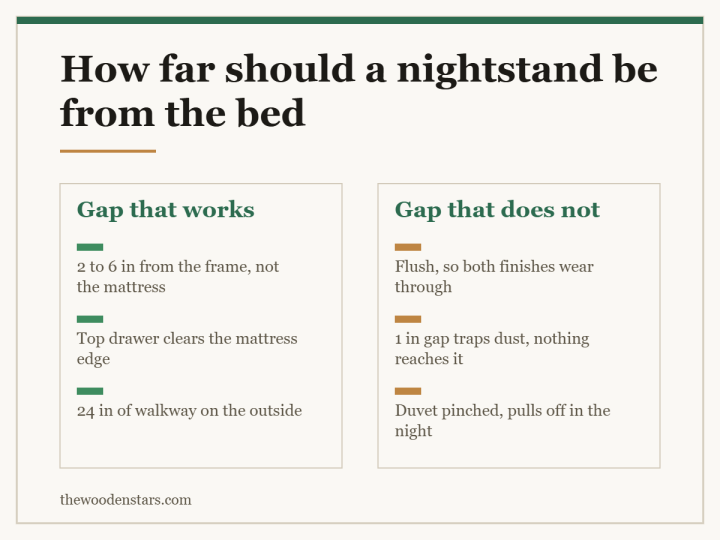
Two rules matter more than the table. A nightstand should land within a couple of inches of the top of the mattress — measure the mattress, not the bed, because a thick mattress moves the target by four inches. And a dresser needs the depth of its deepest drawer plus 24 inches of clear floor in front of it, or you cannot stand there while it is open.
Drawer slides and pulls: measure, do not guess
These are the two parts most often replaced, and both are standardised — which means they are easy to get right and easy to get wrong.
| Part | Standard sizes | How to measure |
|---|---|---|
| Side-mount slides | 10, 12, 14, 16, 18, 20, 22, 24 in | Inside depth of the case, rounded DOWN |
| Cabinet pulls | 3 in, 96 mm, 128 mm, 160 mm | Centre of one screw to centre of the other |
| Knobs | Single screw | Screw diameter, usually 8-32 |
Two traps. Slides are sized to the case, not the drawer, and rounding up means the drawer will not close. And pull spacing of 3 inches and 96 mm are different — 96 mm is about 3.78 inches — so a set bought on the wrong measurement will not line up with existing holes.
Which species belong in a dresser
Case goods are the category where mixed construction is most defensible. A drawer box wants stability and a modest weight; a case side wants a large flat panel that will not cup.
- Oak, maple, birch — the traditional choices for drawer boxes and fronts. Hard enough to take dovetails cleanly.
- Poplar and pine — the traditional choice for the parts you do not see, and there is nothing wrong with that.
- Rubberwood and acacia — the mid-price standard. Both fine; the question is only whether the label means solid or veneer. See wood types.
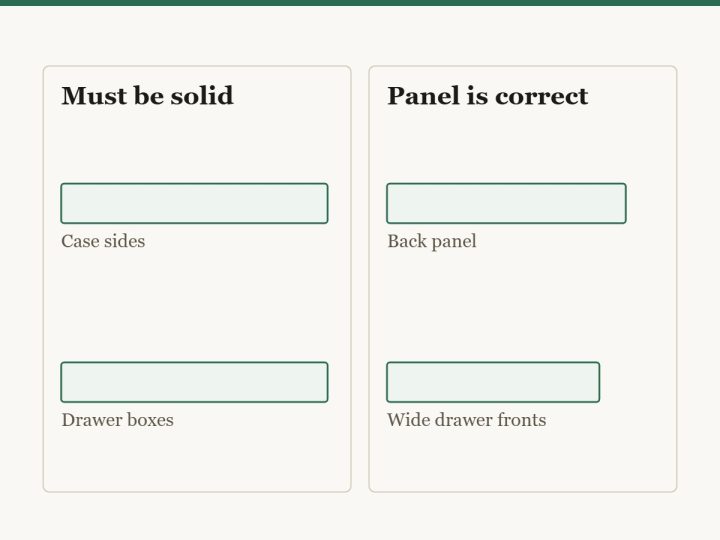
- Plywood for case backs and drawer bottoms — actively better than solid wood here, because it does not shrink across its width. A plywood drawer bottom is not a corner cut.
Solid, engineered or veneer
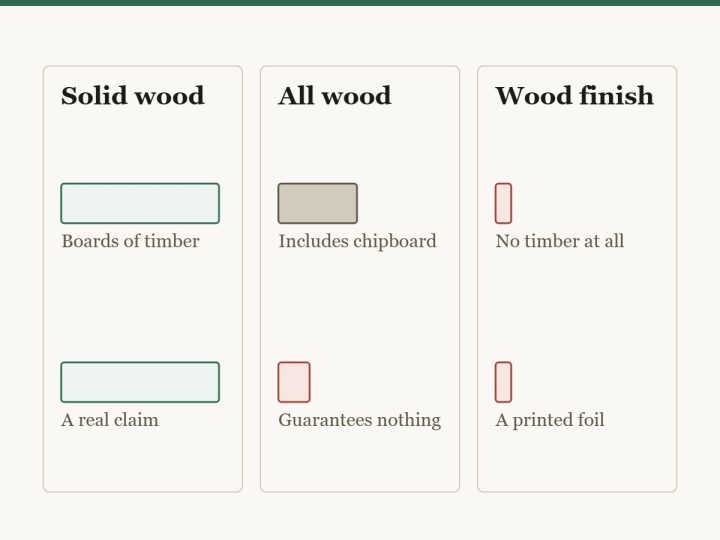
Look at the drawer, not the front. A dresser can have a solid wood front and a stapled particleboard box behind it, and the box is the part that fails.
- Dovetailed solid drawer boxes — will outlast the room.
- Dowelled or screwed solid boxes — perfectly serviceable, repairable with glue and clamps.
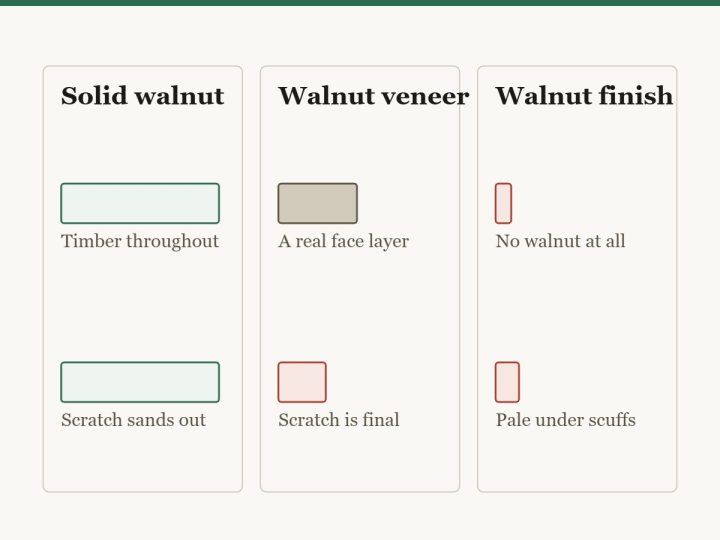
- Stapled particleboard boxes with a printed-paper finish — the corners let go, and there is nothing for glue to hold. This is where “engineered wood” stops being a euphemism and starts being a warning.
Chipped veneer on a case edge, by contrast, is cosmetic and genuinely repairable — filled, coloured and blended in under an hour.
What goes wrong, and why
- A drawer that will not slide. In summer, humidity. Year round, the runner. Check which season it started in before you plane anything — see wood care for the humidity band.
- A drawer that drops at the front as you open it. The slide has come off its rear bracket, or the slide is shorter than the case.
- A drawer that falls right out. The stop has broken off. A ten-cent part, and worth fixing immediately because it is also the tip-over failure mode.
- The whole case leaning or racking. The back panel has come loose. The back is structural; nailing it properly back on re-squares the case and often fixes the drawers at the same time.
- Chipped veneer at a corner. Impact. Cosmetic, fillable, and much easier than people expect.
Parts you can actually replace
- Drawer slides — the highest-value repair in this hub. New ball-bearing slides transform an old chest.
- Knobs and pulls — the cheapest way to change how a piece looks. Measure the spacing first.
- Drawer stops — small blocks or plastic clips. Trivial to fit.
- Anti-tip kits — sold as a strap or a bracket. Fit one per case.
- Drawer bottoms — a sagging bottom is a sheet of 1/4-inch plywood cut to size, not a new dresser.
Before you buy
- Open a drawer fully and look at the corner joint. That one glance tells you more than the whole listing.
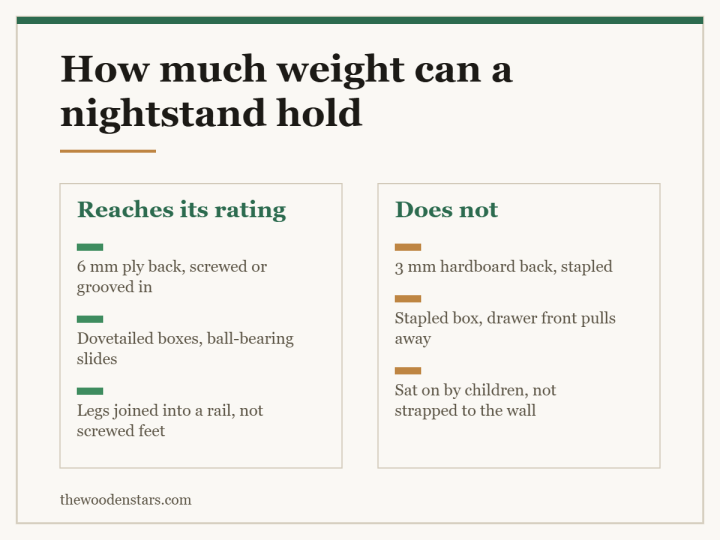
- Check for a solid back panel, not a thin sheet stapled to the outer edge.
- Measure your mattress top before choosing a nightstand height.
- Confirm an anti-tip kit is included, and fit it the day it arrives.
- Push down on an open drawer. If the case moves, the drawers will bind within a year.
Questions we get asked
Are dovetail joints actually worth paying for?
In a drawer box, yes — they resist exactly the pulling force a drawer receives, which is why they have survived three centuries of furniture making. Elsewhere on a dresser they are decoration.
My drawers only stick in August. Do I need new slides?
No. Seasonal-only sticking is moisture in the drawer sides. Deal with the room’s humidity and leave the woodwork alone; planing a drawer that is temporarily swollen leaves it loose all winter.
Can I put metal slides on a dresser built for wooden runners?
Usually yes, and it is one of the most satisfying upgrades available. You need the case’s inside depth, and you may need to pack the sides out to make the drawer sit at the right width.
Is a particleboard dresser always a bad buy?
Not always — it is a bad buy at a solid-wood price. If the drawer boxes are stapled particleboard, treat it as a piece with a five-year life and pay accordingly.
How do I anchor a dresser to a plasterboard wall with no stud?
Use a proper toggle or heavy-duty cavity fixing rated for the load, not a plastic plug. If the restraint pulls out of the wall it has done nothing.