A dining table is the piece people buy wrong most often, and almost always for the same reason: they measure the table and forget to measure the room. The length that seats six is not the length that fits six — chairs need to come out, and people need to walk behind them.
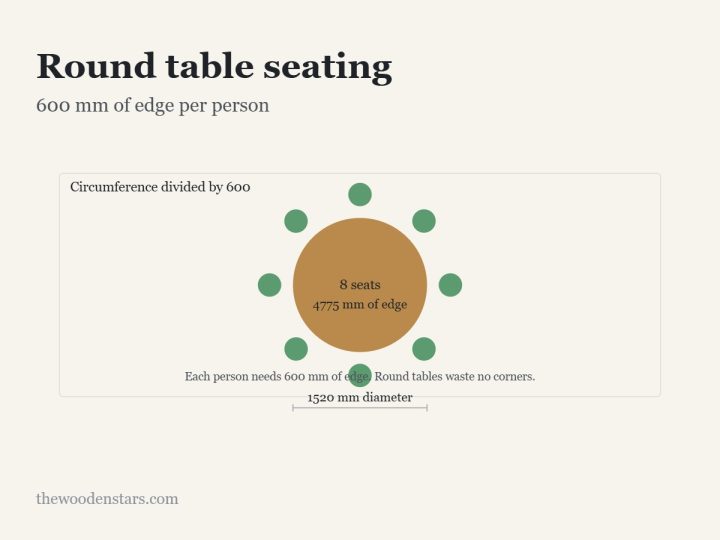
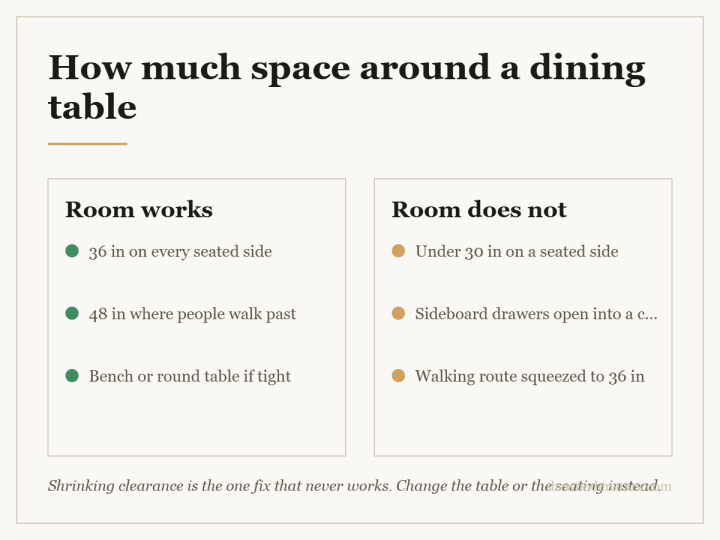
Allow 24 inches of table edge per person, and 36 inches of clear floor behind every chair. That means a table seating six needs roughly 72 inches of top and a room at least 12 feet long. Everything else — species, finish, base style — is a preference. These two numbers are not.
Anatomy of a wooden dining table
Nearly every repair and every replacement part on this hub refers to one of these seven parts, so it is worth learning the names:
- Top — on a solid table, several boards glued edge to edge. The glue lines are the seams that later open up.
- Breadboard ends — short boards running across the ends of the top, at right angles to the main boards. On a well-made table they are attached so the top can still move; on a badly made one they are glued solid and the top cracks.
- Apron — the rails running under the top between the legs. Sets your knee clearance.
- Legs or base — four legs, a double pedestal, or a trestle. Bases fail differently: legs loosen at the joint, pedestals crack at the column, trestles rack side to side.
- Top fasteners — the metal clips or buttons holding the top to the apron. The single most under-appreciated part of the whole table (see below).
- Extension slides — on an extendable table, the geared or friction runners that carry the two halves apart.
- Leaf and leaf pins — the drop-in panel and the dowels that align it.
The dimensions that actually decide the purchase
These are trade conventions, not physical constants — but they are what furniture is designed around, and ignoring them is what makes a room unusable.
| Table length | Seats comfortably | Seats at a squeeze | Minimum room length |
|---|---|---|---|
| 48 in | 4 | 4 | 10 ft |
| 60 in | 6 | 6 | 11 ft |
| 72 in | 6 | 8 | 12 ft |
| 84 in | 8 | 8 | 13 ft |
| 96 in | 8 | 10 | 14 ft |
| Type | Table or counter height | Seat height | Knee clearance |
|---|---|---|---|
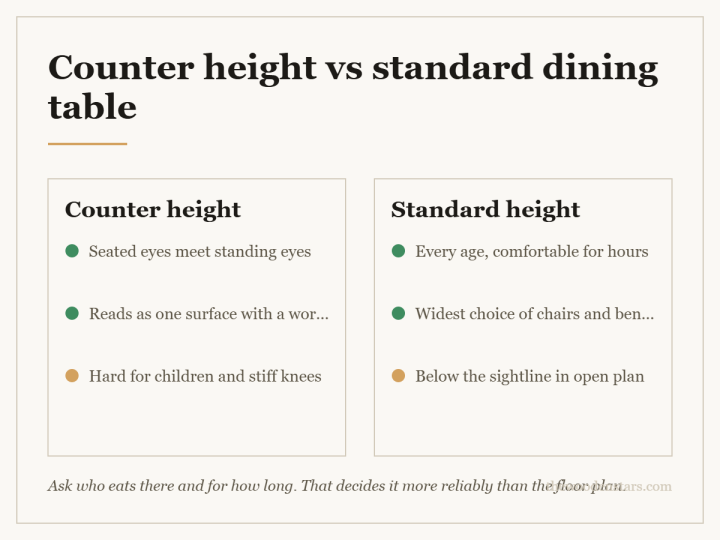
| Dining | 28–30 in | 17–19 in | 24–25 in |
| Counter | 34–36 in | 24–26 in | 30–32 in |
| Bar | 40–42 in | 29–31 in | 36–38 in |
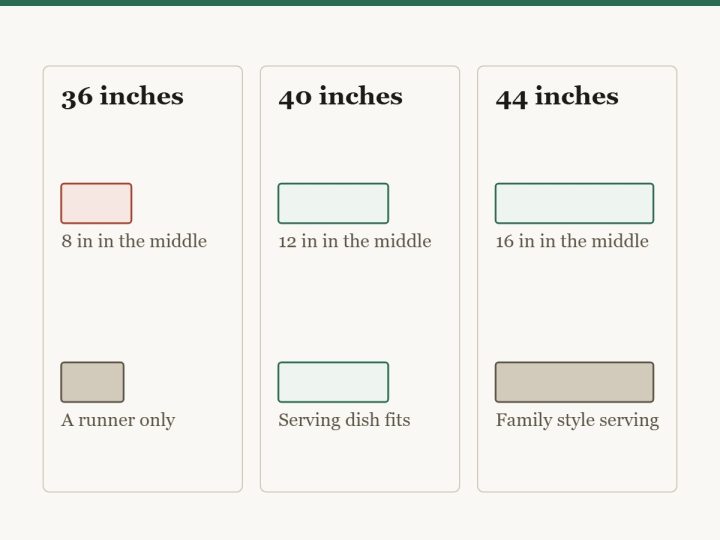
Two rules follow from that second table and are worth committing to memory. There should be 10 to 12 inches between the seat of the chair and the underside of the tabletop — less and you cannot cross your legs, more and you eat with your shoulders up. And a table narrower than 36 inches cannot hold two place settings facing each other plus anything down the middle; 40 to 42 inches is where a table starts feeling generous.
Which species belong on a dining table
A dining top takes more abuse than any other surface in the house: heat, moisture, cutlery, and children. Two properties matter, and they pull in opposite directions — hardness resists dents, and dimensional stability resists the seasonal movement that opens up seams.
- White oak — the default for a reason. Hard, unusually stable for its density, and closed-grain enough to resist water.
- Hard maple — harder than oak and very fine grained, so dents show as bruises rather than dents. Unforgiving of poor finishing.
- Acacia — very common on mid-price tables, and the label hides a problem: acacia is a genus, not a species, and hardness across it varies enormously. See wood types before paying a premium for the word.
- Mango — attractive, sustainable, softer than oak. Fine for a table that will be treated as furniture, marginal for one that will be treated as a workbench.
- Rubberwood — the workhorse of flat-pack “solid wood”. Genuinely solid, genuinely wood, genuinely soft. Not a lie, but not oak.
- Pine — will dent if you look at it. Which is either the charm or the deal-breaker, and only you know which.
Solid, engineered or veneer — on a table it matters more than anywhere else
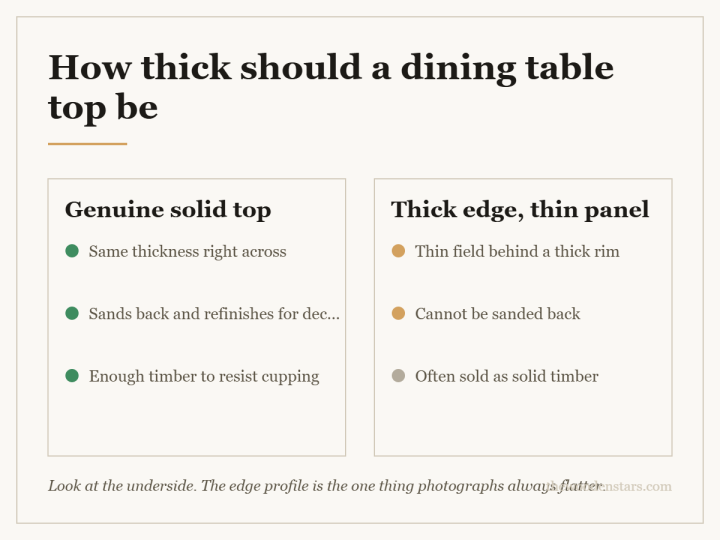
On a bookcase the difference is structural. On a dining table it is the difference between a piece you can refinish in twenty years and one you replace.
- Solid wood top. Can be sanded back and refinished repeatedly. Moves with the seasons, which is why it needs fasteners that let it move.
- Veneer over plywood. Stable, often beautifully figured, and can survive one careful refinish at most — the veneer is well under a millimetre thick.
- Veneer or laminate over MDF. Cannot be refinished at all, and any water that reaches the core swells it permanently. Very common under the phrase “engineered wood”.
The listing will rarely say plainly. The tell is weight, the edge profile, and whether the grain pattern repeats. There is a full method for spotting it on the wood types hub.
What goes wrong, and why
Guides for each of these are being written and will appear in the Fix layer above as they publish. The underlying causes are worth knowing now:
- Wobble. Almost never the floor. It is a loosened apron-to-leg joint, and a shim under a leg treats the symptom while the joint keeps working itself apart.
- A seam opening along the top. The top is shrinking in dry air and something is stopping it from moving — usually screws driven straight through a cleat into the underside.
- White heat marks. Moisture trapped in the finish, not damage to the wood. Reversible, often in minutes. See wood care.
- A leaf that no longer sits flush. The slides have racked out of parallel, or the leaf has cupped from being stored flat in a dry room.
- Chairs that loosen every six months. Chair joints carry a shear load every time someone leans back. Re-gluing without cleaning out the old glue is why the fix never lasts.
Parts you can actually replace
A dining table is one of the most repairable objects in a house, which is why replacing one is usually the wrong instinct.
- Top fasteners — Z-clips and figure-8 fasteners let a solid top expand and contract while staying tight. If a table has screws through a cleat instead, changing them is a ten-minute job that prevents a split top.
- Legs — most legs attach through a mounting plate or a hanger bolt, both standard sizes. A base swap is the cheapest way to change a table’s whole character.
- Extension slides — sold by closed length and travel. Measurable, replaceable.
- Felt pads and chair glides — the cheapest insurance in furniture. A scratch across a top is not always polishable out.
Before you buy
- Measure the room, not the table. Length of table plus 6 feet is the floor space you need.
- Check the doorway and the tightest turn on the way in. A 72-inch top rarely goes round a stairwell. There is a calculator in the sidebar for exactly this.
- Find the words solid and the species name together in the listing. “Acacia finish” and “wood-look” are not “solid acacia”.
- Look for how the top is held on. If the listing shows the underside, look for clips or slotted holes; solid screws through a solid frame is a table that will crack.
- Count the aprons on an extendable table. If there is no apron under the leaf, the leaf will sag under weight.
Questions we get asked
Is a round table better for a small room?
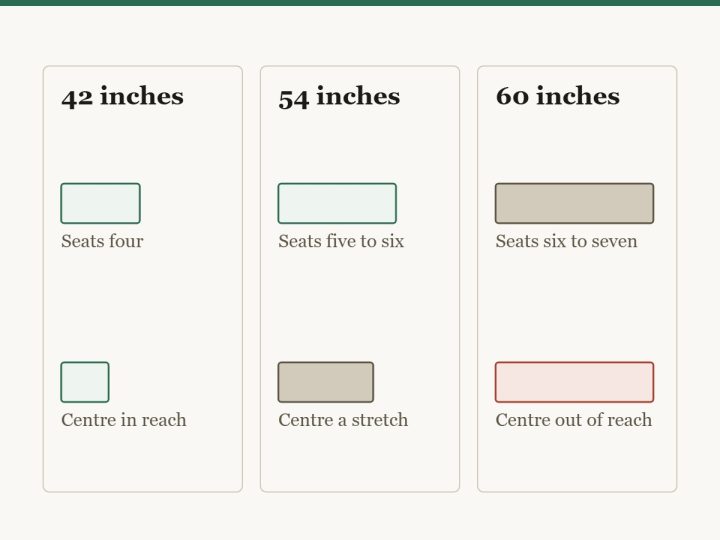
Usually yes, up to about 54 inches across. A round top has no corners to walk into and seats an awkward number of people more gracefully. Past 54 inches the middle becomes unreachable and you are better off with a rectangle.
How many people really fit at a 72-inch table?
Six with room to move, eight if two of them sit at the ends and nobody has broad shoulders. The limit is not the top, it is the 24 inches of edge each person needs.
Does a solid wood table need a tablecloth or a runner?
No — but it does need coasters and trivets. A finish that survives a wet glass will not survive a hot casserole dish, and heat damage is far harder to reverse than water.
Why does the table have a gap at the seam in winter and not in summer?
Because that is what wood does. It loses moisture in heated indoor air and shrinks across the grain. A 40-inch solid top can move a quarter of an inch between seasons. A gap that opens and closes is normal; a gap that never closes means something has been forced.