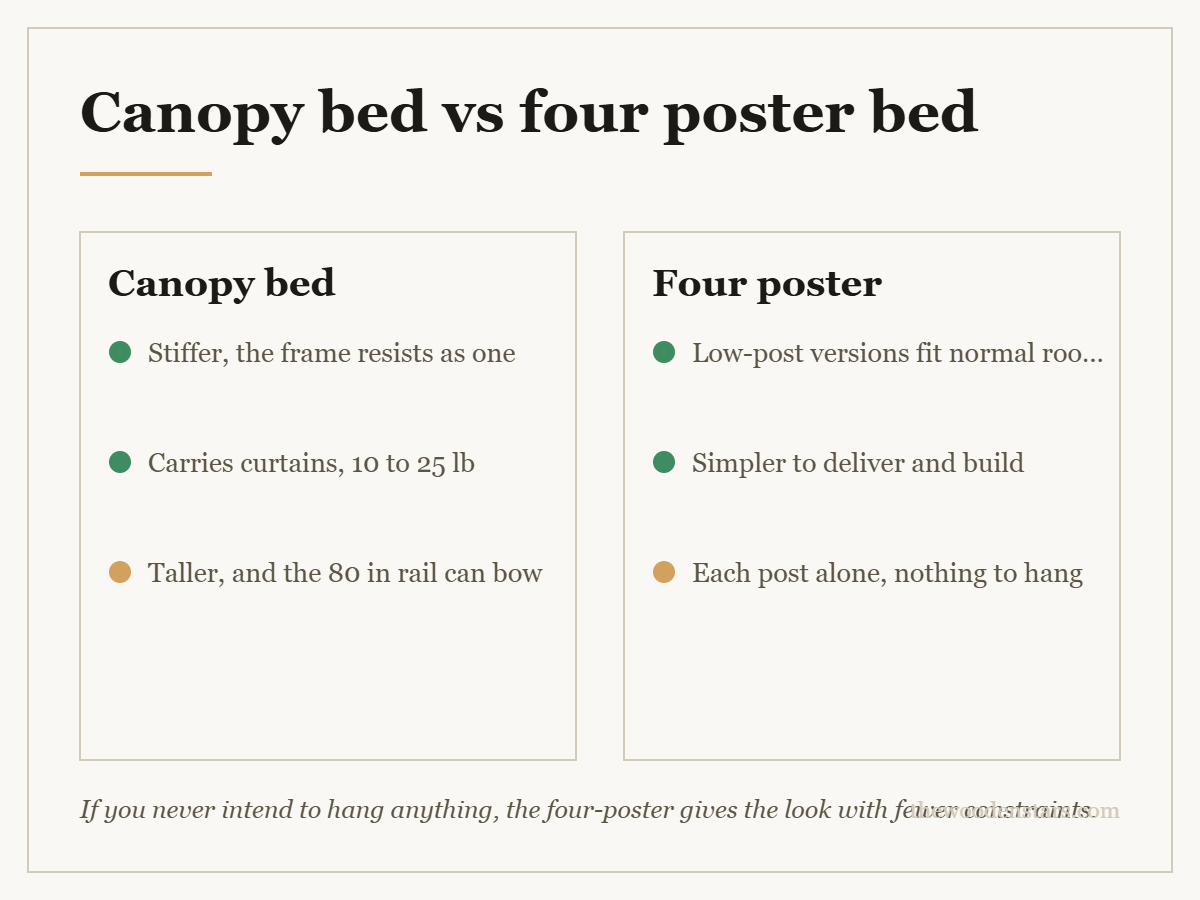
Canopy bed vs four poster bed — The rail is the difference
The Wooden Stars is a participant in the Amazon Services LLC Associates Program. We may earn a commission when you buy through links on our site, at no extra cost to you.
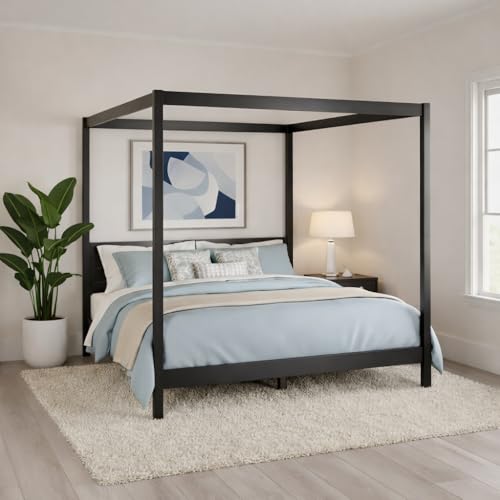
Canopy bed vs four poster bed has one structural answer: a four-poster has four tall posts and nothing joining them at the top; a canopy bed joins those post tops with a rectangle of rails.
That rectangle is the entire difference. It changes what the bed can carry, how rigid it is, how tall it needs the room to be, and how it is delivered.
A four poster bed has four tall posts, open at the top. A canopy bed adds rails joining the post tops into a rectangle. The canopy is what lets you hang fabric — 10 to 25 lb typically — and it makes the frame stiffer, because the rectangle stops the posts leaning. It also adds height: canopies run 76 to 90 inches, four-posters 60 to 84, so leave 6 inches of clear air above whichever you pick. On a canopy, the side rails span 75 to 80 inches unsupported and want 3 inches of depth or they bow.
Canopy bed vs four poster bed: what the top rail changes
Rigidity
Four posts with nothing joining them at the top are four cantilevers. Each one resists sideways movement on its own joint at the rail. Join the tops and the whole thing becomes a frame — push one corner and all four resist together.
In practice a canopy bed with bolted top corners feels noticeably more solid than a four-poster of the same post section. That is the quiet advantage nobody markets.
What you can hang
Only the canopy can carry fabric. A four-poster’s posts can take light ties at the top but nothing spanning, and hanging anything between two posts loads them in the one direction they are weakest.
Height
Canopies are taller: 76 to 90 inches against 60 to 84 for four-posters, which come in “low post” versions too. In a room with a 96-inch ceiling and a fan, that difference decides it.
| Measure | Canopy bed | Four poster |
|---|---|---|
| Top rails | Yes, a full rectangle | None |
| Overall height | 76 to 90 in | 60 to 84 in |
| Can hang fabric | Yes, 10 to 25 lb rated | No |
| Rigidity | Frame resists as one | Each post alone |
| Post section wanted | 2.5 to 4 in | 3 to 4 in, more critical |
| Delivery | Long rigid posts plus long rails | Long rigid posts |
| Suits a low ceiling | Rarely | Low-post versions do |
The rail span, which is the canopy’s own problem
The top side rails of a canopy span the full length of the bed — 75 to 80 inches — carried only at their ends.
Under 3 inches of depth, that rail sags under its own weight, visibly, and hanging fabric makes it worse. Look for:
- Rail depth of 3 inches or more on queen and king.
- A centre cross member tying the two side rails partway along. Not universal, very effective.
- Bolted corners at every top joint. A dry-fitted corner lets the whole rectangle lozenge, which is worse than having no rectangle.
At king width this gets harder still — king canopy beds works through it.
Post section matters on both, more on the four-poster
A post seven feet long with nothing at the top is entirely dependent on its own stiffness and its joint at the side rail. Under 2 inches square, a post that length flexes when you sit on the bed edge.
On a canopy the rectangle shares the load, so 2.5 inches is workable. On a four-poster, prefer 3 inches or more.
Solid hardwood — oak, acacia, birch, rubberwood — holds a bolt in end grain, which is exactly what a post-to-rail joint needs. Veneered MDF posts appear even at high prices; they are the heaviest option and the one that will not hold a bolt under a repeated sideways load. See what engineered wood actually is and the hardwood hardness scale.
The room, which decides it more often than taste
- Ceiling height at the bed’s position, measured to the lowest fixture. A canopy at 84 inches under a 96-inch ceiling reads correctly; at 90 it reads crammed. A ceiling fan usually rules the canopy out.
- Footprint. Posts sit outside the mattress and rails project beyond the posts — allow 5 to 7 inches each way over the bare mattress on either type.
- Delivery. Both ship long rigid posts; a canopy adds two 80-inch top rails. Measure the diagonal at your tightest stair turn — this is where both stop.
General sizing is in queen bed frames and king bed frame and mattress fit.
Underneath, which is a normal bed on both
The posts get the attention and the support system gets none, which is backwards.
Slat spacing under 3 inches for foam, 4 for sprung — bed slat replacement and spacing. Centre support is required at queen and above: 60 inches of slat span dips without it — bed frame centre support legs.
And on both types the rail-to-post joints do double duty — carrying the bed and the tall post. If it creaks, start there: why a wooden bed frame squeaks and bed frame brackets.
With either frame
- Furniture bolts and barrel nuts The fixing that lets a tall corner be pulled up for decades
- Centre support leg Required at queen and above, and often not included
- Levelling feet A tall frame turns a floor dip into a visibly out-of-square rectangle
- Canopy curtain rod Spreads fabric load along the rail instead of at tie points
What to buy


For the canopy in detail, see canopy beds and king canopy beds. For plain frames, wood bed frames and what to check on a queen wood frame. For presence without the height, wall-mounted headboards and how tall a queen headboard should be.
Questions we get asked
What is the difference between a canopy bed and a four poster bed?
A four-poster has four tall posts open at the top. A canopy bed joins those post tops with rails to form a rectangle.
Is a canopy bed sturdier than a four poster?
Usually yes, for the same post section — the top rectangle makes the four posts resist sideways load together instead of individually.
Can you hang curtains on a four poster?
Not properly. There is nothing spanning between the posts, and hanging fabric between two posts loads them where they are weakest.
Which needs a higher ceiling?
The canopy. It runs 76 to 90 inches against 60 to 84 for a four-poster, and low-post versions of the latter fit normal rooms easily.
Why do canopy rails bow?
They span 75 to 80 inches carried only at the ends. A rail under 3 inches deep sags under its own weight, and fabric makes it worse.
How much bigger is the footprint than the mattress?
Five to 7 inches in each direction on either type, because the posts sit outside the mattress and the rails project beyond the posts.