Full size Murphy beds — The compromise size, and when it is right
The Wooden Stars is a participant in the Amazon Services LLC Associates Program. We may earn a commission when you buy through links on our site, at no extra cost to you.

A full size Murphy bed sits between the two sizes people actually consider, and that is both its problem and its use. A full mattress is 54 inches wide and 75 inches long: 16 inches wider than a twin, 6 inches narrower than a queen, and 5 inches shorter than either a queen or a twin XL.
Those five inches of length are the reason a full sometimes fits a room where a queen does not, and the reason it is worth measuring before you dismiss it.
A full Murphy cabinet needs a wall over 54 inches and 75 inches of clear floor. Choose it when the room can take the width of a queen but not the length, or when the bed is for one adult who wants room to move rather than two adults sharing. Two adults can sleep on a full — each gets 27 inches, which is narrower than a standard single bed in most of Europe. It is a real size with a real use; it is not a small queen.
Where the five inches matter
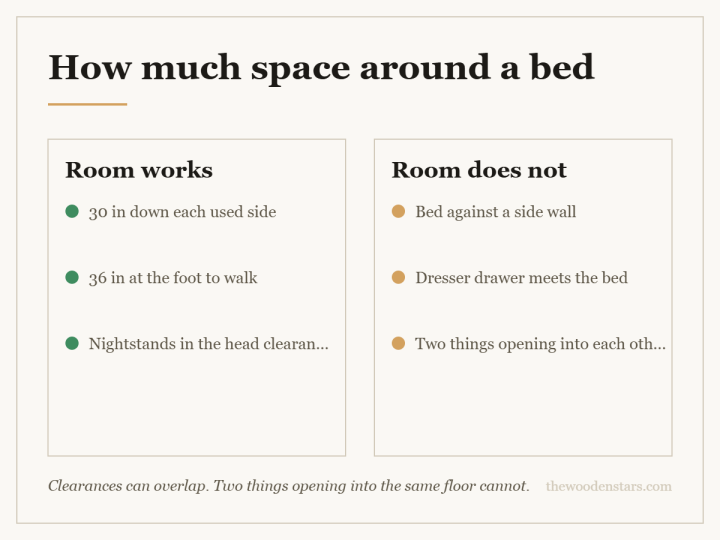
A full and a twin are both 75 inches long. A queen and a twin XL are both 80. If the wall you are working with has a doorway, a radiator or a fitted wardrobe 76 inches out into the room, the full is the largest Murphy bed that fits and the queen is simply out.
That is the honest case for the size, and it is a geometry case rather than a comfort one.
| Size | Mattress | Width per sleeper if two | Clear floor |
|---|---|---|---|
| Twin | 38 × 75 in | Not intended for two | 75 in |
| Full | 54 × 75 in | 27 in each | 75 in |
| Queen | 60 × 80 in | 30 in each | 80 in |
| King | 76 × 80 in | 38 in each | 80 in |
The third column is the one worth sitting with. Twenty-seven inches each is tight — narrower than the single beds most people grew up in. A full is a generous single and a cramped double, and which of those you are buying depends entirely on who sleeps in it.
Who the size actually suits
- One adult with room to spread out. This is the strongest case. A full gives a single sleeper 54 inches, which is luxurious, in a footprint 6 inches narrower than a queen.
- A teenager’s room. Outgrows a twin, does not need a queen, and the wall usually cannot take one.
- A guest room where the guests are occasional couples. Two nights a year on a full is fine. Two nights a month is not.
- A room where 80 inches of floor does not exist. The geometry case above.
What it does not save you
Two things people expect from the full size that it does not deliver.
It is not much cheaper than a queen. The mechanism is sized to the mattress mass, and a full mattress is not dramatically lighter than a queen. The cabinet uses slightly less material. Expect a modest gap rather than a tier change — if price is the driving constraint, read where the money comes out of a cheap Murphy bed instead, because that is where the real spread is.
It does not solve a narrow wall. Fifty-four inches plus cabinet sides is still a substantial run of uninterrupted wall. If wall width is your problem rather than floor length, the size that helps is the twin, not the full.
The mattress limit still applies
Every Murphy cabinet states a maximum mattress thickness, because the mattress folds into the case with the bedding on it. This is independent of size — a full cabinet has the same trap as a queen one — and it is the single most common reason a newly installed Murphy bed will not close.
Buy the cabinet, read its number, then buy the mattress. Not the other way round.
Vertical or horizontal at this size
A vertical full stands 75 inches tall closed. A horizontal full stands about 54 inches tall and runs 75 inches along the wall.
At full size the horizontal version starts to be awkward: it needs 75 inches of wall, which is more than a vertical queen does, so you are trading a large amount of wall for ceiling height. It is the right answer under a sloped ceiling and the wrong answer almost everywhere else. The mechanism is explained in side-mount Murphy beds.
Cabinet material, and the fixing question
As with every wall bed, the material question here is about what happens to the fixings over years of the bed swinging, not about how the front looks. Solid timber and plywood keep holding a screw. Particleboard enlarges its hole and there is no clean repair.
Most cabinets in this price band are engineered panel of some kind. That is not disqualifying — what matters is whether the load points are reinforced and where the board sits. The vocabulary on the listing is decoded in what engineered wood actually is.
Before you order
- Stud finder The cabinet has to land on studs, at full size as much as any other
- Tape measure 75 in of clear floor and the wall width between obstructions
- Spirit level Plumb matters more than it sounds; it decides how the bed folds
- Mattress retention strap Holds the mattress to the platform when it swings up
What to buy


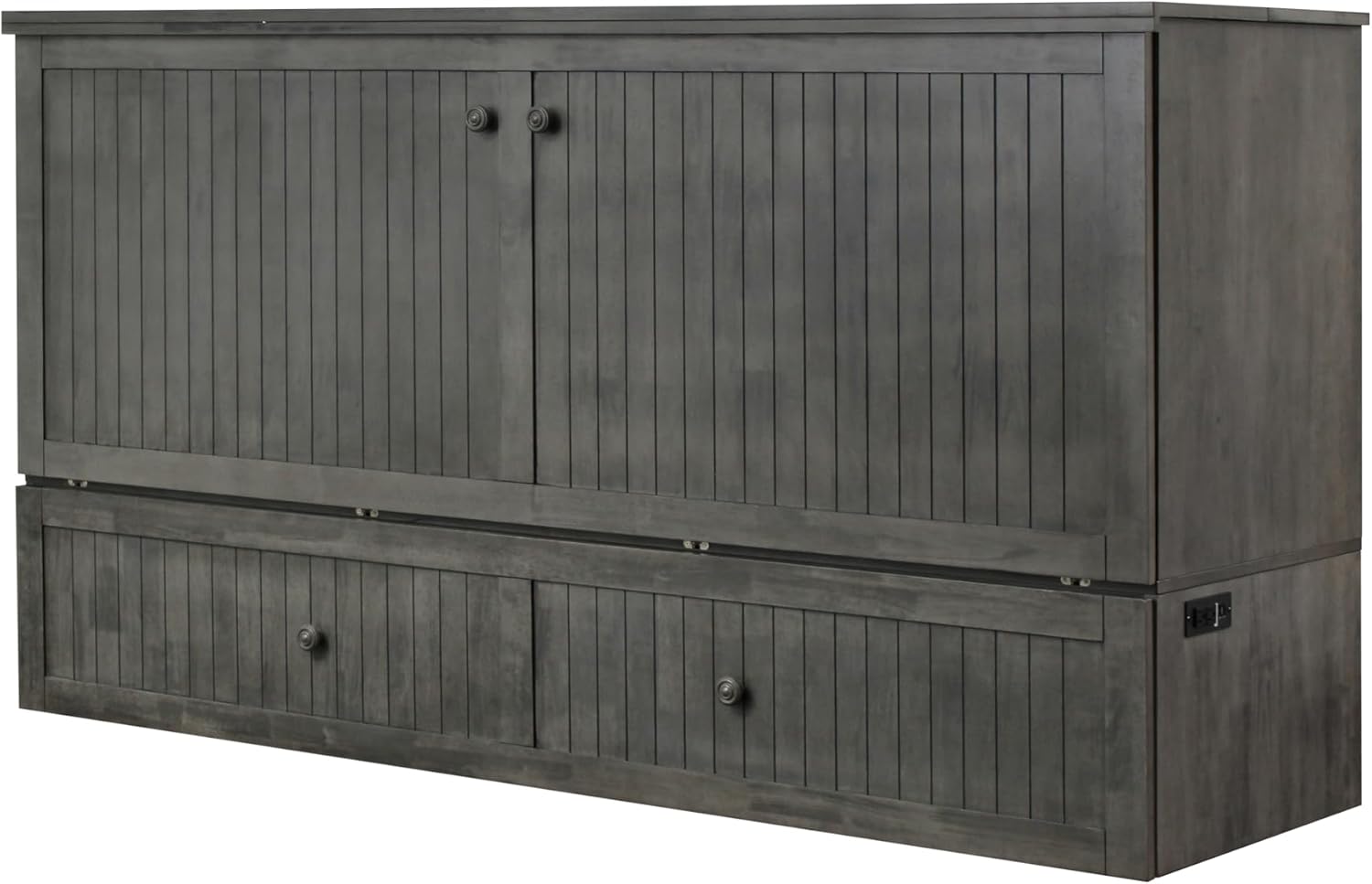

If you are choosing between sizes rather than between products, the four are compared directly in Murphy bed sizes. If the room is genuinely tight, start instead with measuring the room before the bed.
Questions we get asked
Is a full size Murphy bed big enough for two people?
For occasional use, yes. Each person gets 27 inches, which is narrower than a standard single bed. For regular sharing it is not enough, and the extra six inches of a queen is the difference people notice.
What is the difference between a full and a double Murphy bed?
Nothing. “Full” and “double” are the same 54 × 75-inch mattress under two names. Listings use both, sometimes in the same title.
Is a full Murphy bed cheaper than a queen?
Usually a little, rarely a lot. The lift mechanism is sized to the mattress mass and a full mattress is not much lighter than a queen, so most of the cost stays the same.
How much floor does a full Murphy bed need?
Seventy-five inches out from the wall — five less than a queen. That difference is the main practical reason to pick this size.
Can I put a queen mattress in a full Murphy bed?
No. It is six inches too wide and five too long, and the cabinet will not close. Cabinets are built around one mattress size.
Does a full Murphy bed need to be bolted to the wall?
Yes, into studs. The size does not change the mechanics: the mechanism turns the mattress into a lever and the load goes into the wall fixings every time it moves.