Twin over full bunk beds — The bottom bunk is the point
The Wooden Stars is a participant in the Amazon Services LLC Associates Program. We may earn a commission when you buy through links on our site, at no extra cost to you.
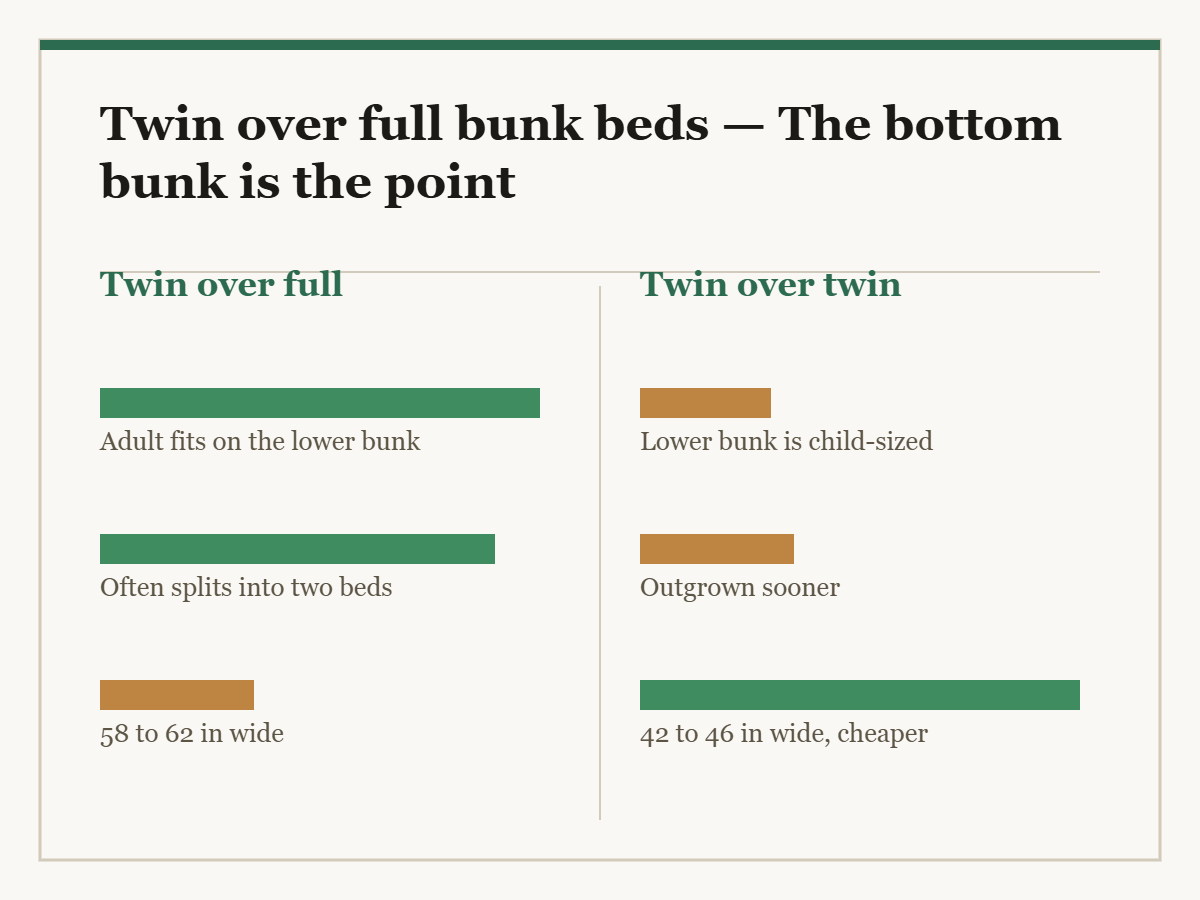
A twin over full bunk puts a 38-inch mattress above a 54-inch one. The two are different widths, so the frame is not symmetrical — the top bunk sits back from one edge or overhangs, and that asymmetry is what you are really choosing.
The reason people buy this configuration is almost always the bottom bunk. A full mattress down there takes an adult, which changes what the bed is for over its life.
A twin over full is 58 to 62 inches wide and 80 inches long — the footprint of a full bed, with a twin above. Overall height is 62 to 72 inches. The number to check is the bottom bunk clear height: you want 36 inches or more for an adult to sit up without stooping, and plenty of frames give only 30 to 33. Check the bottom bunk weight rating separately from the top — a bed sold for children may rate the lower bunk at 250 lb, which is not an adult plus a child reading together. Top mattress thickness is capped, usually at 6 inches, by the guard rail height.
Why the bottom bunk is the whole point
A twin over twin is a children’s bed. A twin over full is a bed that keeps working: a parent can lie on the bottom to read, a teenager can use it without their feet hanging off, and a guest can sleep there.
That only holds if the bottom bunk is actually habitable, which comes down to two numbers.
Clear height under the top deck
An adult sitting upright on a mattress needs about 36 inches from the mattress surface to whatever is above. Add the mattress and you want 42 to 46 inches from the floor to the underside of the top deck.
Many frames give 30 to 33 inches of clear height, which is fine for a child and means an adult sits with their head down. This is the specification that separates a bed you will use from one you will resent.
Bottom bunk weight rating
Stated separately from the top on any honest listing. Two hundred and fifty pounds is a child-and-a-half; 400 lb and up is a real adult bed. If only one figure is given, assume it is the top.
The asymmetry, and what to do about it
A twin is 38 inches wide; a full is 54. Sixteen inches have to go somewhere, and manufacturers solve it two ways.
Flush on one side. The top bunk lines up with one edge of the bottom and the 16 inches step in on the other. This is the common arrangement, it is structurally simple — both posts on the flush side run straight up — and it means the ladder goes on the stepped side.
Centred. Eight inches of step on each side. Looks balanced and needs either angled members or a wider top frame carried on brackets, which is more to go wrong.
The flush version is the better bet. The stepped side needs its own post down to the floor at the head and foot — check that it has one. A top bunk carried entirely on a cantilever from the other side is the arrangement to walk away from.
| Measure | Typical | What to want |
|---|---|---|
| Overall width | 58 to 62 in | Full mattress plus frame |
| Overall length | 78 to 82 in | — |
| Overall height | 62 to 72 in | Leave 30 in above the top mattress |
| Bottom clear height | 30 to 40 in | 36 or more for an adult |
| Top mattress max | 6 in | Stated by the maker, it is a rail limit |
| Top weight rating | 200 to 400 lb | 400 if an adult may sleep there |
| Bottom weight rating | 250 to 500 lb | Check it is quoted separately |
Guard rails and the mattress rule
The guard rail on the top bunk must stand 5 inches above the mattress surface. Frames are built around a stated maximum mattress thickness — almost always 6 inches — and going over it quietly removes the rail’s function.
Two other rail details worth checking:
- Rails on both sides, even the side against a wall. Beds move, walls have gaps, and a gap between rail and wall is worse than no wall.
- No gap wider than 3.5 inches anywhere in the rail or between the rail and the deck. That is the standard figure for preventing a child slipping through.
The same mattress-thickness arithmetic applies elsewhere in space-saving beds — murphy bed mattress requirements works through it for a different mechanism.
Whether it splits into two beds
Plenty of twin over full frames are sold as convertible: unbolt them and you get a standalone twin and a standalone full. This is worth real money over a decade, and it is worth checking rather than assuming.
What makes it genuine:
- Both halves have four legs of their own when separated, not two legs and a bracket.
- The posts are the right length for a standalone bed rather than leaving stubs sticking up.
- The hardware is included for both configurations. A conversion that needs parts you have to source later usually does not happen.
If it does not convert, the bed’s life ends when the children outgrow bunks. If it does, you have a twin and a full — see twin bed frames and full bed frames for what those are worth separately, and full against queen if you are sizing the lower bunk for an adult.
Getting it into the room
This is a big piece of furniture and the constraints are physical.
- Side rails are about 80 inches long and rigid. Measure the diagonal at your stair turn.
- It assembles upright and needs the full room height clear while you work.
- Two people, minimum. Lifting a full-width top deck into position is not a solo job.
- Ceiling fixtures. A 72-inch bunk under a ceiling fan is a problem discovered late.
What it is made of
Two people sleep on this frame at once, one of them above the other. Every joint sees a cyclic load, and the rail-to-post joints on the top bunk see it worst.
Solid hardwood — rubberwood, birch, acacia, oak — holds a bolt in end grain indefinitely. That is why the 400 lb-plus ratings all sit on hardwood frames. See the hardwood hardness scale and the best wood for furniture.
Pine is softer and works, with joints checked more often.
Particleboard does not belong in a bunk bed at any price. It does not hold a screw under cyclic load, and on a bunk the failure mode is not a wobble — see what engineered wood actually is.
If the frame already creaks, work through why a wooden bed frame squeaks, and check slat spacing on both decks in bed slat replacement and spacing.
With the bed
- T-handle hex key The supplied key is too short to torque a bunk joint properly
- Felt slat tape Stops the slats rubbing, which is most bunk-bed noise
- Levelling feet A bunk that rocks diagonally is an uneven floor, not a bad frame
- Under-bunk storage bins The lower bunk still has a void under it worth using
What to buy


For two twins instead, see twin over twin bunk beds. For an open bay under the top bunk, twin over full loft beds. For two full mattresses, full size bunk beds. Material and joints are covered in wooden bunk beds, and storage versions in bunk beds with storage stairs.
Questions we get asked
How wide is a twin over full bunk?
Fifty-eight to 62 inches overall — the footprint of a full bed. The top twin is 16 inches narrower and steps in on one side.
Can an adult sleep on the bottom?
Yes, if the clear height is 36 inches or more and the lower bunk is rated 400 lb or above. Plenty of frames give only 30 to 33 inches.
How thick can the top mattress be?
Usually 6 inches. The guard rail has to stand 5 inches above the mattress surface, and a thicker mattress removes that.
Does it split into two beds?
Many do. Check that each half has four legs of its own and that the conversion hardware is included.
Which side does the ladder go on?
The stepped side, on the common flush-on-one-side layout. Check the stepped side has its own posts to the floor rather than being cantilevered.
What ceiling height do I need?
Leave about 30 inches above the top mattress. With a 68-inch frame that means a standard 96-inch ceiling is comfortable — measure to the lowest fixture.