Daybeds with a trundle — Pop-up or roll-out
The Wooden Stars is a participant in the Amazon Services LLC Associates Program. We may earn a commission when you buy through links on our site, at no extra cost to you.
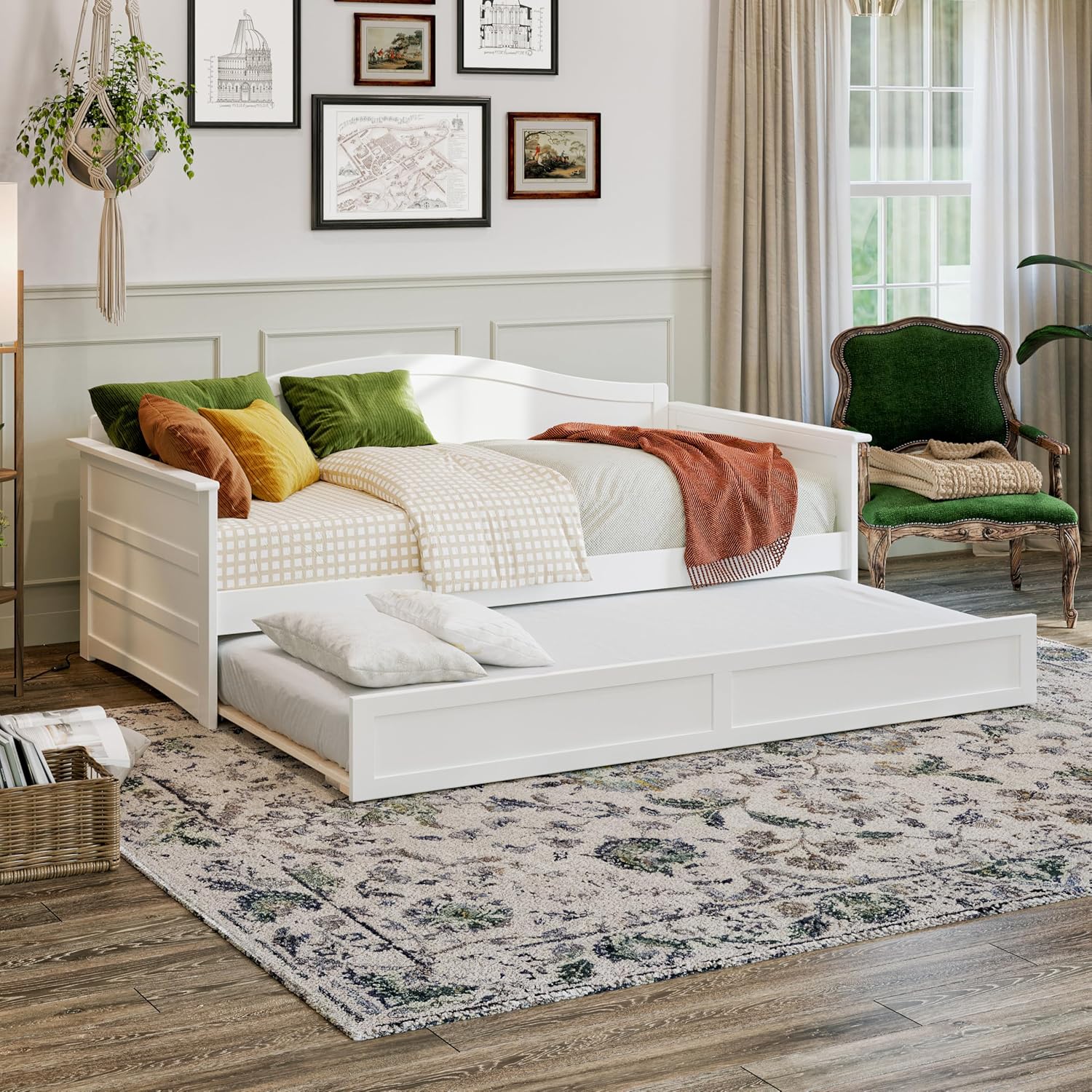
A trundle is a second mattress on a rolling frame that lives under the first one. It turns one twin bed into two, and in a spare room that is worth more than any amount of storage.
There are two kinds and they are not variations on a theme. One gives you a proper second bed at normal height; the other gives you a mattress on the floor. The listings use the same word for both.
A pop-up trundle rolls out and then lifts on a scissor mechanism to the same height as the main bed, so the two can be pushed together into a king-ish double or used as two beds at normal height. A roll-out trundle stays low — the mattress ends up 8 to 14 inches off the floor. Pop-up costs more and is the one worth having. Either way the trundle mattress is limited to 6 to 8 inches thick by the clearance under the deck, and you need 38 to 44 inches of clear floor alongside to roll it out. A trundle uses the whole void, so no drawers.
Pop-up against roll-out
Pop-up trundle
The frame rolls out, then a scissor or linkage mechanism lifts the mattress to the height of the main bed — usually 14 to 20 inches.
What that buys: two beds at the same height, which can be pushed together to make one large sleeping surface, and a second bed an adult can get out of without rolling onto the floor.
What it costs: more money, more weight, and a mechanism that has to be operated — usually by lifting a strap at the head end while the frame takes the weight.
Roll-out trundle
The frame rolls out on castors and stays where it is. The mattress sits 8 to 14 inches off the floor.
Perfectly good for a child. For an adult it is a low bed, and getting out of it is a floor-level manoeuvre. It is the cheaper and much more common version.
Mattress thickness, which is fixed by the gap
The trundle has to live under the main deck, so the clear height under that deck is the hard limit.
- Trundle frame: 3 to 5 inches including castors.
- Clearance under the main deck: typically 11 to 14 inches.
- Which leaves 6 to 9 inches for the mattress, and makers usually state a maximum of 6 or 8.
A thicker mattress simply will not go back under. This is the specification people discover after buying a mattress separately, and there is no way round it.
Practical consequence: a trundle mattress is a thin one, so a topper does more for the guest experience here than anywhere else. It comes off and stores flat.
| Feature | Pop-up | Roll-out |
|---|---|---|
| Mattress height when out | 14 to 20 in | 8 to 14 in |
| Can join the main bed | Yes, into one surface | No |
| Suits adults | Yes | Poorly |
| Mechanism | Scissor lift, operated | Castors only |
| Weight | Heavier | Lighter |
| Typical extra cost | Significant | Small |
Floor space to roll it out
The trundle comes out sideways from under the daybed, and it is as deep as the daybed is.
Allow 38 to 44 inches of clear floor alongside — the trundle’s own width plus room to walk around it once it is out. That is about the same as the daybed’s own depth again.
Which means a daybed with a trundle in a small spare room fills the floor when it is in use. That is usually acceptable, because it is in use overnight, and it is worth picturing before ordering rather than at 11pm with a guest waiting.
Also check which side it rolls out. Most are handed, and a trundle that opens towards a wardrobe is a trundle you cannot open.
What you give up
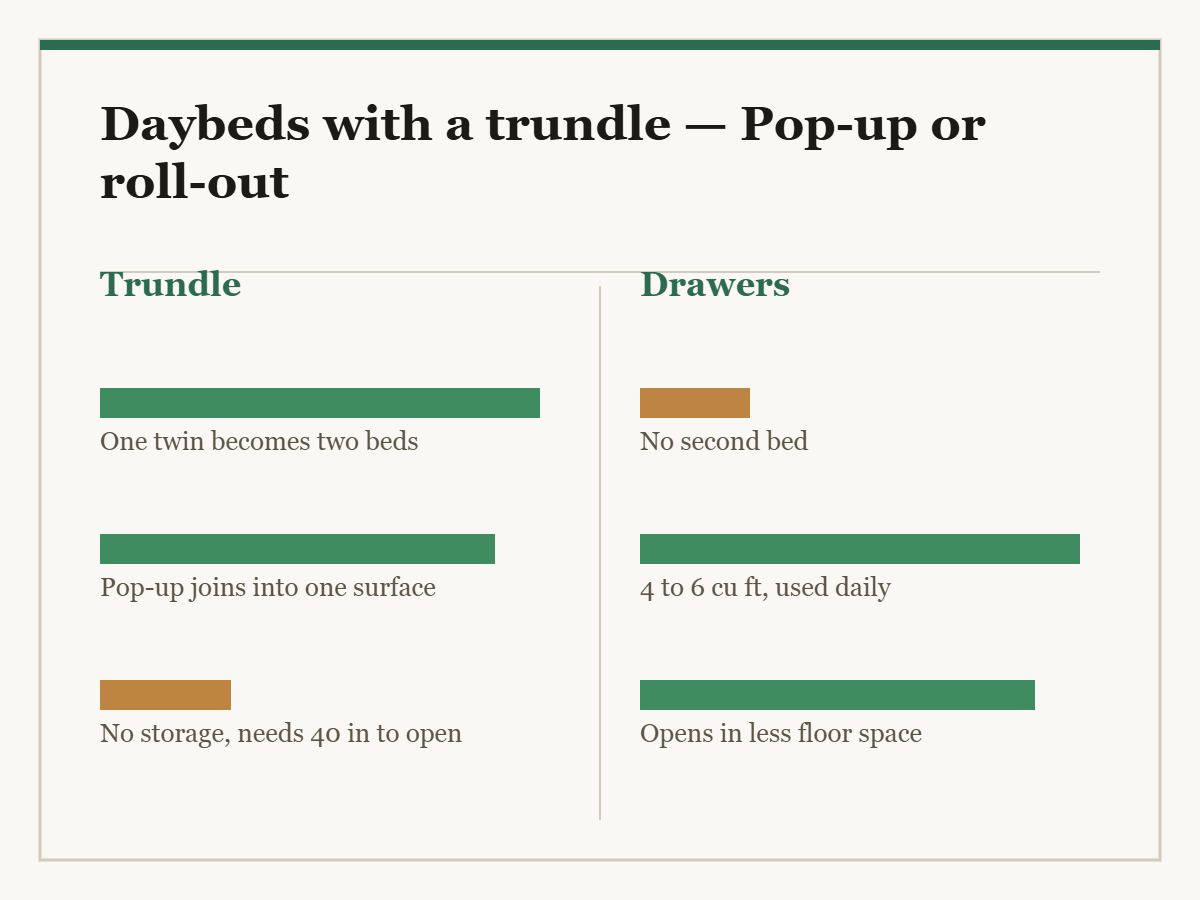
The void under a daybed is one void. A trundle uses all of it.
So: no drawers. If the room is short of storage rather than short of beds, the drawers are the better buy — 4 to 6 cubic feet, reachable daily, covered in daybeds with storage.
The decision is really about how often each gets used. A second bed used four times a year against drawers used every day is not a close call in most spare rooms — unless the spare room’s job is guests, in which case it is the opposite.
The castors and the floor
A trundle rolls on castors on your floor — there is no alternative, because it has to move.
On hard floors this works. Look for castors with a soft tread rather than bare plastic, because a loaded trundle on bare plastic wheels marks timber.
On carpet it is harder work. Larger-diameter castors help significantly — small wheels sink into pile and large ones ride over it. If the trundle you want has small hard wheels and the room is carpeted, they are usually replaceable.
A pop-up mechanism adds weight, so this matters more on that version.
The daybed itself still has to be right
A trundle changes nothing about the bed above it.
Seat height is set by the main mattress — 6 to 8 inches keeps it near 22 to 26 — and a trundle frame usually raises the deck a little to make room, so check the stated figure rather than assuming. See twin daybeds.
Cushion depth for seating: 14 to 17 inches on a twin.
The main deck: timber slats under 3 inches apart, not a wire grid — bed slat replacement and spacing. A centre leg is still wanted across 75 inches, and it has to be positioned so the trundle clears it — bed frame centre support legs.
The ends should be panelled rather than posts and a rail, so the frame does not rack — the back rail levers on those joints every time somebody leans back.
What it is made of
Solid hardwood holds the back-to-end bolt under repeated leaning, and holds the castor mounts on the trundle frame — the hardwood hardness scale.
Particleboard fails at the castor fixings first on a trundle, because those screws take a shear load every time it is pulled out — what engineered wood actually is.
For creaks, the usual order: joints, slats, floor — why a wooden bed frame squeaks.
With the trundle
- Mattress topper A trundle mattress is capped at 6 to 8 inches, and a topper fixes the night
- Large-diameter castors Small hard wheels sink into carpet, and they are usually replaceable
- Bed connector strap Holds a popped-up trundle against the main bed so they do not drift apart
- Fitted sheets for a thin mattress Standard deep-pocket sheets will not stay on a 6-inch mattress
What to buy



For the daybed itself, see twin daybeds, full size daybeds and queen daybeds. For storage instead of a second bed, daybeds with storage. For two beds without a trundle, twin over twin bunk beds. A guest bed that disappears entirely is in murphy bed against sofa bed.
Questions we get asked
What is the difference between a pop-up and a roll-out trundle?
A pop-up lifts on a mechanism to the height of the main bed, so the two can join into one surface. A roll-out stays at 8 to 14 inches off the floor.
How thick can the trundle mattress be?
Six to 8 inches, limited by the clearance under the main deck. A thicker one will not go back under.
How much floor space do I need to open it?
Thirty-eight to 44 inches alongside — the trundle’s width plus room to walk round it.
Can I have a trundle and drawers?
No. There is one void under the deck and the trundle uses all of it.
Is a trundle comfortable for an adult?
A pop-up, yes. A roll-out puts the mattress 8 to 14 inches off the floor, which most adults find low.
Will it roll on carpet?
With large-diameter castors, yes. Small hard wheels sink into pile — and they are usually replaceable.