Daybed vs sofa bed — Sleeps better, seats worse
The Wooden Stars is a participant in the Amazon Services LLC Associates Program. We may earn a commission when you buy through links on our site, at no extra cost to you.
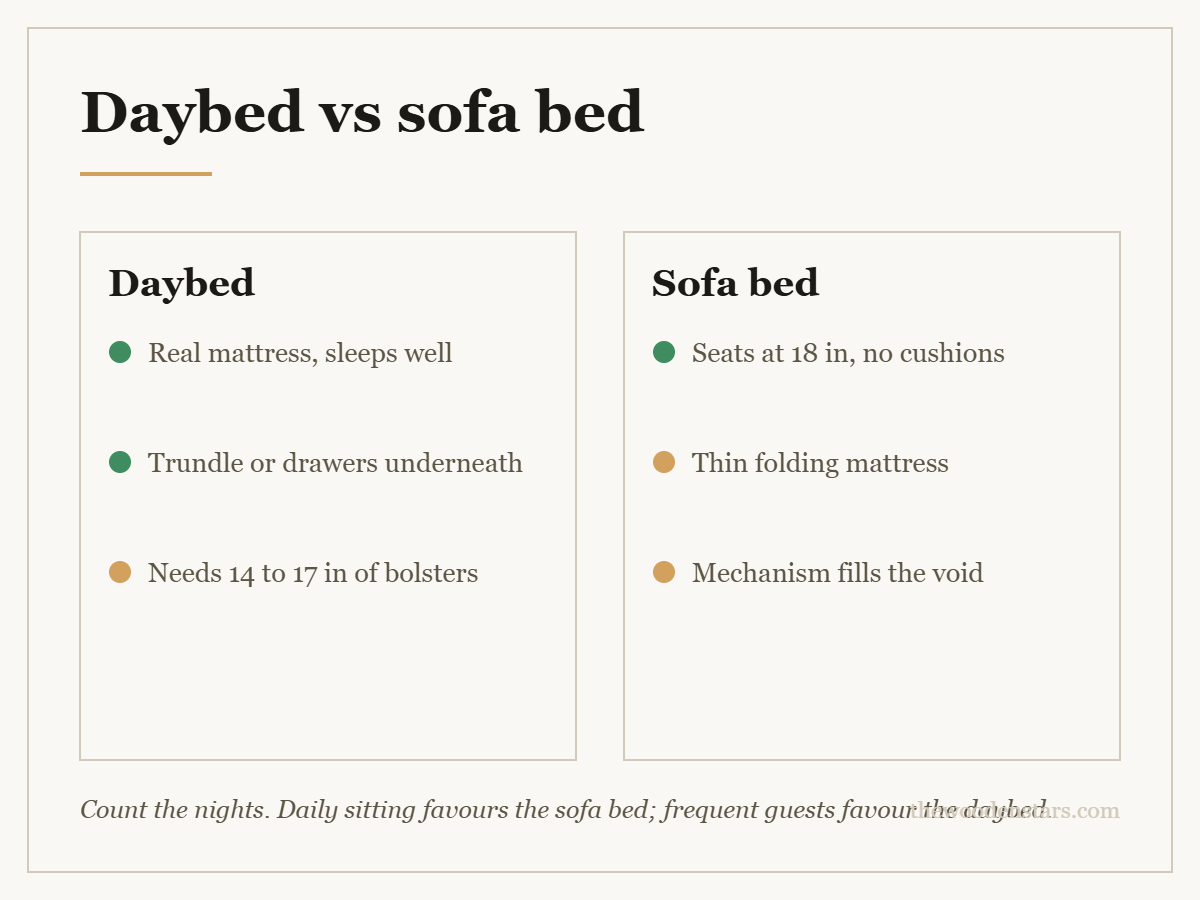
Daybed vs sofa bed comes down to which half of the job you care about: one sleeps properly and seats badly, the other seats properly and sleeps on a compromise.
Nothing in the price or the styling changes that trade. It is set by the shape of the two objects.
A daybed is a bed with three sides that takes a standard mattress — so it sleeps as well as any bed, and it seats badly because it is 38 inches deep against a sofa’s 21 to 24, needing 14 to 17 inches of firm bolsters to sit against. A sofa bed is a sofa first: it seats correctly at 17 to 19 inches with no cushions to buy, and it sleeps on a thin folding mattress over a mechanism. Pick the daybed if guests stay often; pick the sofa bed if people sit there daily and stay twice a year.
Daybed vs sofa bed: the trade in one paragraph
A daybed uses a real mattress — 6 to 12 inches of foam or springs on slats. A sofa bed uses a folding mattress, typically 4 to 5 inches, over a hinged steel frame that has a bar across it. That bar is the thing people remember.
Conversely a sofa bed’s seat is built to be sat on: depth, height and back angle are all designed for it. A daybed’s “seat” is the front 20 inches of a mattress, with a rail three feet behind your back.
| Measure | Daybed | Sofa bed |
|---|---|---|
| Mattress | Standard twin or full, 6 to 12 in | Folding, 4 to 5 in |
| Sleeps | Properly, every night if needed | Occasional guests |
| Seat height | 20 to 30 in, set by the mattress | 17 to 19 in |
| Depth | 38 to 60 in | 33 to 40 in |
| Cushions needed | 14 to 17 in of firm bolster | None |
| Mechanism | None | Hinged frame, a wearing part |
| Under-bed use | Trundle or drawers | Nothing, the mechanism fills it |
Seat height, which the mattress decides
A daybed deck sits at 14 to 18 inches. Then:
- 6-inch mattress: seat at 20 to 24 inches. Close to a dining chair — upright, feet flat.
- 8-inch: 22 to 26. Comfortable for most people.
- 12-inch: 26 to 30. Sleeps beautifully, perches badly.
A sofa bed does not have this lever — it seats at 17 to 19 because that is what it was built for. If the piece is mainly seating, that fixed correctness is worth more than it sounds. The daybed version of this arithmetic is in twin daybeds.
What each one does badly
The daybed’s weakness: cushions
You need 14 to 17 inches of firm cushion depth at the back on a twin, and 26 to 30 on a full — see full size daybeds. Soft cushions compress to nothing and you end up perching. And when the daybed becomes a bed, all that cushion has to go somewhere. In a spare room it usually ends up on the floor.
The sofa bed’s weakness: the mechanism
A folding frame is a wearing part with a bar across the middle at hip height. Better ones use a slatted deck and a thicker mattress, and cost accordingly. All of them are heavier to open than a daybed, which needs no opening at all.
There is a third option that avoids both weaknesses by removing the bed from the room entirely — see murphy bed against sofa bed.
Underneath: a real advantage for the daybed
A daybed deck at 14 to 18 inches leaves about 10 cubic feet of usable void. A sofa bed’s mechanism fills that space entirely.
So a daybed can have a trundle — a second mattress that rolls out, turning one twin into two — or drawers holding 2 to 3 cubic feet each. Not both; it is one void. The two options are set out in daybeds with a trundle and daybeds with storage.
For a guest room this is often the deciding factor: a daybed with a pop-up trundle sleeps two adults at proper mattress height, which no sofa bed of the same footprint does.
How to choose, in two questions
- How many nights a year does someone sleep on it? Over about twenty, the mattress matters more than the seat, and the daybed wins.
- How many hours a week does someone sit on it? Over about ten, the seat matters more, and the sofa bed wins.
A third consideration decides ties: who buys the cushions. A daybed without good bolsters is not seating at all, and those are a real line item — sometimes a quarter of the daybed price.
What the daybed is made of
The joint that matters is where the back rail meets the end frames. Every time someone leans back, that joint takes a lever — and on a full or queen daybed the back rail is 80 inches long.
Solid hardwood holds that bolt indefinitely — the hardwood hardness scale, the best wood for furniture.
Particleboard ends fail exactly there — what engineered wood actually is.
Also check the deck: timber slats under 3 inches apart, not a steel wire grid. A grid sags into a hammock under nightly use and cannot be fixed — bed slat replacement and spacing.
If you choose the daybed
- Firm bolster cushions You need 14 to 17 inches of depth, and soft ones compress to nothing
- Mattress topper Lets a thin mattress keep the seat height and still sleep well
- Slat roll Replaces a sagging wire grid deck with proper timber slats
- Centre support leg A 75-inch span still wants a leg in the middle
What to buy


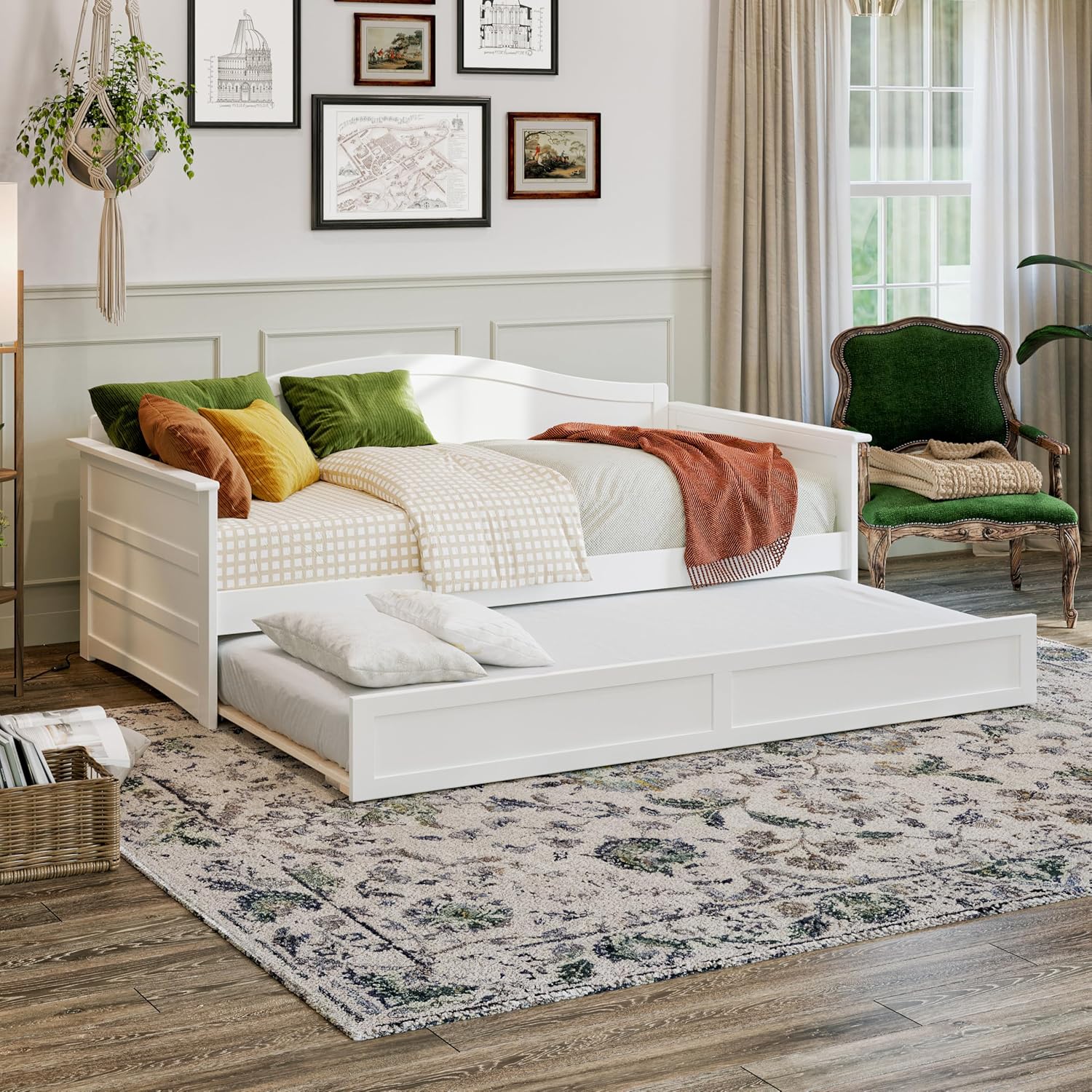
By size, see twin daybeds, full size daybeds and queen daybeds. For a second sleeping place, daybeds with a trundle. For the comparison against a bed that disappears, murphy bed against sofa bed, and against a plain twin, daybed against twin bed.
Questions we get asked
Is a daybed more comfortable to sleep on than a sofa bed?
Yes. A daybed takes a standard mattress of 6 to 12 inches; a sofa bed uses a folding mattress of 4 to 5 over a frame with a bar in it.
Is a daybed comfortable to sit on?
Only with 14 to 17 inches of firm bolster cushion behind you. Without that you are perching on the front edge of a 38-inch-deep mattress.
Which one is better for a small room?
The sofa bed is usually shallower, 33 to 40 inches against a daybed’s 38 to 60. But a daybed with a trundle sleeps two in the same footprint.
Can a daybed have storage underneath?
Yes — drawers of 2 to 3 cubic feet each, or a trundle. Not both; there is one void. A sofa bed’s mechanism fills that space.
How high does a daybed sit?
Twenty to 30 inches to the top of the mattress, decided almost entirely by mattress thickness. A sofa bed is fixed at 17 to 19.
Which lasts longer?
The daybed, usually — it has no mechanism. A sofa bed’s folding frame is a wearing part, and it is the thing that fails first.