Wood vs metal bed frame — Noise is the real divide
The Wooden Stars is a participant in the Amazon Services LLC Associates Program. We may earn a commission when you buy through links on our site, at no extra cost to you.
Wood vs metal bed frame is usually argued on looks and strength. In practice the difference people live with is noise — and the two materials fail in opposite ways.
A wooden frame creaks and can be fixed. A metal frame rattles and mostly cannot.
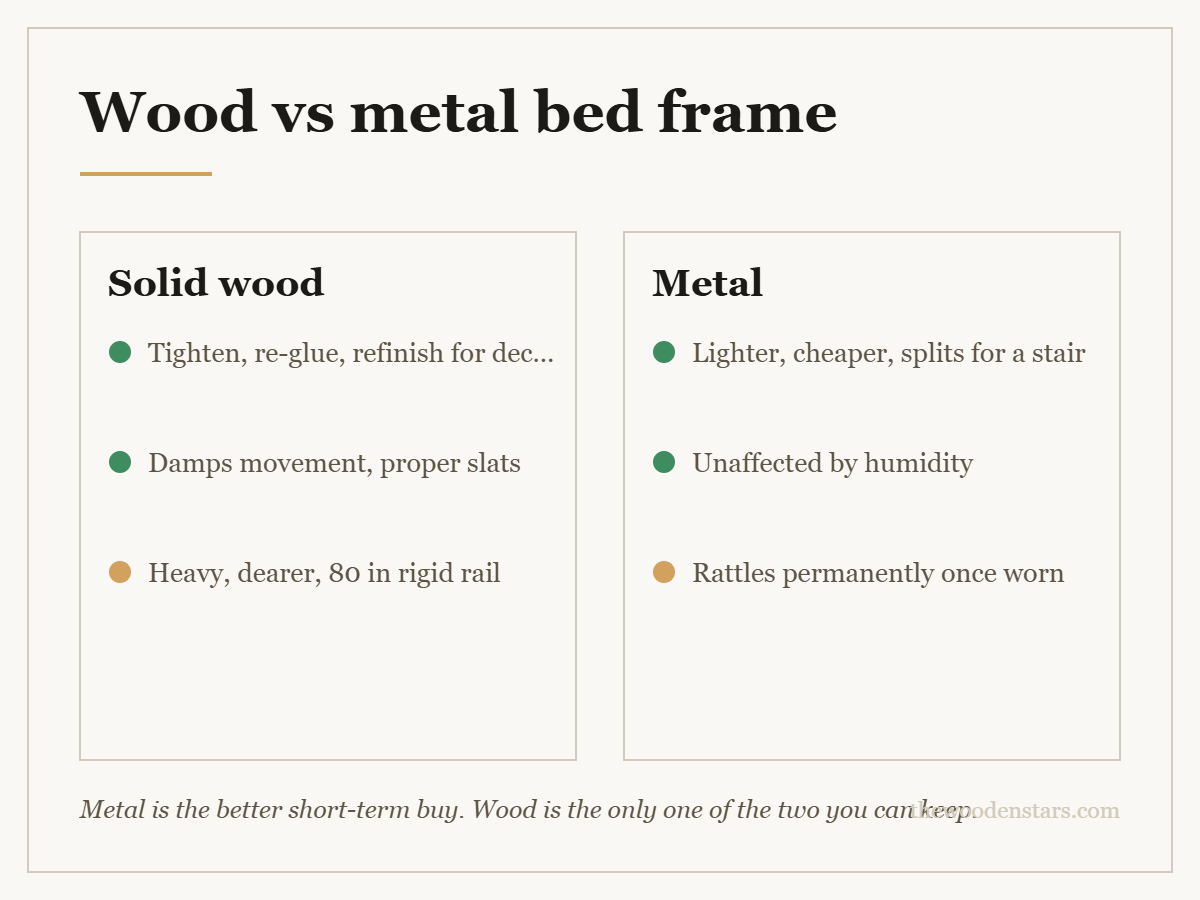
A metal frame is lighter, cheaper, ships flat and resists humidity — but its joints are bolt-through-tube, and once a hole elongates the rattle is permanent. A solid hardwood frame is heavier and dearer, and its joints can be re-glued, re-tightened and re-drilled indefinitely, which is why wooden frames outlast metal ones by decades. On strength both reach 1,000 lb-plus if built properly; the material is not the variable, the centre support is. Choose metal for a guest room or a short stay, wood for a bed you intend to keep.
Wood vs metal bed frame: how each one fails
This is the useful comparison, because both are strong enough when new.
Metal fails at the fastener hole. A tubular frame is bolted through thin-walled steel. Every time the bed moves, the bolt works against the hole edge. Over a year or two the hole elongates from round to oval, the joint develops play, and the frame rattles. You cannot re-tighten this away — the bolt is already tight, the hole is the problem — and welding or re-drilling is beyond most households. Rubber washers and thread lock buy you months.
Wood fails at the glue line or the bolt seat. A wooden joint loosens, creaks, and then either takes a turn of the bolt or a squirt of glue. Both are ten-minute fixes with ordinary tools, and both can be done repeatedly for the life of the timber.
That asymmetry is the real argument. It is not that wood is stronger; it is that wood is repairable. The diagnosis for either is in why a wooden bed frame squeaks.
| Measure | Solid wood | Metal |
|---|---|---|
| Weight | 60 to 120 lb | 30 to 60 lb |
| Typical cost | Higher | Lower |
| Noise when loose | Creak, fixable | Rattle, usually permanent |
| Joints | Bolts into barrel nuts, glue | Bolts through tube |
| Repairable | Yes, indefinitely | Rarely |
| Humidity | Moves seasonally | Unaffected |
| Slat support | Usually solid timber slats | Often thin steel or ply |
| Lifespan | Decades | 5 to 15 years |
Where metal is genuinely the better buy
Guest rooms and short stays. A bed used thirty nights a year will not elongate a bolt hole in your lifetime. Paying four times as much for repairability you will never use is poor value.
Rentals and moves. Light, flat-packs small, and nobody minds if it does not survive the third move.
Humid rooms. Steel does not move with moisture. Solid timber does, which is why a wooden frame in a damp room can bind and then loosen with the seasons.
Tight stairs. Metal rails are usually two pieces that bolt together; wooden rails are one rigid 80-inch piece. That single fact decides some purchases — see queen against king bed frames for the stair arithmetic.
Thin profiles. Steel achieves a slim look at a section wood cannot, which is the honest aesthetic argument for it.
Where wood wins, and it is not mainly strength
It can be kept. A hardwood frame with bolted joints can be tightened annually, re-glued when a joint opens, and refinished when the surface tires. Twenty years is unremarkable.
Quieter under load. Timber damps vibration; steel transmits it. Even when both are tight, a metal frame conducts more movement between two sleepers.
Better slats, usually. Wooden frames tend to come with solid timber slats at proper spacing. Metal frames often use thin steel bars or sprung ply, which are the first thing to bow — bed slat replacement and spacing.
It takes a headboard properly. Bolting a headboard to timber is straightforward; to a thin steel rail it is a compromise — queen headboard mounting.
Species and hardness matter here: the hardwood hardness scale, and be clear on terms — what engineered wood actually is. A particleboard “wood” frame has none of the advantages above and fails faster than steel.
Strength: the material is not the variable
Both reach 1,000 lb and beyond when built properly, and both fail well under it when not. What actually decides the rating:
- The centre support. A 60 or 76-inch span without a rail and legs to the floor sags regardless of material. This is the single biggest factor — bed frame centre support legs.
- Rail section. Thin-walled tube and thin timber both flex. Look for wall thickness on steel and 1.75 inches or more on hardwood rails.
- Slat spacing. Under 3 inches for foam, whatever the frame is made of.
- Joint type. Barrel nuts and hook plates are good in either material; cam locks are poor in both.
The arithmetic is in how much weight a bed frame can hold.
If it already rattles or creaks
On wood: tighten every bolt with a T-handle key, then check the slats. Most noise is slat-on-rail rub, fixed with felt tape. An open glue joint takes wood glue and a clamp.
On metal: add rubber or nylon washers at every bolt, apply thread lock, and put felt between the slat ends and the rail. If a hole has already gone oval, a slightly larger bolt with a wide penny washer either side will often buy another year or two.
Either way the fix order is the same: slats first, brackets second, centre leg third — bed frame brackets.
Whichever material
- Felt slat tape Slat-on-rail rub is most bed noise, in wood or steel
- T-handle hex key The supplied L-key cannot torque a bed joint properly
- Nylon washers and thread lock The only real remedy for a metal frame’s rattle
- Centre support leg Decides the load rating far more than the material does
What to buy


For wooden frames, see wood bed frames, queen bed frames and king size bed frames. For the load question, how much weight a bed frame can hold. For sizing, queen against king. For noise, why a wooden bed frame squeaks.
Questions we get asked
Is a wood or metal bed frame better?
Wood for a bed you intend to keep, because its joints can be tightened and re-glued indefinitely. Metal for a guest room, a rental or a tight stair.
Which is stronger?
Neither, inherently — both reach 1,000 lb when built properly. The centre support decides the rating, not the material.
Why do metal bed frames rattle?
The bolt wears the hole in the thin steel tube from round to oval. The bolt is already tight, so tightening does not help.
Can a metal frame’s rattle be fixed?
Partly. Nylon washers, thread lock and a wider penny washer buy time. A badly elongated hole needs welding or re-drilling.
Is a wooden frame quieter?
Generally, yes — timber damps vibration where steel transmits it. And when a wooden frame does creak, the fix is ten minutes.
Does a wooden frame move with humidity?
Solid timber moves seasonally, which can make a frame bind and then loosen. In a damp room that is a genuine point for metal.