Canopy beds — What the posts have to hold
The Wooden Stars is a participant in the Amazon Services LLC Associates Program. We may earn a commission when you buy through links on our site, at no extra cost to you.
A canopy bed is a four-poster with a frame joining the tops of the posts. That rectangle in the air is the whole point of the design and it is also the only engineering problem the bed has that an ordinary frame does not.
Everything else — the mattress support, the joints, the timber — is a normal bed. The canopy is what decides whether the thing feels solid or sways when someone sits down.
A canopy bed adds 76 to 90 inches of height, so measure your ceiling first: you want at least 6 inches of clear air above the top rail, more if there is a fan. The frame is a rectangle on four legs, and what stops it racking is either diagonal bracing, a bolted corner at each top joint, or the headboard and footboard acting as panels. Post sections under 2 inches square flex noticeably at queen and king width. Expect $300 to $600 for a solid timber queen. And check what the canopy is rated to carry before hanging curtains, lights or anything else from it.
Height, which is the first thing to check
Canopy beds are tall in a way photographs flatten. The usual range is 76 to 90 inches to the top rail — that is six to seven and a half feet.
A standard ceiling is 96 inches. So an 84-inch canopy leaves one foot of air, which looks right. An 90-inch canopy in a room with a 96-inch ceiling leaves six inches and reads as crammed.
Three things eat into that headroom before you even start:
- A ceiling fan or pendant. Measure to the lowest point of the fixture, not the ceiling.
- A sloping ceiling. Measure at the point the bed will stand, and at the head end specifically.
- Curtains or fabric. A canopy with drapes needs the fabric to hang clear, which usually means it reads a few inches taller.
What stops it swaying
A canopy is a rectangle standing on four legs. Push it sideways and, without something resisting the movement, it becomes a parallelogram. This is the same racking problem as any tall furniture, and here it is visible as a sway you feel when you sit on the edge.
Three things resist it, and a good bed has at least two:
Bolted corner joints at the top
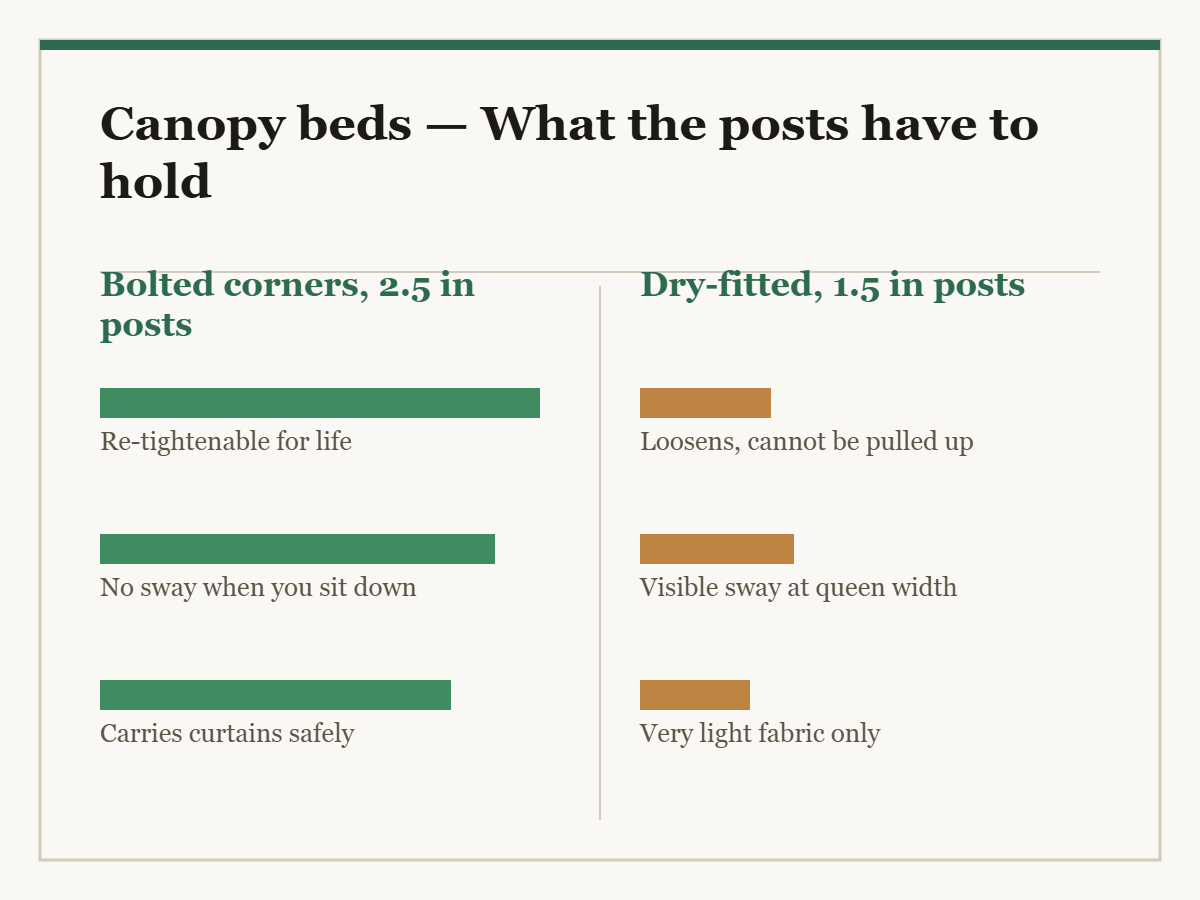
The side rails and end rails of the canopy bolt into the post tops rather than dropping into a slot. A bolted joint can be re-tightened for the life of the bed; a dry-fitted one cannot.
A headboard and footboard that act as panels
A solid or slatted panel between two posts triangulates that end. This is why a canopy bed with a proper headboard feels quite different from four bare posts with rails.
Post section
Under 2 inches square, a post seven feet long flexes. At 2.5 to 3 inches it does not. This is the single biggest difference between a canopy bed that feels solid and one that does not, and it is stated in the specification often enough to check.
| Size | Mattress | Overall footprint | Typical height |
|---|---|---|---|
| Twin | 38 × 75 in | 42 × 80 in | 76 to 84 in |
| Full | 54 × 75 in | 58 × 80 in | 78 to 86 in |
| Queen | 60 × 80 in | 66 × 86 in | 80 to 88 in |
| King | 76 × 80 in | 82 × 86 in | 82 to 90 in |
| California king | 72 × 84 in | 78 × 90 in | 82 to 90 in |
The footprint is bigger than the mattress
A canopy bed’s posts sit outside the mattress, and the rails project beyond the posts. Allow 5 to 7 inches in each direction over the bare mattress size.
A queen canopy is therefore about 66 × 86 inches on the floor, not 60 × 80. In a 10 × 12-foot bedroom that is the difference between a walkway either side and a squeeze on one.
Allow 24 inches of clear floor on each side you use, and 30 at the foot if there is a route past. General sizing is in queen bed frames and king bed frame and mattress fit.
What you can hang from it
This is where people get into trouble, because the canopy looks like a structural frame and often is not one.
Light curtains — a few pounds spread across a rail — are fine on any canopy bed.
Heavy drapes or a fabric canopy put a real load on the rails, concentrated at whatever the fabric is tied to. Check the stated rating; many are 10 to 20 lb total.
String lights are light but the fixing is the issue — a staple into a post is a hole in furniture you will keep for twenty years. Use ties rather than fasteners.
Anything a child can pull on is the one to say no to. A canopy rail is at head height for a standing adult and a canopy bed with a child swinging on the frame is a different load case entirely.
Under the mattress, which is a normal bed
The canopy gets the attention and the support system gets none, which is backwards — the slats are what you lie on.
Slat spacing should be under 3 inches for a foam mattress and no more than about 4 for a sprung one. Wider and the mattress sags between them and the warranty usually lapses. The detail is in bed slat replacement and spacing.
A centre support is required at queen and above. Sixty inches of slat span without a leg to the floor in the middle will dip — see bed frame centre support legs.
Rail joints carry the whole bed into the posts. On a canopy bed those posts are also carrying the canopy, so the joint is doing two jobs. If a bed creaks, this is the first place to look — why a wooden bed frame squeaks and bed frame brackets.
Timber, and why it matters more on a tall frame
A post seven feet long, 2.5 inches square, carrying a rail at the top, is a cantilever with a lever arm most furniture does not have.
Solid hardwood — oak, acacia, rubberwood, birch — is stiff enough at that section. It also holds a bolt in end grain, which is exactly what the top corner joint needs.
Pine works and is softer, so the joints want to be bolted rather than screwed, and they want checking after the first year.
Veneered MDF posts appear at the bottom of the range. They are heavy, they look right, and they do not hold a bolt under a repeated sideways load. On a canopy bed this is the one material choice that changes the outcome — the distinctions are in what engineered wood actually is and solid wood against engineered wood against veneer.
For species and hardness, the hardwood hardness scale and the best wood for furniture.
Getting it into the room
A canopy bed is the most awkward bed to deliver and assemble, and it is worth thinking about before ordering rather than on the landing.
- The posts are the long parts — 76 to 90 inches, rigid, and they do not bend round a stair turn. Measure the diagonal of your stairwell.
- It assembles upright. You cannot build it lying down and stand it up, so you need the room’s full height clear while you work.
- Two people minimum. Holding a rail in place at seven feet while someone starts a bolt is a two-person job.
- Level it before final tightening. A canopy amplifies a floor dip into a visibly out-of-square rectangle — levelling feet and glides.
With the bed
- Bed frame brackets Rail-to-post joints carry the bed and the canopy at once
- Centre support leg Required at queen and above, often not included
- Levelling feet A canopy shows an uneven floor as an out-of-square frame
- Furniture bolts and barrel nuts The fixing that lets a canopy corner be re-tightened
What to buy


For the biggest version, see king canopy beds. For a bed frame without the height, wood bed frames and what to check on a queen wood frame. If the room is the constraint, murphy beds for small spaces solve it differently.
Questions we get asked
How tall is a canopy bed?
Seventy-six to 90 inches to the top rail. Leave at least 6 inches of clear air above it, measured to the lowest ceiling fixture.
Will it fit under an 8-foot ceiling?
Usually yes — 96 inches takes an 84-inch canopy comfortably. A ceiling fan often decides against it.
Why does my canopy bed sway?
Thin posts or dry-fitted top joints. Posts under 2 inches square flex at queen width, and a joint that is not bolted cannot be re-tightened.
How much bigger is the footprint than the mattress?
Five to 7 inches in each direction. A queen canopy is about 66 × 86 inches on the floor.
Can I hang curtains from it?
Light ones, yes. Heavy drapes need the stated rating checked — many canopies are rated for 10 to 20 lb in total.
What should the posts be made of?
Solid hardwood at 2.5 inches square or more. Veneered MDF posts look right and do not hold a bolt under a sideways load.